Beating the Shin Splints Treadmill Trap: 2026 Bike Market Trends
Analyzing the 2026 market shift from treadmills to upright, recumbent, and spin bikes for shin splint recovery, featuring biomechanical data and pricing.

The Notorious Shin Splints Treadmill Dilemma: A 2026 Market Shift
For years, the home fitness industry operated on a singular assumption: if you are a runner, you need a treadmill. However, as we move through 2026, a massive consumer pivot is underway. Driven by the widespread prevalence of medial tibial stress syndrome (MTSS), runners are increasingly abandoning high-impact belts in favor of low-impact stationary bikes. The classic shin splints treadmill cycle—where athletes push through micro-tears on high-impact decks only to suffer prolonged, season-ending inflammation—has forced a reevaluation of home cardio equipment.
According to the American Academy of Orthopaedic Surgeons, shin splints are caused by repetitive stress on the shinbone and the connective tissues that attach muscles to the bone. When running on a treadmill, the ground reaction forces can reach 2.5 times a runner's body weight. This repetitive eccentric loading traumatizes the tibialis anterior and soleus muscles. Consequently, the 2026 cardio market has seen a surge in demand for stationary bikes—specifically upright, recumbent, and spin models—as the ultimate active recovery and cross-training tools.
Biomechanical Breakdown: Why Cycling Replaces Running for Recovery
Unlike the eccentric muscle contractions required to absorb shock on a treadmill belt, cycling relies almost entirely on concentric muscle contractions. This means the muscles shorten as they produce force, eliminating the jarring deceleration phase that tears at the periosteum (the connective tissue wrapping the shinbone). The Mayo Clinic frequently recommends low-impact cross-training to maintain cardiovascular fitness while allowing bone and tissue remodeling.
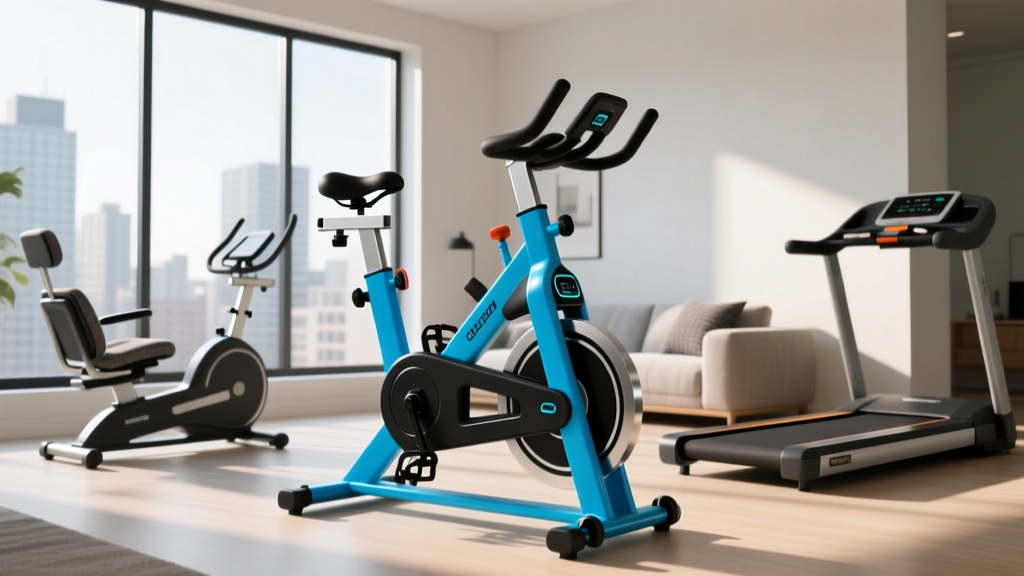
However, not all stationary bikes are created equal. The 2026 market is distinctly segmented into three categories, each serving a specific phase of injury recovery and biomechanical need.
2026 Stationary Bike Market Matrix
| Bike Type | Axial Load (Spine/Legs) | Tibialis Strain | 2026 Avg Price | Top Model |
|---|---|---|---|---|
| Upright | Moderate (Seated) | Very Low | $800 - $1,500 | Schwinn IC4 |
| Recumbent | Zero (Back-Supported) | None | $700 - $4,500+ | NuStep T4r |
| Spin (Indoor Cycle) | High (Standing/Seated) | Low (Cadence Dep.) | $1,500 - $2,500 | Keiser M3i |
Upright Bikes: The Biomechanical Bridge
Upright stationary bikes mimic the traditional geometry of a road bicycle but with a slightly more relaxed stack-and-reach ratio. For runners transitioning away from the treadmill, upright bikes offer the closest cardiovascular mimicry to running without the impact.
Market Leaders and Specifications
In 2026, the Schwinn IC4 (retailing around $999) remains a dominant force in the home upright market. It features a 40-pound perimeter-weighted flywheel and a micro-adjustable magnetic resistance system. The magnetic resistance is crucial for shin splint recovery; unlike friction-pad resistance, which can cause jerky pedal strokes at low cadences, magnetic eddy currents provide a buttery-smooth 100 levels of resistance. This allows runners to maintain a steady 85-95 RPM cadence, promoting vascular flushing in the lower legs without straining the healing periosteum.
For those seeking integrated programming, the NordicTrack S22i ($2,199) offers a 22-inch pivoting touchscreen and automatic resistance adjustments. The S22i's Q-factor (the horizontal distance between the pedals) is engineered at 160mm, closely mirroring a natural running gait width and preventing the lateral knee and hip deviations that can occur on narrower, cheaper upright bikes.
Recumbent Bikes: Zero-Axial Loading for Acute Flare-Ups
When a runner is in the acute phase of MTSS—where even walking down stairs causes sharp pain along the medial border of the tibia—upright bikes may still place too much static load on the lower extremities. Enter the recumbent bike. By shifting the user's center of gravity backward and supporting the lumbar spine, recumbent bikes eliminate axial loading entirely.
Clinical vs. Consumer Models
The consumer market is anchored by the Schwinn 270 Recumbent ($799). Its step-through design requires zero leg-lifting to mount, a vital feature when the tibialis anterior is too inflamed to handle the dorsiflexion required to swing a leg over a traditional bike saddle. The ventilated mesh seat and 25 levels of magnetic resistance allow for purely concentric, zero-impact blood flow to the lower legs.
On the clinical and high-end rehabilitation side, the NuStep T4r (priced upwards of $4,500) represents the pinnacle of 2026 recovery technology. While technically a recumbent cross-trainer, its coupled arm-and-leg motion allows runners to offload up to 40% of the leg workload to their upper body. This enables severely injured athletes to maintain elite VO2 max levels while their shin tissue completely remodels.
'The goal of active recovery for medial tibial stress syndrome is to stimulate osteoblastic activity through increased blood flow without introducing the eccentric shear forces that caused the micro-fractures in the first place. Recumbent cycling achieves this perfectly.'
Spin Bikes: High-Cadence Vascular Flushing
Spin bikes (or indoor cycles) are built for performance. They feature aggressive geometry, heavy flywheels, and the ability to ride out of the saddle. For runners in the sub-acute or return-to-run phase of shin splint recovery, spin bikes are the ultimate tool for rebuilding lower-leg tendon stiffness and capillary density.
The Engineering of the Keiser M3i and Peloton Bike+
The Keiser M3i ($2,295) is widely considered the gold standard for biomechanical purity. Its V-shaped frame allows for infinite micro-adjustments in both seat height and fore/aft positioning. For a runner with a history of shin splints, dialing in the exact saddle height is non-negotiable; a saddle that is just 5mm too low forces excessive ankle dorsiflexion at the top of the pedal stroke, which can prematurely fatigue the healing tibialis anterior. The M3i's magnetic resistance and lightweight aluminum flywheel allow for ultra-high cadence work (110-120 RPM), which acts as a mechanical pump to flush metabolic waste from the lower legs.
Alternatively, the Peloton Bike+ ($2,495) offers a unique advantage for recovery: its 23.8-inch rotating screen. This allows users to seamlessly transition from a 45-minute low-impact ride to a 15-minute guided floor-stretching session targeting the soleus, gastrocnemius, and Achilles tendon—all of which dictate the tension placed on the shinbone.
2026 Purchasing Framework: Matching Equipment to Injury Phase
To maximize your equipment investment and protect your lower legs, use this clinical decision framework when selecting your treadmill alternative:
- Phase 1: Acute Pain (Days 1-14) - Pain is present during daily walking. Recommendation: Recumbent Bike. Focus on 30-45 minute steady-state rides at a low resistance (RPE 4-5) to promote blood flow without structural load.
- Phase 2: Sub-Acute Healing (Days 15-30) - Pain is gone during daily activities but tender to the touch. Recommendation: Upright Bike. Introduce moderate resistance and focus on maintaining a cadence above 85 RPM to rebuild muscular endurance in the quads and glutes, which absorb impact upon return to running.
- Phase 3: Return to Run (Days 30+) - Bone is remodeled and pain-free. Recommendation: Spin Bike. Incorporate high-cadence intervals and brief, seated standing climbs to re-stiffen the Achilles and lower leg tendons, preparing them for the 2.5x body weight impact of the pavement.
Expert Verdict: Redefining the Home Cardio Floorplan
The era of relying solely on a treadmill for run-specific fitness is over. The data and biomechanical realities of 2026 dictate that a comprehensive home gym must include a low-impact alternative. Whether you opt for the zero-gravity relief of a Schwinn recumbent, the biomechanical bridging of a NordicTrack upright, or the high-cadence flushing of a Keiser spin bike, integrating stationary cycling into your routine is the most effective way to break the shin splints treadmill trap. By matching the specific bike type to your current phase of tissue healing, you can maintain elite cardiovascular fitness while ensuring your tibias remain resilient for the miles ahead.
More gear to consider
All reviews
Treadmill Motor Sizing & iFIT App for Treadmill Setup Guide

Swimmers Treadmill vs Stationary Bikes: Upright, Recumbent & Spin

Curved vs Motorized Treadmill Setup & Treadmill Control Board Guide

Elliptical vs Treadmill: Is a Treadmill Good Exercise Long-Term?

Under Desk Treadmill Review: Garmin Treadmill Walk Value Analysis