Rubber Hex vs Urethane: Space & Dumbbell Shoulder Workouts for Men
Compare rubber hex vs urethane dumbbells for small home gyms. Discover space-saving layouts and effective dumbbell shoulder workouts for men.

The Small-Home-Gym Dilemma: Choosing the Right Iron for Tight Spaces
As multi-use living spaces become the norm in 2026, home gym design has shifted from sprawling garage setups to highly optimized 6x6-foot bedroom or living room corners. When your training zone is constrained, every piece of equipment must justify its physical footprint. This is especially true when selecting free weights for upper-body training, where movement clearance and storage geometry dictate your daily experience.
If you are designing a compact training area and planning to run intensive dumbbell shoulder workouts for men, the debate between rubber hex dumbbells and urethane dumbbells goes far beyond mere aesthetics. The physical shape, material off-gassing, and stacking mechanics of these two dumbbell types will fundamentally alter your room layout, storage rack selection, and even the air quality of your workout space. Below, we break down the exact spatial and material differences, provide a space-optimized layout guide, and deliver a high-yield shoulder routine designed specifically for tight clearances.
Rubber Hex vs Urethane: Material, Dimensions, and Spatial Impact
To optimize a small room, you must understand how dumbbell head geometry affects storage and floor space. While both options protect your flooring from dropped iron, their spatial behaviors are vastly different.
Rubber Hex Dumbbells: The Budget-Friendly Space Eater
Rubber hex dumbbells (like the popular Rogue Fitness Rubber Hex line, averaging $1.60 per pound in 2026) feature a six-sided head coated in recycled rubber.
- Storage Geometry: The hexagonal heads do not stack flush on standard flat horizontal shelves. They interlock unpredictably, meaning they require vertical A-frame racks or specialized cradle trays. An A-frame rack typically demands a 25x25-inch floor footprint, eating into your valuable lateral movement space.
- Environmental Impact: Recycled rubber off-gasses volatile organic compounds (VOCs). In a small, unventilated bedroom, this tire-like odor can be overwhelming and cause respiratory irritation during heavy cardiovascular or high-rep sets.
- Durability Edge Case: If placed near a window, direct UV sunlight will cause the rubber to dry out, crack, and eventually flake onto your floor over a 2-to-3-year period.
Urethane Dumbbells: The Premium Space-Saver
Urethane dumbbells (such as the REP Fitness 12-Sided Urethane series, averaging $3.20 per pound) are cast from a high-density, odorless polyurethane compound.
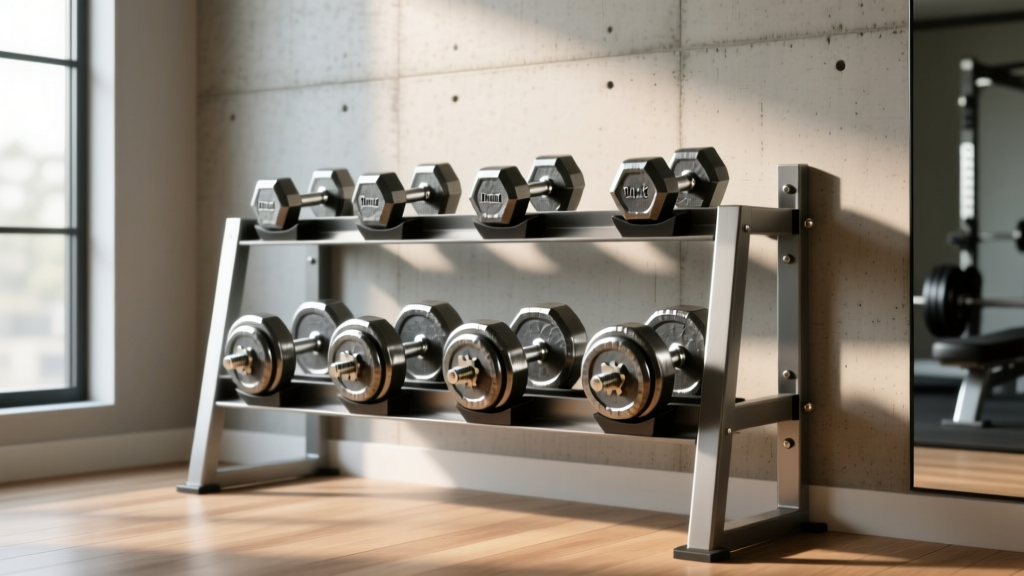
- Storage Geometry: Urethane dumbbells are typically round or 12-sided. This CNC-machined geometry allows them to sit perfectly flush on flat, horizontal 3-tier shelving units. You can push a horizontal rack flush against a wall, requiring only 22 inches of depth and zero floor-standing legs, effectively reclaiming up to 4 square feet of floor space compared to an A-frame.
- Environmental Impact: Urethane is completely odorless and UV-resistant. It is the only viable choice for multi-use rooms where air quality and sunlight exposure cannot be strictly controlled.
- Durability Edge Case: While urethane is virtually indestructible regarding drops, the hardened 12-sided edges can scuff baseboards if you are maneuvering them in a room with less than 3 feet of wall clearance.
Comparative Footprint Matrix
| Feature | Rubber Hex Dumbbells | 12-Sided Urethane Dumbbells |
|---|---|---|
| Avg. Cost (2026) | $1.50 - $1.80 / lb | $2.80 - $3.50 / lb |
| Optimal Rack Type | Vertical A-Frame (Floor-standing) | Horizontal 3-Tier (Wall-adjacent) |
| Rack Floor Footprint | ~4.5 sq. ft. (25" x 25") | ~2.5 sq. ft. depth (pushed to wall) |
| Off-Gassing / Odor | High (Recycled Rubber) | None (Odorless Polyurethane) |
| UV Resistance | Low (Degrades in sunlight) | High (Sunlight safe) |
Designing the 6x6 Foot Shoulder Training Zone
According to guidelines on home gym safety and spatial planning from the National Strength and Conditioning Association (NSCA), you must account for the full wingspan of the lifter plus the length of the equipment. For shoulder training, lateral movements require the most clearance.
To execute effective dumbbell shoulder workouts for men in a tight 6x6 foot zone, follow these layout rules:
- The Ceiling Check: Overhead pressing requires at least 12 inches of clearance above your fully extended arms. In rooms with standard 8-foot ceilings, tall lifters (6'0"+) must perform overhead presses seated to avoid punching the drywall or ceiling fans.
- The Lateral Radius: A standard dumbbell lateral raise requires roughly 6.5 feet of total width (arm span + 10-inch dumbbells). In a 6-foot room, you must utilize bent-over or chest-supported variations to keep the weights within a 4-foot radius.
- Floor Protection: Because space is tight, dropping weights is inevitable. Use 3/4-inch thick horse stall mats cut precisely to your 6x6 zone to prevent the urethane or rubber from transferring kinetic energy into your home's subfloor.
Space-Efficient Dumbbell Shoulder Workouts for Men
When your physical footprint is restricted, you must manipulate biomechanics—specifically leverage and time-under-tension—rather than relying on massive, heavy dumbbells that require wide stances and momentum. The following routine leverages principles outlined in the ExRx Shoulder Exercise Directory to maximize medial and anterior deltoid hypertrophy without requiring a 10-foot wingspan.
1. Seated Z-Press (Anterior Deltoid Focus)
The Z-Press is performed seated flat on the floor with legs extended straight out in a V-shape.
- Spatial Benefit: Eliminates the need for a bulky adjustable bench and prevents the backward lean that often causes lifters to bump into walls or racks behind them.
- Execution: 4 sets of 8-10 reps. Keep your core braced to maintain an upright torso. The strict leverage forces the anterior delts to work overtime without needing excessively heavy dumbbells.
2. Chest-Supported Incline Lateral Raise (Medial Deltoid Focus)
Set an adjustable bench to a 30-degree incline. Lie face down (chest supported) and perform lateral raises.
- Spatial Benefit: By stabilizing the torso, you eliminate the need for a wide, athletic stance and prevent momentum-swinging. Your entire movement radius is confined to the width of the bench plus 12 inches on either side.
- Execution: 3 sets of 12-15 reps. Focus on a 2-second pause at the top of the movement to maximize metabolic stress.
3. Half-Kneeling Single-Arm Overhead Press (Unilateral Stability)
Kneel on one knee (use a foam pad) and press a single dumbbell overhead.
- Spatial Benefit: Requires only a 2x4 foot floor footprint. It also corrects left-to-right strength imbalances without requiring the wide stance of a bilateral standing press.
- Execution: 3 sets of 10 reps per arm. Keep the non-working arm tight to your ribcage to avoid clipping nearby walls or equipment.
4. Leaning One-Arm Lateral Raise (Inferior Head Stretch)
Anchor one hand to a vertical squat rack post or a sturdy door hinge, lean outward, and perform single-arm lateral raises.
- Spatial Benefit: Alters the resistance curve, providing maximum tension at the bottom of the movement. It requires zero extra floor space and utilizes existing vertical structures in your room.
- Execution: 3 sets of 12 reps per arm. Control the negative phase for 3 seconds.
Vertical vs. Horizontal Storage: Reclaiming Your Floor
The final step in space optimization is how you store the iron post-workout. If you opted for Urethane Dumbbells, invest in a wall-mounted or low-profile horizontal tray rack. Brands like Prime Fitness and REP offer 3-tier horizontal racks that sit just 22 inches off the wall. This allows you to place a utility bench directly in front of the rack, creating a dual-use zone where the storage footprint is entirely hidden beneath your workout area.
If you chose Rubber Hex Dumbbells, you are likely using a vertical A-Frame. To optimize this, place the A-Frame in a dead corner at a 45-degree angle. This prevents the protruding handles from catching your clothing or skin when navigating the tight room, and it opens up a straight, unobstructed pathway for your lateral raise movements.
Final Expert Recommendations
Designing a home gym in a constrained environment requires sacrificing either budget or floor space. If your 2026 home gym is located in a shared living space or bedroom, the premium cost of 12-sided urethane dumbbells is a mandatory investment for odorless air quality and flush, wall-adjacent storage. Pair them with a chest-supported bench routine to keep your lateral raise radius compact. If you are outfitting a garage or basement where ventilation and floor depth are not issues, rubber hex dumbbells on a corner-angled A-frame will deliver the exact same hypertrophic results for your shoulder workouts at nearly half the cost.
More gear to consider
All reviews
Top Dumbbell Racks to Optimize Dumbbell Movements (2026)

Barbell Guide: Weight, Knurling & Biceps Dumbbell Workout Fixes

Bumper Plate vs Iron Plate Trends & The Side Lying Dumbbell Raise

What Are Dumbbell Shoulder Presses? Loadable Dumbbell Budget Guide

Barbell Collar Types Compared: Securing 50kg Dumbbell and Bar Loads