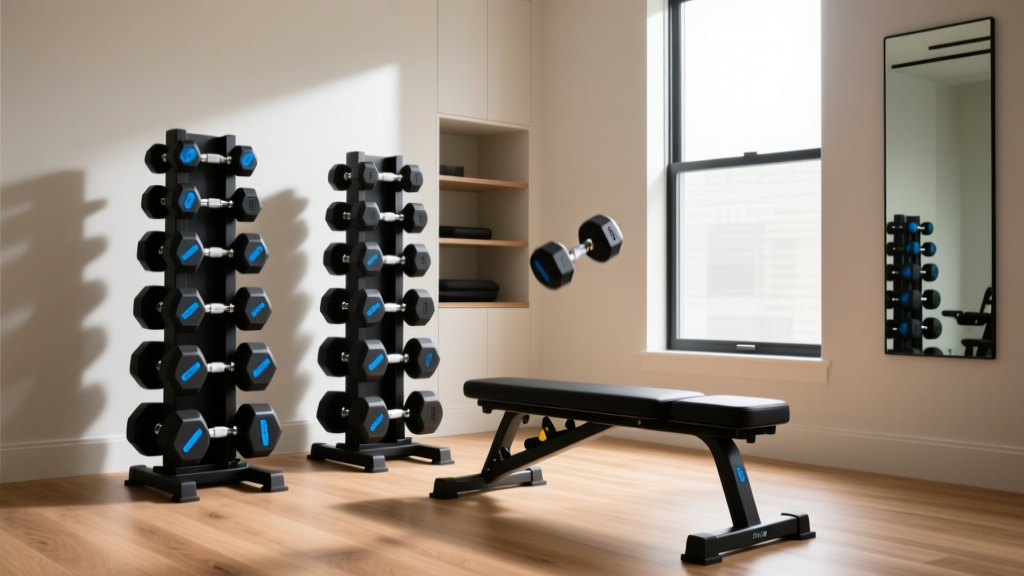
Rubber Hex vs Urethane Dumbbells & Kettlebell Handles for Dumbbells
Compare rubber hex vs urethane dumbbells for your 2026 home gym. We break down costs, durability, and the value of adding kettlebell handles for dumbbells.

The Home Gym Budget Dilemma: Upfront Cost vs. Lifetime Value
Building a functional free-weight setup in 2026 requires navigating a minefield of material choices, fluctuating steel prices, and aggressive marketing. For most home gym owners, the core of their resistance training revolves around a solid set of dumbbells. However, the debate between rubber hex dumbbell vs urethane dumbbell models remains one of the most contentious topics in fitness equipment purchasing. Do you save money upfront with vulcanized rubber, or invest in premium polyurethane elastomers?
Furthermore, maximizing a tight budget means looking beyond just the dumbbells themselves. Smart lifters are increasingly turning to modular accessories—specifically kettlebell handles for dumbbells—to replicate the biomechanics of kettlebell training without buying an entirely separate, expensive set of cast-iron bells. In this comprehensive budget breakdown and value analysis, we will dissect the true cost of ownership, material failure modes, and the financial genius of hybridizing your free-weight rack.
Rubber Hex Dumbbells: The Budget-Friendly Starter
Rubber-coated hex dumbbells, such as the ubiquitous CAP Barbell or Yes4All lines, have been the default entry-level choice for decades. The hexagonal heads prevent rolling, and the rubber coating is intended to protect both the floor and the iron core from rust.
Pricing Breakdown & Material Specs
As of early 2026, rubber hex dumbbells typically cost between $1.20 and $1.80 per pound. A standard 10-pair set (ranging from 5 lbs to 50 lbs in 5-lb increments, totaling 550 lbs) will cost approximately $660 to $990. The coating is usually a recycled rubber blend vulcanized with sulfur. While this keeps manufacturing costs low, it introduces significant environmental and sensory drawbacks, most notably the release of volatile organic compounds (VOCs) that result in a lingering 'tire shop' odor in poorly ventilated rooms.
Failure Modes: When Cheap Costs More
From an engineering perspective, vulcanized rubber has distinct failure modes:
- UV and Ozone Degradation: If your home gym is in a garage or sunroom, UV exposure breaks down the sulfur bonds. Within 2 to 3 years, the rubber will dry-rot, crack, and leave a sticky black residue on your hands and floors.
- Edge Chipping: The durometer (hardness) of budget rubber is relatively low. Drop a 40 lb rubber hex dumbbell from shoulder height onto bare concrete, and the hex corners will chip or tear away from the iron core.
- Handle Fatigue: Many budget hex sets use cast-iron handles with minimal knurling that can bend or snap at the weld point if subjected to heavy lateral torque.
Urethane Dumbbells: The Premium Investment
Urethane (polyurethane) is the gold standard for commercial gyms and high-end home setups. Brands like Rogue Fitness Urethane Dumbbells and Rep Fitness dominate this space by utilizing virgin polyurethane elastomers.
The Polyurethane Advantage
Urethane dumbbells command a premium, generally pricing out between $3.50 and $5.00 per pound. That same 550 lb, 10-pair set will cost between $1,925 and $2,750. However, the material science justifies the expense. Polyurethane is a cross-linked polymer that is virtually impervious to UV light, ozone, and moisture. It does not off-gas VOCs, meaning it is entirely odorless upon unboxing.
Expert Insight: The Durometer Scale
Premium urethane dumbbells are poured at an 85A to 90A durometer rating—roughly the hardness of a heavy-duty shopping cart wheel or industrial shoe sole. This high density allows the dumbbell to absorb and disperse impact energy rather than tearing. According to extensive drop-testing by BarBend's comprehensive dumbbell guide, high-quality urethane can survive thousands of drops from 4 feet onto rubber matting without cosmetic or structural failure.
Maximizing Utility: Kettlebell Handles for Dumbbells
If you are building a budget gym, buying a full set of dumbbells and a full set of kettlebells is financially redundant. This is where kettlebell handles for dumbbells become a masterstroke in value engineering. Devices like the KettleShell or generic adjustable clamp-on handles allow you to slide a standard dumbbell handle into a secure, weighted housing that mimics the offset center of mass of a traditional kettlebell.
The Math: Dumbbells + Handle vs. Dedicated Kettlebells
A quality competition-grade kettlebell set (8kg, 12kg, 16kg, 20kg, 24kg) from a reputable brand will cost upwards of $600 to $800. Furthermore, kettlebells take up significant floor space and require specialized racks.
By investing $45 to $65 in a pair of heavy-duty clamp-on kettlebell handles for dumbbells, you instantly convert your existing 20 lb, 35 lb, and 50 lb dumbbells into functional kettlebells. While Garage Gym Labs kettlebell testing notes that true kettlebell flows (like juggling or extreme grip-width snatches) still require dedicated cast-iron bells, 90% of standard home gym users only need kettlebells for goblet squats, swings, and Turkish get-ups—all of which are perfectly replicated using a dumbbell loaded into a kettlebell handle adapter.
Head-to-Head Value Matrix
To visualize the budget breakdown, let us compare a 5-50 lb dumbbell setup alongside the kettlebell accessory strategy.
| Feature / Metric | Rubber Hex Dumbbells | Urethane Dumbbells | Kettlebell Handle Add-On |
|---|---|---|---|
| Cost Per Pound | $1.20 - $1.80 | $3.50 - $5.00 | Flat fee: ~$55 |
| Set Cost (550 lbs) | ~$825 | ~$2,300 | N/A (Uses existing DBs) |
| UV / Ozone Resistance | Poor (Degrades in 2-3 yrs) | Excellent (Lifetime) | Excellent (Steel/Alloy) |
| Odor / Off-Gassing | High VOCs initially | Zero Odor | Zero Odor |
| Drop Durability | Low (Edges chip/tear) | High (85A-90A Durometer) | N/A |
5-Year Total Cost of Ownership (TCO) Analysis
When evaluating fitness equipment, the initial price tag is only half the equation. We must calculate the Total Cost of Ownership over a 5-year period, factoring in replacement costs and spatial efficiency.
"A budget rubber hex set kept in a non-climate-controlled garage will likely require replacing at least 30% of the pairs by year four due to dry-rot and handle snapping. Urethane is a buy-it-for-life asset that retains up to 60% of its resale value on the secondary market."
The Hybrid Budget Strategy
If your total free-weight budget is capped at $1,200, buying urethane is mathematically impossible for a full set. However, relying solely on rubber hex limits your training modalities. The optimal 2026 budget strategy is as follows:
- Buy a partial Urethane Set: Purchase urethane dumbbells only for your most-used weights (e.g., 25 lbs, 30 lbs, 35 lbs, and 40 lbs). Cost: ~$550.
- Supplement with Rubber Hex: Buy rubber hex for the extreme light and heavy ends of the spectrum (5-20 lbs for warmups, 50-60 lbs for heavy presses) where drop-risks are lowest and replacement costs are negligible. Cost: ~$350.
- Invest in Kettlebell Handles for Dumbbells: Spend $55 on a high-quality clamp-on handle system. This unlocks swings, goblet squats, and offset carries using your 35 lb and 40 lb urethane bells. Cost: $55.
Total Spend: $955. Result: You get the durability of urethane where it matters most, the utility of a full kettlebell suite, and you stay well under a grand.
Final Verdict: Where Should Your Money Go?
The choice between a rubber hex dumbbell vs urethane dumbbell ultimately hinges on your training environment and long-term financial philosophy. If you are outfitting a climate-controlled spare bedroom and strictly performing controlled, floor-based isolation movements, rubber hex dumbbells offer undeniable upfront value.
However, if you train in a garage, drop your weights during metabolic conditioning, or care about indoor air quality, urethane is the only logical choice. By pairing a strategic, mixed-material dumbbell set with kettlebell handles for dumbbells, you achieve maximum biomechanical versatility and long-term financial efficiency without compromising on the quality of your daily lifts.
More gear to consider
All reviews
Bumper Plate vs Iron Plate Comparison: Progressing Beyond the Dumbbell Pilates Workout
EZ Curl Bar vs Straight Bar Care & Target 8 lb Dumbbells Maintenance

Cast Iron vs Competition Kettlebells: Upgrading Dumbbell Exercises That Target Triceps

Best Neoprene Sets to Curl 50 lb Dumbbells at Home (2026 Guide)

Deadlift Alternative With Dumbbells vs Kettlebells: 2026 Guide