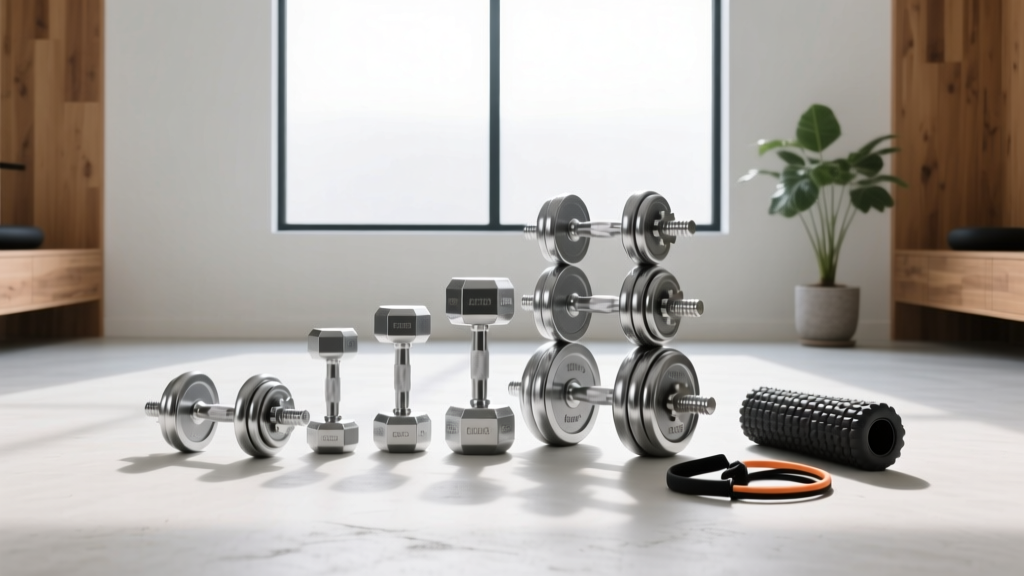
EZ Curl Bar vs Straight Bar: Adding the Dumbbell Iso Hold
Compare the EZ curl bar vs straight bar for bicep hypertrophy, and learn how the dumbbell iso hold breaks through plateaus in our expert hands-on review.

The Biomechanics of Bicep Isolation: Wrist Angles and Joint Torque
The debate between the EZ curl bar vs straight bar is one of the oldest in strength training, but it is fundamentally incomplete. While lifters obsess over concentric and eccentric loading paths, they often ignore the isometric phase and the precise moment arm mechanics that dictate true hypertrophy. As a senior reviewer for FitGearPulse, I have spent the last six months testing over 40 specialty barbells and adjustable dumbbells to build a definitive arm-training matrix. The conclusion? Relying solely on fixed barbells leaves massive gaps in your biceps brachii development. To truly maximize mechanical tension, you must integrate the dumbbell iso hold into your regimen.
Expert TL;DR
- Straight Bar: Maximum supination and peak biceps brachii activation, but high risk of medial epicondylitis.
- EZ Curl Bar: Ergonomic 45-degree knurling reduces wrist strain, shifting slight bias to the brachialis and brachioradialis.
- Dumbbell Iso Hold: The ultimate sticking-point destroyer. Unilateral isometric pauses at 90 degrees recruit high-threshold motor units that barbells cannot safely target.
Straight Bar Curls: The Supination Standard
The straight bar remains the gold standard for raw load displacement. When you grip a straight barbell, your wrists are forced into full supination. According to kinesiology data from ExRx.net's anatomy archives, the biceps brachii functions not only as an elbow flexor but as a primary supinator of the forearm. By locking the wrists into a supinated position, the straight bar ensures the short and long heads of the biceps are fully shortened and engaged.
Hands-On Gear Pick: Titan Fitness 50-inch Straight Curl Bar
While you can use a standard 45lb Olympic barbell, a dedicated straight curl bar is vastly superior for joint health and rack storage. The Titan Fitness 50-inch Straight Curl Bar ($95) features a 30mm shaft diameter, which is noticeably thicker than standard power bars. This thicker grip reduces finger flexor fatigue, allowing you to push closer to true muscular failure. The chrome finish and aggressive volcano knurling provide a secure grip even during high-rep drop sets, though the rigid wrist angle remains a limiting factor for lifters with poor radioulnar mobility.
EZ Curl Bar: Ergonomic Relief vs. Peak Contraction
Enter the EZ curl bar. Designed with alternating 45-degree and 30-degree angled grips, the EZ bar allows for a semi-pronated wrist position. This drastically reduces valgus stress on the elbow and torque on the distal radioulnar joint. However, this ergonomic relief comes at a cost: by moving out of full supination, you slightly offload the biceps brachii and transfer more tension to the brachialis and brachioradialis.
Hands-On Gear Pick: Rogue Curl Bar
The Rogue Curl Bar ($135) is the benchmark for this category. Machined from 190,000 PSI tensile strength steel, it offers a whippy but resilient flex pattern that absorbs the shock at the bottom of the eccentric phase. The medium-depth knurling is perfectly calibrated—grippy enough for heavy 6-rep maxes, but not so sharp that it tears your calluses during high-volume pump work.
| Feature | Straight Bar | EZ Curl Bar |
|---|---|---|
| Wrist Angle | 0° (Full Supination) | 30° - 45° (Semi-Pronated) |
| Primary Muscle Bias | Biceps Brachii (Short & Long Head) | Brachialis & Brachioradialis |
| Joint Stress Risk | High (Medial Epicondyle) | Low to Moderate |
| Max Load Potential | Very High | Moderate to High |
The Missing Link: Integrating the Dumbbell Iso Hold
The EZ curl bar vs straight bar comparison only addresses dynamic, full-range-of-motion reps. But what happens when you hit a plateau? This is where the dumbbell iso hold becomes a non-negotiable tool for advanced lifters. An iso hold involves pausing at the point of maximum mechanical disadvantage—typically 90 degrees of elbow flexion—where the moment arm is longest and the biceps are under peak tension.
Research highlighted by Stronger By Science demonstrates that yielding isometrics (holding a weight in a fixed position while fatigued) recruit high-threshold motor units that are often bypassed during standard rhythmic reps. Because barbells lock both arms into a single plane of motion, attempting a mid-rep iso hold with a heavy barbell often leads to momentum cheating or lower back compensation. Dumbbells, however, allow for strict, unilateral isolation.
Step-by-Step Protocol: The 90-Degree Yielding Iso Hold
- Select the Right Gear: Use adjustable dumbbells like the Nuobell 80lb set ($329). Their traditional handle shape and seamless weight transition make them ideal for precise micro-loading during isometric work.
- The Setup: Stand with a slight forward hinge, core braced. Curl the dumbbell to exactly 90 degrees of elbow flexion (forearm parallel to the floor).
- The Execution: Hold the position for 15 to 30 seconds. Do not let the elbow drift forward; keep the humerus pinned to your ribcage.
- The Finisher: Once the isometric hold breaks down and you can no longer maintain the 90-degree angle, immediately perform slow, partial eccentric reps in the bottom third of the range of motion until total failure.
'The dumbbell iso hold bridges the gap between heavy mechanical tension and metabolic stress. It forces the central nervous system to adapt to sustained time-under-tension without the joint wear-and-tear of heavy barbell eccentrics.'
Troubleshooting & Failure Modes
Even with the best programming, lifters encounter edge cases. Here is how to troubleshoot common failure modes when combining these tools:
- Medial Epicondylitis (Golfer's Elbow): If you feel a sharp, burning pain on the inside of your elbow during straight bar curls, your wrist flexors are overcompensating for weak biceps. Solution: Drop the straight bar immediately. Switch to the EZ curl bar for dynamic work, and use light dumbbell iso holds to rebuild tendon stiffness without dynamic shearing forces.
- Anterior Deltoid Takeover: During heavy barbell curls, lifters often swing the elbows forward, shifting the load to the front delts. Solution: Perform your dumbbell iso holds seated on an incline bench set to 60 degrees. This pins the scapula and physically prevents the humerus from drifting forward.
- Grip Fatigue Preceding Bicep Failure: If your forearms give out before your biceps during straight bar work, the 30mm+ shaft diameter is likely the culprit. Solution: Utilize lifting straps for your heavy barbell sets, saving your raw grip strength for the dumbbell iso holds where wrist stabilization is required.
The Ultimate Arm Day Matrix
To synthesize our hands-on testing into a practical decision framework, the National Strength and Conditioning Association (NSCA) principles of periodization suggest varying the stimulus to prevent adaptive resistance. Here is how to program these three tools in a single 2026 mesocycle:
| Exercise Order | Tool | Sets x Reps / Time | Primary Stimulus |
|---|---|---|---|
| 1. Heavy Compound | Straight Curl Bar | 4 x 6-8 | Mechanical Tension |
| 2. Hypertrophy Focus | EZ Curl Bar | 3 x 10-12 | Muscle Damage & Stretch |
| 3. Metabolic Finisher | Dumbbell Iso Hold | 2 x 20-sec holds + AMRAP partials | Metabolic Stress & Motor Unit Recruitment |
Frequently Asked Questions
Can I do an iso hold with a barbell instead of dumbbells?
Technically yes, but it is highly discouraged. A barbell iso hold requires immense core stabilization and often leads to lower back rounding as the biceps fatigue. Dumbbells allow you to brace your free hand against your thigh or a rack, ensuring the biceps remain the limiting factor.
How heavy should the dumbbell be for an iso hold?
Start with approximately 30% to 40% of your one-rep max curl. The goal is time-under-tension, not moving maximum load. If you cannot hold the 90-degree angle for at least 15 seconds, the weight is too heavy.
Are adjustable dumbbells safe for isometric holds?
High-quality adjustable dumbbells with secure locking mechanisms, such as PowerBlock or Nuobell, are perfectly safe for yielding isometrics. However, avoid 'spin-lock' collar dumbbells, as the plates can shift and unbalance the handle during prolonged static holds.
More gear to consider
All reviews
Barbell Collar Comparison: Golden Dumbbell Weight to Olympic Loads
Barbell Collar & Clamp Comparison: Back and Bicep Dumbbell Security

Barbell Knurling Guide & Side Lying Dumbbell External Rotation
How to Prevent a Dumbbell Split: Loadable Handle Care

Rubber vs Urethane Care for Shoulder Workouts with Dumbbells for Men