
Rubber Hex vs Urethane: Is the Round Dumbbell Set Obsolete?
Analyze the 2026 market shift from rubber hex and the classic round dumbbell set to premium urethane. Compare costs, materials, and gym trends.

The 2026 Commercial Fitness Shift: Beyond the Legacy Round Dumbbell Set
If you walk into a newly built boutique strength facility or a renovated commercial health club in 2026, you will immediately notice a change in the free weight aisles. The iconic, chrome-handled round dumbbell set—once the undisputed king of the gym floor—is rapidly being relegated to storage rooms or specialized Olympic lifting platforms. In its place, facility managers are making a calculated pivot toward premium urethane hex dumbbells, actively bypassing both traditional round profiles and standard rubber hex alternatives.
This shift is not merely aesthetic. It is driven by a rigorous market analysis of lifecycle costs, liability reduction, and material science advancements. According to recent facility equipment audits reported by Club Industry, gym operators are prioritizing equipment that minimizes flooring damage, eliminates rolling hazards, and withstands high-volume abuse without structural degradation. To understand why the market is moving away from both the classic round dumbbell set and cheap rubber hex models, we must dissect the material science, geometry, and long-term economics of modern free weights.
Executive Market Summary
- Legacy Decline: The traditional round dumbbell set is losing market share due to rolling liabilities and rack-space inefficiencies.
- Material Upgrade: Cast Polyurethane (CPU) is replacing Styrene-Butadiene Rubber (SBR) in high-end facilities due to superior abrasion resistance and zero VOC off-gassing.
- Cost Reality: While urethane costs 2.5x more upfront than rubber hex, its 10-year replacement rate is 80% lower, yielding a superior ROI for commercial operators.
Material Science Deep Dive: SBR Rubber vs. Cast Polyurethane
The debate between rubber hex and urethane is fundamentally a debate about polymer chemistry. Most budget-friendly rubber hex dumbbells are manufactured using recycled SBR (Styrene-Butadiene Rubber) or low-grade virgin rubber compounds. While SBR provides adequate shock absorption, it is highly susceptible to environmental degradation.
The VOC and Off-Gassing Problem
Recycled rubber hex dumbbells are notorious for off-gassing Volatile Organic Compounds (VOCs). In a poorly ventilated home gym or a densely packed commercial facility, the sulfuric, 'burnt tire' odor of degrading SBR rubber is a major deterrent for members. Urethane, conversely, is an inert polymer once cured. High-quality cast polyurethane (CPU) emits zero odor, making it the mandatory choice for luxury fitness clubs and indoor residential spaces where air quality is paramount.
Durometer Ratings and Drop-Test Resilience
Hardness in elastomers is measured using the Shore A scale, standardized under ASTM International testing protocols (specifically ASTM D2240).
- Standard Rubber Hex: Typically registers between 80A and 85A. This softer compound is prone to 'chunking' or tearing when dropped onto hard rubber flooring from heights above 1.5 meters.
- Premium Urethane: Engineered to sit between 90A and 95A. This higher durometer rating provides a unique paradox: it feels harder to the touch, protecting the aesthetic edges from chipping, but possesses a higher tensile strength and tear resistance that allows it to absorb kinetic energy without structural failure.
The Geometry Problem: Why Hex is Cannibalizing Round
Why is the classic round dumbbell set fading from general fitness floors? The answer lies in spatial geometry and liability. A traditional round dumbbell set requires specialized, contoured saddle racks to prevent the weights from rolling off the display. If a member improperly returns a 50 lb round dumbbell to a flat shelf, or leaves it on the floor, it becomes a severe rolling hazard. According to fitness industry liability data tracked by organizations like IHRSA, slip, trip, and fall incidents involving rolling free weights represent a notable fraction of gym floor injuries.
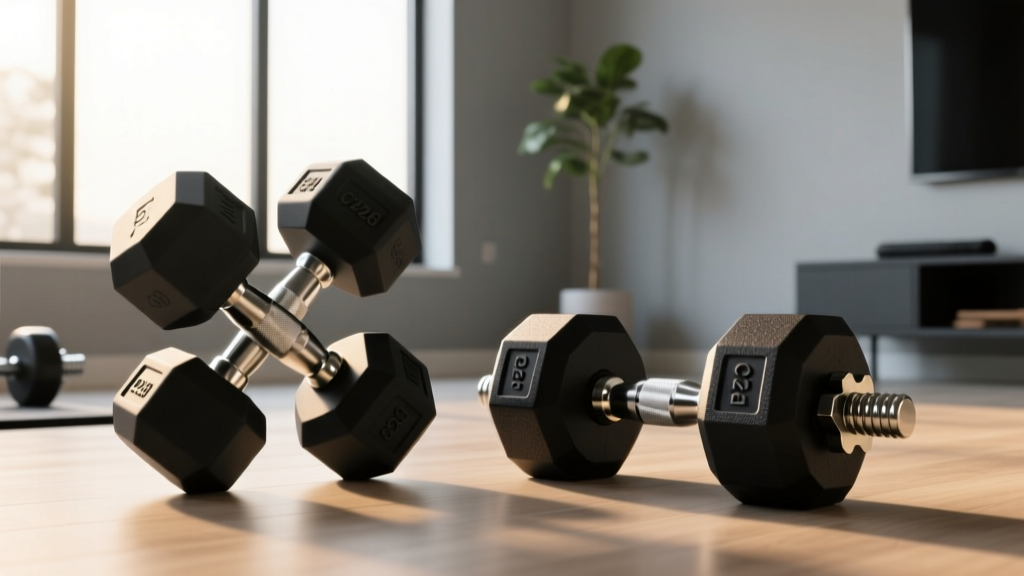
The hexagonal profile inherently solves the rolling issue. However, early rubber hex models introduced a new problem: edge degradation. When dropped, the sharp 120-degree corners of cheap rubber hex dumbbells would compress, tear, and eventually crumble, leaving black scuff marks and rubber debris across the gym floor. Urethane hex dumbbells solved this by utilizing slightly beveled edges combined with the high tear-strength of CPU, effectively merging the anti-roll safety of the hex profile with the durability required for heavy commercial use.
Lifecycle Cost Analysis (2026-2036)
Procurement officers often experience 'sticker shock' when pricing urethane against rubber or legacy round sets. However, a 10-year total cost of ownership (TCO) model reveals a different financial reality. The data below reflects average 2026 B2B wholesale pricing for a full 5-100 lb set (5 lb increments, paired).
| Metric | Rubber Hex (SBR) | Urethane Hex (CPU) | Urethane Round (Anti-Roll) |
|---|---|---|---|
| Upfront Cost (Full Set) | $2,800 - $3,200 | $7,500 - $8,800 | $8,200 - $9,500 |
| Cost Per Pound | ~$1.65 / lb | ~$4.25 / lb | ~$4.80 / lb |
| Est. Replacement Cycle | 3 - 4 Years | 10+ Years | 10+ Years |
| 10-Year TCO (incl. 1 replacement) | $5,600 - $6,400 | $7,500 - $8,800 | $8,200 - $9,500 |
| Flooring Damage Risk | High (Scuffing/Chunking) | Low | Low |
While the initial capital expenditure for urethane is significantly higher, the elimination of a mid-cycle replacement (required for rubber hex) narrows the gap. Furthermore, the hidden costs of floor repair and member complaints regarding rubber odors push the true ROI firmly in favor of urethane for commercial spaces.
Common Failure Modes in High-Volume Facilities
When evaluating the transition away from standard rubber and traditional round profiles, facility managers must understand the specific mechanical failure modes of free weights. No dumbbell is invincible, but they fail in distinctly different ways:
- The 'Rattle' (Press-Fit Collar Failure): In budget rubber hex dumbbells, the steel handle is often pressed into the rubber head using a simple friction collar. Over thousands of drops, the kinetic shock expands the rubber and bends the internal collar, resulting in a loose head that 'rattles' during curls or presses. Premium urethane sets utilize bolted assemblies or ultra-high-tolerance machined steel inserts to prevent this.
- UV and Ozone Degradation (Yellowing): Early generations of urethane utilized aromatic polyurethane, which turned a sickly yellow when exposed to UV light from gym windows. Modern 2026 formulations use aliphatic polyurethane, which is entirely UV-stable and retains its matte black or custom-colored finish indefinitely.
- Chrome Peeling and Knurling Wear: The handle is just as critical as the head. Cheap round and hex sets use low-grade chrome plating that flakes off, exposing the underlying steel to rust from sweat. Top-tier urethane lines feature industrial hard-chrome or Cerakote finishes paired with medium-depth volcano knurling that maintains grip without tearing calluses.
Strategic Procurement Framework: Who Should Buy What?
Despite the overwhelming market trend toward urethane hex, there is no single 'perfect' dumbbell for every scenario. Use this decision matrix to guide your 2026 equipment purchases:
1. The Commercial Globo-Gym & Boutique Studio
Recommendation: Urethane Hex (Full 5-100lb+ Set)
Rationale: Maximum durability, zero odor, and elimination of rolling hazards. The high upfront cost is easily amortized over a decade of heavy, unsupervised use. The hex profile ensures members leave weights safely on flat racks without specialized saddles.
2. The Garage / Home Gym Enthusiast
Recommendation: Virgin Rubber Hex or Urethane Hex (Condensed Sets)
Rationale: If budget is a primary constraint, virgin rubber hex (not recycled SBR) offers a middle ground with minimal odor and decent durability. However, if the gym is located in a finished basement or shared living space, the zero-VOC nature of urethane makes it a mandatory upgrade for indoor air quality.
3. Olympic Weightlifting & Functional Fitness Platforms
Recommendation: Urethane Round Dumbbell Set (with Anti-Roll Flats)
Rationale: This is the one arena where the round dumbbell set survives and thrives. Functional fitness athletes and Olympic lifters often prefer the ergonomics of a round head for movements like renegade rows, devil presses, and heavy dumbbell snatches, where the sharp corners of a hex dumbbell can dig into the wrist or collarbone. To mitigate the rolling hazard, buyers must spec urethane round sets that feature a machined 'flat spot' on the side, allowing them to sit securely on the floor and standard racks without rolling away.
The Final Verdict
The fitness equipment market in 2026 is defined by a demand for high-density, low-maintenance solutions. The legacy round dumbbell set, while ergonomically beloved by strength athletes, has lost the war for general gym floor real estate due to spatial inefficiency and liability concerns. Simultaneously, rubber hex dumbbells are being exposed as a false economy, burdening operators with replacement cycles and environmental complaints. Cast polyurethane hex dumbbells have emerged as the undisputed apex predator of the free weight aisle, offering a masterclass in material science, safety, and long-term financial sense.
More gear to consider
All reviews
Barbell Collar Types Compared: Securing Weights for Dumbbell Sit Ups
Rubber Hex vs Urethane: 2026 Gear for a Biceps Routine With Dumbbells
Bumper vs Iron Plates: Bent Over Rows Dumbbell Bench Care

Dumbbell Side Lateral Raises: Adjustable Dumbbell Mistakes & Fixes

Single Dumbbell Pec Exercises: Space-Saving Loadable Setup Guide
