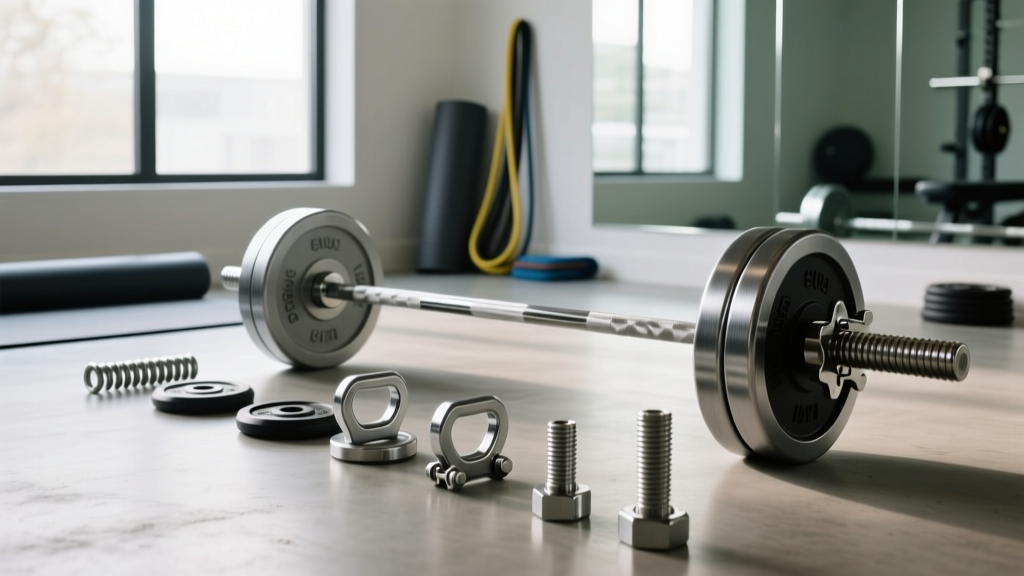
Barbell Collar Types for Presses and Dumbbell Bench Chest Workout
Compare barbell collar types, from spring clips to lever clamps, and learn how to secure loadable handles for your dumbbell bench chest workout safely.

The Physics of Plate Shift and Rotational Torque
Weight room safety is rarely about the catastrophic failures you see on viral gym videos; it is about the micro-movements that compromise biomechanics and invite injury. When executing a heavy barbell bench press, asymmetrical force output is a natural occurrence. If your weight plates are not secured with the proper collar, even a millimeter of lateral plate shift alters the bar's center of gravity. This creates rotational torque mid-rep, forcing your stabilizer muscles to compensate and potentially derailing your pressing groove. According to BarBend's barbell collar testing methodology, the grip force required to keep a 45-pound bumper plate stationary during an explosive concentric phase far exceeds the tension provided by standard hardware store spring clips.
But collars are not just for the barbell. As athletes increasingly utilize Olympic loadable dumbbell handles to bridge the gap between barbell stability and unilateral hypertrophy, selecting the right locking mechanism becomes a critical component of your equipment arsenal. This guide dissects the exact specifications, failure modes, and ideal use cases for every major collar type on the market in 2026.
Safety Alert: Never rely on the lip of an Olympic sleeve to retain plates during horizontal pressing movements. A 2.5kg plate sliding off a barbell during a bench press creates an immediate, unrecoverable seesaw effect that has resulted in severe pectoral tears and facial trauma.Comprehensive Comparison Matrix: 4 Main Collar Types
Before diving into specific models, it is essential to understand the mechanical differences between the four primary collar categories. The table below outlines the core specifications you need to evaluate based on your training style.
| Collar Type | Mechanism | Avg. Grip Force | Price Range (Pair) | Sleeve Space Used | Best Application |
|---|---|---|---|---|---|
| Spring Clip | Steel coil tension | Low (15-30 lbs) | $8 - $15 | 1.5 - 2.0 inches | Light accessories, warm-ups |
| Locking Clamp | Polycarbonate cam/TPU | Medium (80-120 lbs) | $25 - $45 | 0.8 - 1.2 inches | General powerlifting, commercial gyms |
| Lever-Action | Aluminum cam lever | High (150-200+ lbs) | $60 - $85 | 0.9 - 1.1 inches | CrossFit, rapid barbell cycling |
| Competition | Calibrated knurled screw | Maximum (300+ lbs) | $100 - $160 | 1.5 inches (Exact) | Olympic weightlifting, IPF meets |
Deep Dive: Spring Clips vs. Locking Clamps
Spring Clips (The Budget Standard)
The traditional chrome or coated steel spring clip is the most ubiquitous collar in the world, primarily due to its low cost. However, from an engineering standpoint, it is the least reliable. Spring clips rely entirely on the tensile strength of the metal coil. Over time, repeated expansion and contraction lead to metal fatigue. Furthermore, the inner grip ridges often fail to bite into the smooth zinc or chrome finish of a barbell sleeve, especially if chalk dust accumulates in the grooves.
- Pros: Extremely cheap, lightweight, requires zero learning curve.
- Cons: Prone to slipping under heavy vibration, difficult to remove with sweaty hands, high failure rate over time.
Locking Clamps (The Commercial Workhorse)
Locking clamps, popularized by brands like Lock-Jaw and Pro-Loc, utilize a rigid polycarbonate or ABS plastic body lined with a high-friction TPU (thermoplastic polyurethane) inner ring. When you snap the lever shut, a cam mechanism drives the TPU ring tightly against the steel sleeve.
For the average home gym owner or commercial facility, a high-quality locking clamp in the $30 to $40 range is the optimal balance of security and convenience. The Lock-Jaw Pro, for instance, features a push-button release that prevents the accidental unlocking that can occur with older flip-clip designs when the barbell is dropped on the floor.
Elite Tier: Competition and Lever Collars
Competition Calibrated Collars
In sanctioned Olympic weightlifting and powerlifting, collars are not just safety devices; they are part of the total calculated weight. Eleiko's calibrated competition collars, for example, are precision-machined from aluminum and steel to weigh exactly 2.5 kilograms per pair. They feature a knurled inner surface and a threaded locking screw that bites aggressively into the sleeve. While they offer unparalleled grip force that completely eliminates plate rattle during a violent barbell clean and jerk, their slow application time makes them entirely impractical for general fitness or high-volume bodybuilding sessions.
Lever-Action Collars (The Quick-Release King)
If your training involves rapid weight changes or barbell cycling, lever-action collars are mandatory. The Rogue Fitness AH-1 Aluminum Collars represent the gold standard in this category. Machined from 6061 aircraft-grade aluminum, they utilize a heavy-duty stainless steel cam lever. Weighing just 0.45 pounds per collar, they clamp down with immense force but can be released in a fraction of a second with a simple flick of the thumb. Priced around $65 per pair, they are an investment that pays dividends in training efficiency.
Securing Loadable Handles for Your Dumbbell Bench Chest Workout
While traditional collars are designed for 7-foot Olympic barbells, the modern strength athlete frequently incorporates Olympic loadable dumbbell handles into their programming. If you are structuring a heavy push day and plan to transition from barbell presses to a targeted dumbbell bench chest workout using loadable handles, your collar choice becomes exponentially more critical.
Loadable dumbbell handles typically feature much shorter sleeves than a standard barbell—often ranging from 2.5 to 4.5 inches in length. This creates a severe spatial constraint. If you use bulky spring clips or wide competition collars, you may consume 30% to 50% of your available loading space, physically preventing you from adding enough 10-pound or 25-pound plates to reach your target weight for the dumbbell bench chest workout.
Expert Insight: When utilizing loadable dumbbells for heavy unilateral chest pressing, rotational torque is magnified. The shorter the lever arm (the dumbbell handle), the more violently the plates will attempt to spin if they are not locked flush against the inner sleeve lip. Low-profile locking clamps or specialized micro-collars are mandatory here to maximize loading space while ensuring the plates do not shift during the descent of the press.
Furthermore, transitioning between equipment in a busy gym requires speed. Lever-action collars allow you to strip the barbell and instantly lock down your loadable dumbbell handles in seconds, keeping your heart rate elevated and your rest intervals strictly timed during your dumbbell bench chest workout supersets.
Real-World Troubleshooting & Edge Cases
Pro-Tip: The Sleeve Tolerance IssueNot all Olympic sleeves are created equal. While the standard is 50mm, manufacturing tolerances mean some budget barbells feature sleeves that are 49.2mm or 49.5mm. If you are using rigid polycarbonate locking clamps on an undersized sleeve, the TPU liner may not compress enough to create a secure lock. Always test your collars on your specific barbell brand. If you notice slippage, switch to a flexible TPU-lined strap collar or a lever-action metal collar that can micro-adjust to the tighter tolerance.
Dealing with Chalk Buildup
Magnesium carbonate (gym chalk) is the enemy of collar friction. Chalk acts as a dry lubricant between the steel sleeve and the collar's inner grip. To maintain maximum holding power, wipe down the last two inches of your barbell and dumbbell sleeves with a damp microfiber cloth before applying your collars. This simple 5-second habit will double the effective lifespan of your collar's gripping mechanism.
The FitGearPulse Buying Framework
Use this decision tree to select the exact collar type for your facility and training style:
- For Olympic Weightlifters & Competitors: Invest in calibrated competition collars. The exact weight and zero-tolerance grip are non-negotiable for the snatch and clean & jerk.
- For CrossFit & High-Intensity Functional Training: Purchase lever-action aluminum collars (like the Rogue AH-1). The speed of release during AMRAP workouts will save you valuable seconds and reduce hand fatigue.
- For Powerlifters & General Strength: High-quality locking clamps (Lock-Jaw or Pro-Loc) offer the best balance of security, durability, and price for heavy squats, deadlifts, and bench presses.
- For Loadable Dumbbell & Accessory Work: Opt for low-profile clamping collars to preserve sleeve space, ensuring you can load adequate weight for your dumbbell bench chest workout and heavy unilateral rows.
Ultimately, treating your collars as a critical piece of safety equipment rather than an afterthought will protect your body, your equipment, and the integrity of your training data. Secure the sleeves, respect the physics, and press with absolute confidence.
More gear to consider
All reviews
Rubber Hex vs Urethane Dumbbells: Pandora Dumbbell Charm

EZ Curl Bar vs Straight Bar Care & Dumbbell Raises Chest Tips

Barbell Collar Clamp Comparison & Dumbbell Woodchoppers GIF
Power Rack vs Squat Rack vs Stand: Close-Grip Dumbbell Bench Press

Olympic vs Standard Plates: Setup for Dumbbell Rows
