Rowing Technique & Buying Guide: The Treadmill Was Invented in 1818
Master your rowing technique and find the perfect machine. While the treadmill was invented in 1818, modern rowers offer superior full-body cardio for 2026.

From Penal Labor to Peak Performance: Why We Row
It is a strange quirk of fitness history that the treadmill was invented in 1818 by Sir William Cubitt as a punitive labor device for prisoners, whereas the indoor rowing machine (ergometer) was developed specifically to train elite athletes for the water. Today, as we navigate the home fitness landscape of 2026, the rowing machine remains the undisputed king of low-impact, full-body cardiovascular conditioning. While treadmills isolate the lower body and subject joints to repetitive ground reaction forces, a properly executed rowing stroke engages 86% of your muscle mass per stroke.
This comprehensive guide will break down the precise biomechanics of the rowing stroke, compare resistance mechanisms, and provide a data-driven buying guide featuring the top ergometers on the market.
The Biomechanics of the Rowing Stroke
Before investing $1,000+ in an ergometer, you must understand the mechanics of the stroke. According to the American Council on Exercise, the rowing stroke is not an arm pull; it is a highly coordinated kinetic chain sequence. The power distribution is roughly 60% legs, 20% core, and 20% arms.
The Four Phases of the Stroke
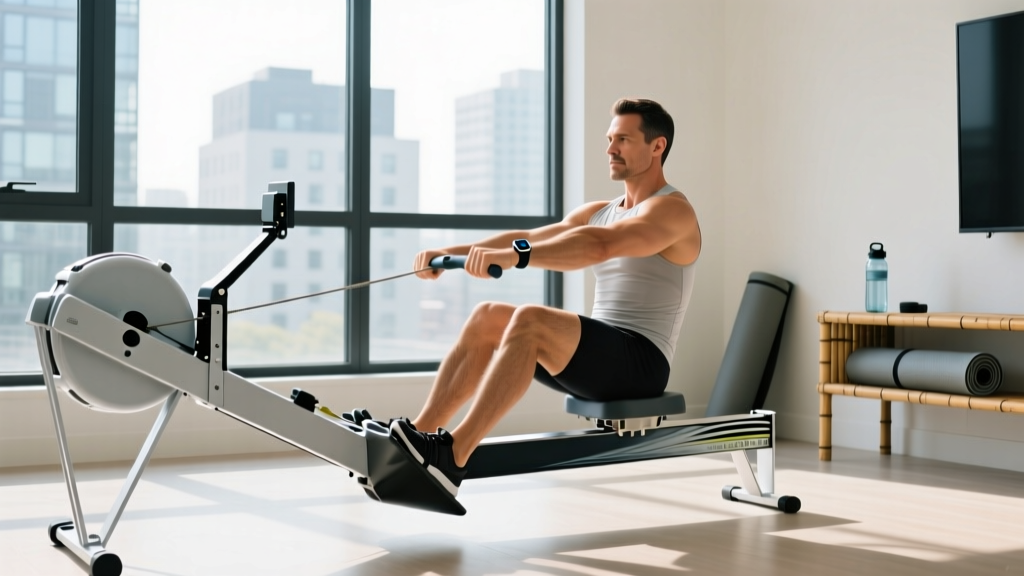
- The Catch: Shins are vertical (or as close as flexibility allows), arms straight, shoulders relaxed, and the torso leaning forward at about 11 o'clock. The lats are engaged to 'hang' off the handle.
- The Drive: Initiate with a powerful leg push. The arms remain completely straight until the handle passes the knees. Once the legs are nearly extended, the core swings open to 1 o'clock, followed by the arms drawing the handle to the lower sternum.
- The Finish: Legs are fully extended, core is braced, and the handle is pulled to the bottom of the ribcage. Elbows are drawn past the torso. Avoid leaning back past 1 o'clock, which places sheer stress on the lumbar spine.
- The Recovery: The exact reverse of the drive. Arms extend first, torso hinges forward past the knees, and finally, the knees bend to slide back to the catch. The recovery should take twice as long as the drive (a 1:2 ratio).
Do not blindly set the damper to 10. According to Concept2, a damper setting of 10 does not equal 'heavier' or 'better' workouts; it simply alters the drag factor. For most indoor training, a drag factor between 110 and 130 (usually a damper setting of 3 to 5) accurately simulates the feel of a sleek racing shell on water.
Air vs. Magnetic vs. Water: Resistance Mechanisms Compared
The resistance type dictates the noise level, maintenance requirements, and the 'feel' of the stroke. Below is a comparison matrix of the three primary resistance types dominating the 2026 market.
| Resistance Type | Feel & Dynamics | Noise Level | Maintenance | Best For |
|---|---|---|---|---|
| Air | Infinite resistance based on stroke intensity; highly dynamic. | High (Loud whoosh) | Low (Occasional chain oil, dusting) | CrossFitters, competitive rowers, data purists. |
| Magnetic | Consistent, quiet resistance; lacks the 'catch' feel of air/water. | Very Low (Near silent) | Very Low (Belt driven, no oil) | Apartment dwellers, late-night exercisers. |
| Water | Smooth, auditory 'swoosh' mimicking real water; heavy catch. | Moderate (Soothing water sound) | Moderate (Water purification tablets, tank sealing) | Aesthetics, sensory feedback, living room placement. |
2026 Ergometer Buying Guide: Top Models & Pricing
When selecting a machine, you are evaluating the monitor ecosystem, the rail length (crucial for tall users), and the structural integrity of the frame. Here are the benchmark models for this year.
1. Concept2 RowErg (Standard Legs)
- Price: ~$990
- Resistance: Air
- Monitor: PM5 (Bluetooth & ANT+)
- The Verdict: The undisputed gold standard. The PM5 monitor provides unparalleled accuracy, and the machine's resale value is virtually unmatched. The standard 14-inch seat height is ideal for indoor rowing competitions and CrossFit gyms.
2. Rogue Echo Rower
- Price: ~$1,250
- Resistance: Air
- Monitor: Rogue PM5-compatible or proprietary Echo app integration
- The Verdict: Built with Rogue's signature over-built steel frame, the Echo Rower feels slightly more rigid than the Concept2 during aggressive catch phases. It is a favorite among garage gym owners who prioritize heavy-duty aesthetics.
3. Hydrow Arc
- Price: ~$1,495
- Resistance: Electromagnetic
- Monitor: 16-inch HD Touchscreen
- The Verdict: A massive departure from traditional air rowers. The Arc uses a webbed strap and electromagnetic resistance, making it nearly silent. It is heavily reliant on subscription content ($44/month), making it ideal for users who need instructor-led motivation rather than raw data.
4. WaterRower Natural (Oak)
- Price: ~$1,595
- Resistance: Water
- Monitor: S8 Monitor (Basic LCD)
- The Verdict: A piece of functional furniture. The wooden frame absorbs vibration, and the water tank provides a highly realistic catch. However, the S8 monitor lacks native Bluetooth for third-party apps, requiring a separate sensor upgrade for competitive tracking.
Monitor Ecosystems & App Integration
In 2026, the hardware is only half the equation; the software ecosystem dictates long-term adherence. The British Rowing governing body frequently references standardized split times, which requires accurate monitor calibration.
- Concept2 ErgData / Logbook: Completely free, deeply analytical, and the universal language of indoor rowing. If you want to compete in online challenges or submit scores to the CrossFit Open, PM5 compatibility is mandatory.
- Hydrow / Peloton Integration: High production value, scenic rows, and coaching. Excellent for beginners, but locks you into a recurring monthly subscription model.
- Third-Party Apps (EXR, Kinomap): Air and magnetic rowers with open Bluetooth (ANT+ / BLE) allow you to use gamified rowing apps where your stroke rate and wattage control an avatar in a virtual 3D environment.
Critical Sizing Metrics: Inseam and Footprint
A common failure mode in buying a rowing machine is ignoring the monorail length. If you are over 6'2', you must verify the maximum inseam clearance.
Warning: Rail Length ConstraintsThe Concept2 RowErg accommodates up to a 38-inch inseam. If your inseam exceeds 38 inches (common for users 6'4' and taller), you must purchase the optional Extra Long Legs or Extended Rail accessory (approx. $150-$200) to prevent the seat carriage from derailing off the back of the monorail during the catch.
Maintenance and Edge Case Failures
Rowing machines are remarkably durable, but they are not maintenance-free. Here are the specific edge cases and maintenance protocols you need to know:
- Chain Stretch (Air Rowers): Over 3-5 years of heavy use, the nickel-plated steel chain will stretch. If the chain begins to slip over the sprocket teeth during the catch, it requires replacement (a $30 part, but requires basic mechanical aptitude).
- Bungee Cord Retraction Failure: The internal elastic bungee that pulls the chain back into the housing loses elasticity over time. If the handle does not retract fully, the bungee needs to be replaced or tightened via the rear housing access panel.
- Water Tank Algae (Water Rowers): Never use tap water in a water rower. The minerals will promote algae growth and degrade the polycarbonate tank seals. Always use distilled water and drop in the manufacturer-provided chlorine purification tablet every 6 months.
Frequently Asked Questions
Can I use a rowing machine every day?
Yes, rowing is a low-impact, concentric-heavy movement, meaning there is no eccentric muscle tearing (like the downward phase of a squat or the foot-strike of running). Elite rowers train 2-3 times daily. For beginners, 4-5 days a week of 30-45 minutes at a conversational pace (Zone 2, typically 18-20 strokes per minute) is optimal for building aerobic capacity without CNS burnout.
Why does my lower back hurt after rowing?
Lower back pain is almost always a technique flaw, specifically 'shooting the slide.' This occurs when you initiate the drive with your legs, but your core is disengaged, causing your hips to shoot backward while your shoulders stay put. This transfers the load directly to the lumbar erectors. Focus on bracing your core and moving the handle and seat simultaneously during the first third of the drive.
While the treadmill was invented in 1818 to punish, the modern rowing machine was built to empower. By prioritizing stroke mechanics and selecting an ergometer that fits your biomechanical and spatial needs, you are investing in the most efficient piece of cardiovascular equipment available in 2026.
More gear to consider
All reviews
ProForm Treadmill Belt Setup & Feature Comparison Guide

Treadmill Speeds Chart: Walking Pad Guide 2026
Curved vs Motorized: The Long Walk Movie Theater Treadmill Setup

Treadmill Motor Guide: How to Lose Fat on Treadmill
Elliptical vs Treadmill: WalkingPad C2 Mini Foldable Treadmill Test
