Beyond the Rhythm Fun Treadmill Manual: Rowing Machine Buying Guide
Upgrading from a walking pad? Explore our 2026 rowing machine buying guide, technique breakdown, and model comparisons to elevate your home cardio.

The Home Gym Evolution: From Walking Pads to Full-Body Cardio
If you have recently misplaced your Rhythm Fun treadmill manual or simply found that a compact under-desk walking pad no longer meets your cardiovascular demands, you are experiencing a common home gym evolution. While walking pads are excellent for NEAT (Non-Exercise Activity Thermogenesis) and low-impact stepping, they lack the upper-body engagement and high-intensity ceiling required for advanced cardiovascular conditioning. Transitioning to a rowing machine (ergometer) is the logical next step for athletes seeking comprehensive, joint-friendly, high-yield cardio.
Why Transition from a Treadmill to a Rower?
When you outgrow the limited resistance and biomechanical scope of a standard motorized treadmill or walking pad, the rowing machine offers a stark contrast in physiological demand. According to the Mayo Clinic's guidelines on aerobic exercise, engaging large muscle groups across both the upper and lower body simultaneously maximizes oxygen consumption (VO2 max) and caloric expenditure.
Unlike the repetitive, lower-body-dominant strike of a treadmill, rowing recruits approximately 86% of the body's musculature. The biomechanical breakdown of a proper rowing stroke is roughly 60% legs, 30% core, and 10% arms. This distribution not only spares the knee and ankle joints from the repetitive ground-reaction forces associated with running but also builds posterior chain strength (glutes, hamstrings, erector spinae, and lats) that treadmills entirely neglect.
The 2026 Rowing Machine Market: Top Models Compared
The indoor rowing market has bifurcated into two primary categories: traditional air/magnetic resistance workhorses and smart connected rowers. When upgrading your home gym, understanding the resistance mechanism is critical to matching the machine to your training style.
| Model | Resistance Type | Max User Weight | Connectivity | 2026 Price Range |
|---|---|---|---|---|
| Concept2 RowErg | Air (with adjustable damper) | 500 lbs | Bluetooth (PM5 Monitor) | $1,100 - $1,250 |
| Hydrow Arc | Electromagnetic | 325 lbs | 22" HD Touchscreen | $1,495 + Sub |
| NordicTrack RW900 | Magnetic (Silent) | 300 lbs | iFIT Integration | $1,699 + Sub |
| Echelon Row | Magnetic (32 levels) | 300 lbs | App-based (BYOD) | $1,299 + Sub |
Air vs. Magnetic Resistance: Which is Right for You?
Air Resistance (e.g., Concept2): The resistance is dynamically linked to your effort. The harder you pull, the more air the flywheel displaces, creating exponential drag. This makes air rowers the gold standard for competitive CrossFit athletes and Olympic rowers. The trade-off is noise; air rowers generate a distinct "whoosh" that can be disruptive in shared living spaces.
Magnetic/Electromagnetic Resistance (e.g., Hydrow, NordicTrack): These utilize magnets to create eddy currents against a metal flywheel. The result is a near-silent, incredibly smooth stroke that is ideal for apartment dwellers or early-morning exercisers. However, the resistance curve feels more linear and less "alive" than an air rower, which can alienate purists.
Mastering the Rowing Technique: The 4-Phase Stroke
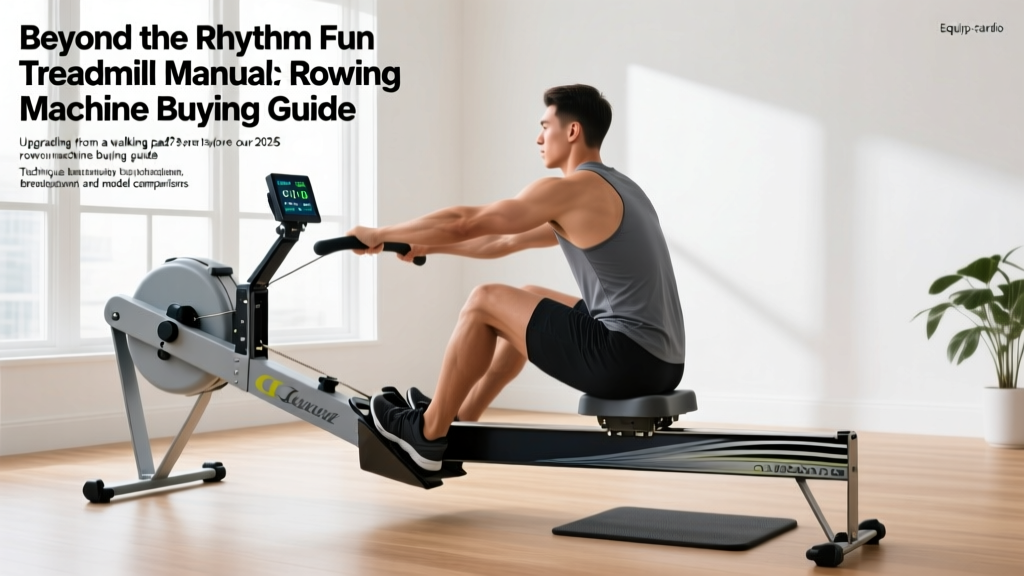
The most common mistake treadmill converts make on a rowing machine is treating the handle like a lat pulldown bar, relying entirely on upper-body pulling. Proper rowing is a pushing exercise first. The Concept2 official technique guide breaks the stroke into four distinct phases. Mastering these is non-negotiable for preventing lower back shear forces.
- The Catch: Slide forward until your shins are perfectly vertical (do not compress past vertical, or you will lose power and strain the patellar tendon). Your arms are straight, shoulders are relaxed, and your torso is hinged forward at roughly an 11 o'clock angle.
- The Drive: Initiate the movement by explosively pushing through your heels. Do not bend your arms yet. Your legs do the heavy lifting. Once your legs are nearly fully extended, hinge your torso back to a 1 o'clock position, and finally, draw the handle to your lower ribs (just below the sports bra line).
- The Finish: Legs are fully extended (but not hyperextended), core is braced, and the handle is lightly touching your torso. Your elbows should be drawn back and slightly away from your ribs.
- The Recovery: This is the active rest phase. Reverse the sequence: arms extend first, torso hinges forward past 12 o'clock, and only then do the knees bend to slide back to the Catch. The recovery should take twice as long as the drive (a 1:2 ratio).
Expert Insight: The Drag Factor Fallacy
Many beginners set the damper lever on an air rower to 10, assuming it mimics a heavy treadmill incline. This is a critical error that leads to premature fatigue and lumbar strain. For 90% of aerobic workouts, set the damper between 3 and 5. This yields a "drag factor" of 100-130, which accurately simulates the hydrodynamic drag of a real racing shell on water.
Common Rowing Machine Failure Modes & Maintenance
Unlike motorized treadmills that suffer from electronic board failures and belt friction, rowing machines are largely mechanical. However, neglect leads to specific, costly failure modes.
- Chain Stretch and Rust: On air and chain-driven magnetic rowers, the steel chain requires maintenance. Never use WD-40. Wipe the chain with a paper towel and apply purified mineral oil or 3-in-One oil every 50 hours of use. A dry chain will stretch and eventually jump the sprocket teeth.
- Bungee Cord Degradation: The retraction mechanism that pulls the handle back to the cage relies on an internal elastic bungee cord. Over 3 to 5 years, this cord loses elasticity or snaps. If your handle fails to retract fully, the bungee needs replacing—a $15 part, but an annoying teardown process.
- Monitor Battery Corrosion: The PM5 and similar LCD monitors draw minimal power, but leaving alkaline batteries inside during humid summer months or long periods of inactivity guarantees acid corrosion on the logic board. Always use lithium AA batteries or remove them if the machine will sit idle for more than a month.
- Monorail Pitting: The wheels that carry the seat will grind into the aluminum or steel monorail if sweat and dust are allowed to accumulate. Wipe the track with a damp microfiber cloth after every single session to prevent permanent pitting, which causes a bumpy, uneven stroke.
Frequently Asked Questions: Making the Switch
Can I use my existing heart rate monitor with a new rower?
Yes, but with caveats. Most modern rowing machines (including the Concept2 PM5 and Echelon monitors) support standard Bluetooth Low Energy (BLE) and ANT+ chest straps, such as the Polar H10 or Garmin HRM-Pro. However, optical wrist-based monitors (like the Apple Watch) often struggle with accuracy during rowing due to the intense, repetitive wrist flexion and grip contraction, which restricts blood flow and confuses the optical sensors.
How much floor space do I actually need?
While a treadmill requires a permanent 3x6 foot footprint plus rear clearance for safety, most rowing machines measure roughly 8 feet long during use but can be stood upright on their end or separated into two pieces for storage. If you are replacing a bulky treadmill or dealing with the limitations of a walking pad, a vertically stored Concept2 or Hydrow Arc requires less than 2 square feet of floor space when not in use.
Is rowing safe for lower back pain?
When performed with correct sequencing (legs-core-arms), rowing is highly therapeutic for the lower back, as it strengthens the erector spinae and glutes without axial loading (spinal compression). However, if you have an active herniated disc or acute sciatica, the flexed position at the "Catch" phase can exacerbate symptoms. Consult a physical therapist before transitioning from a low-impact walking pad to an ergometer if you have a history of lumbar pathology.
More gear to consider
All reviews
Walking Pad vs Treadmill: What Does the Treadmill Help With? (2026)
Are Bowflex Treadmills Good? Belt Maintenance Costs

Treadmill Motor Guide: How to Lose Fat on Treadmill

Curved vs Motorized Treadmill: Belt Care & Treadmill Oil (Walmart)
Rowing Machine Buying Guide & Technique: Rower vs Circle Treadmill