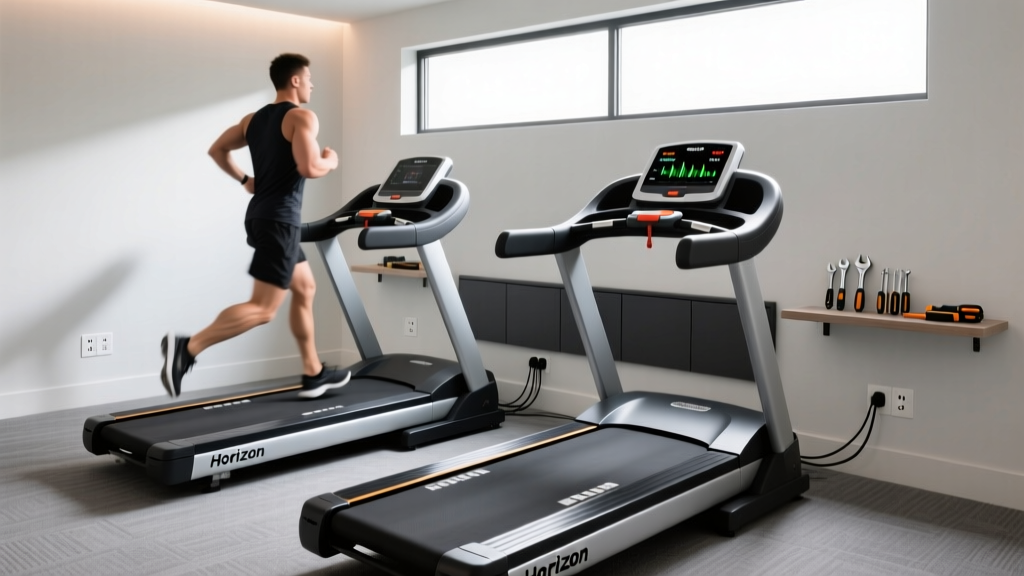
Curved vs Motorized: Is the Precor TRM 445 Treadmill Right for You?
Compare curved manual treadmills with motorized models like the Precor TRM 445 treadmill. Explore biomechanics, costs, and maintenance in our 2026 guide.

The Biomechanical Divide: Self-Powered vs. Motor-Driven Decks
The home and commercial fitness market in 2026 has firmly bifurcated into two distinct cardiovascular camps: traditional motorized treadmills and self-powered curved manual treadmills. While both elevate heart rates and improve cardiovascular health, the underlying biomechanics, energy expenditure, and mechanical failure points are vastly different. According to the Mayo Clinic, varying your cardiovascular modalities is essential for joint longevity and muscular balance, making the choice between a curved deck and a motorized belt a critical decision for your long-term training ecosystem.
Curved manual treadmills rely entirely on the user's posterior chain—specifically the glutes, hamstrings, and calves—to pull the slatted belt backward. This results in a forefoot strike pattern and reduces impact forces on the patellofemoral joint. Conversely, motorized treadmills utilize a continuous-duty motor to pull the belt beneath the user, which often encourages a heel-strike gait and requires the user to focus on keeping up with the machine rather than driving the belt themselves.
Data Highlight: Caloric Expenditure
Peer-reviewed biomechanical studies and data analyzed by the American Council on Exercise (ACE) indicate that running on a curved non-motorized treadmill can increase caloric expenditure by up to 30% compared to a motorized treadmill at the exact same perceived rate of exertion (RPE). The lack of motor assistance forces greater motor unit recruitment in the lower extremities.
The Motorized Gold Standard: Precor TRM 445 Treadmill
When evaluating the motorized side of the spectrum, the Precor TRM 445 treadmill remains a benchmark for light-commercial and premium home gyms. Unlike entry-level residential models that utilize 2.5 HP DC motors prone to overheating during HIIT sessions, the TRM 445 is engineered around a 4.0 HP AC continuous-duty motor. This ensures consistent torque delivery even when a 250 lb user drops from a 12 mph sprint to a 3 mph recovery walk.
Proprietary Impact Control and Belt Dynamics
Precor's proprietary Ground Effects Impact Control (GFX) system is the primary differentiator for the TRM 445. The deck features a multi-zone flexibility design: the rear third of the deck (where initial foot strike occurs) is engineered to absorb kinetic shock, while the front third is rigid to provide a firm lever for toe-off propulsion. Furthermore, the 20-inch by 56-inch running surface accommodates the natural lateral drift that occurs during fatigue-induced marathon training, a luxury not afforded by narrower curved alternatives.
- MSRP (New): $8,495 - $9,200 (often bundled with P82 or P84 consoles)
- Refurbished Market (2026): $4,200 - $4,800 for certified pre-owned commercial models
- Electrical Requirement: Dedicated 20-Amp, 120V commercial circuit (NEMA 5-20R plug)
- Top Speed / Incline: 12 mph / 15% grade
Top Curved Manual Contenders in 2026
If your training methodology prioritizes high-intensity interval training (HIIT), CrossFit-style metabolic conditioning, or sprint mechanics, a curved manual treadmill is likely the superior tool. The two dominant forces in this space are the AssaultRunner Elite and the TrueForm Runner.
AssaultRunner Elite vs. TrueForm Runner
The AssaultRunner Elite (priced at $3,299) utilizes a 17-inch wide, 67-inch long vulcanized rubber slat belt. It is exceptionally durable but demands rigorous maintenance to prevent the polyurethane slats from cracking in low-humidity environments. The TrueForm Runner ($5,495) features a slightly wider 18-inch belt and a deeper curve radius, which many biomechanists argue provides a more natural transition from walking to sprinting without the 'tipping point' effect found on steeper curved decks.
Head-to-Head Specification Matrix
| Feature | Precor TRM 445 (Motorized) | AssaultRunner Elite (Curved) | TrueForm Runner (Curved) |
|---|---|---|---|
| Drive Mechanism | 4.0 HP AC Motor | Self-Powered (Magnetic Resistance) | Self-Powered (Gravity/Friction) |
| Running Surface | 20' x 56' (Flat) | 17' x 67' (Curved) | 18' x 63' (Curved) |
| Unit Weight | 340 lbs | 280 lbs | 375 lbs |
| Max User Weight | 350 lbs | 350 lbs | 400 lbs |
| Incline / Decline | 0% to 15% Incline | Fixed Curve | Fixed Curve |
| Power Requirement | 120V / 20A Dedicated | None (Console uses CR2032) | None |
Installation Logistics: The Hidden Dealbreakers
One of the most overlooked aspects of purchasing high-end cardio equipment is the spatial and electrical infrastructure required. The Precor TRM 445 treadmill is a commercial-grade machine. It requires a dedicated 20-amp circuit. Plugging a 4.0 HP AC motor into a standard 15-amp residential bedroom circuit shared with lighting or HVAC systems will inevitably trip the breaker during peak acceleration phases, and over time, will degrade the treadmill's inverter board.
Curved manual treadmills, entirely devoid of drive motors, bypass this electrical hurdle completely. You can place an AssaultRunner Elite in a garage, a basement, or an off-grid facility without worrying about voltage drops. However, their physical footprint—specifically the height of the curved handrails (often exceeding 62 inches)—can be problematic in rooms with low ceiling clearance or sloped attic roofs.
Maintenance Realities and Failure Modes
Every machine breaks; the difference lies in how and when. Understanding the failure modes of motorized versus manual treadmills will dictate your total cost of ownership over a 10-year lifecycle.
Motorized Failure Modes (Precor TRM 445)
- Drive Belt Slippage: The ribbed drive belt connecting the motor to the front roller stretches over 3-5 years. Symptoms include a momentary hesitation or 'jerking' of the belt under heavy foot strikes.
- Deck Friction and Waxing: Precor utilizes a wax-infused belt system. While it requires less frequent maintenance than residential treadmills, failure to clean the deck area will lead to excessive amp-draw on the motor, eventually frying the motor controller board (a $600+ replacement part).
- Incline Actuator Burnout: Pushing a 340 lb machine to a 15% grade repeatedly with a 250 lb user places immense strain on the incline motor. Actuator gear stripping is a common failure point in commercial settings.
Curved Manual Failure Modes
- Slat Bearing Seizure: Curved treadmills utilize dozens of individual slats, each riding on internal ball bearings. Dust, pet hair, and humidity can cause these micro-bearings to seize, resulting in a 'dead spot' on the belt that feels like sudden resistance during a sprint.
- Polyurethane Cracking: The rubber slats are susceptible to UV degradation and drying out. If placed near a sun-facing window, the slats can become brittle and crack within 4 to 6 years, requiring a full belt replacement (costing upwards of $800).
- Drive Belt Tension Loss: The internal Kevlar-reinforced belts that connect the left and right slat arrays can lose tension, requiring manual adjustment via the rear axle tensioners.
Decision Framework: Which Deck Belongs in Your Gym?
Choosing between a curved manual treadmill and a premium motorized option like the Precor TRM 445 treadmill is not about finding the objectively 'better' machine, but rather aligning the equipment with your specific physiological goals and spatial constraints.
Buy the Precor TRM 445 (Motorized) If:
- You are training for endurance events (marathons, triathlons) and need to maintain precise, locked-in paces for 60+ minutes.
- You require incline simulation (up to 15%) to mimic hill climbing and vary your muscular recruitment.
- You have multiple users in the household with varying fitness levels, requiring easy speed adjustments and integrated safety stop-keys.
- You have the electrical infrastructure (20A dedicated circuit) to support a commercial AC motor.
Buy a Curved Manual Treadmill If:
- Your primary training modality is HIIT, Tabata, or CrossFit-style metabolic conditioning where rapid, self-regulated speed changes are mandatory.
- You want to actively target and strengthen your posterior chain (glutes and hamstrings) while reducing patellar impact.
- You lack the electrical infrastructure for a commercial motorized treadmill or want to place the unit in an off-grid or garage space.
- You prefer a machine with zero electronic motor components that could fail, accepting the mechanical maintenance of slat bearings instead.
'In 2026, the smartest home gym builders aren't just buying equipment; they are buying specific biomechanical adaptations. The Precor TRM 445 offers unmatched pacing consistency and joint protection for high-mileage runners, while curved decks remain the undisputed kings of anaerobic power output and posterior chain development.' — FitGearPulse Biomechanics Editorial Team
Final Verdict
If your budget allows for the $8,000+ investment (or $4,500 on the certified refurbished market) and your electrical panel can support it, the Precor TRM 445 treadmill is an heirloom-grade motorized machine that will outlast three generations of residential folding treadmills. However, if your goal is to maximize caloric burn per minute, improve sprint mechanics, and eliminate the risk of motor-board failures, allocating $3,299 toward an AssaultRunner Elite provides a superior ROI for high-intensity athletes. Assess your training split, verify your electrical capacity, and choose the deck that matches your physiological demands.
More gear to consider
All reviews
Rowing Guide: How to Connect Apple Watch to Planet Fitness Treadmill

ProForm Carbon TLS Treadmill vs. Walking Pads: 2026 Comparison

Beyond the Treadmill Manual: Step-by-Step Stair Climber Guide

Stationary Bike Types vs Weslo Cadence G 5.9i Folding Treadmill
Buying a Treadmill for Your Treadmill and Stairmaster Workout Setup