Power Rack vs Squat Stand: Standing Dumbbell Squeeze Press Guide
Compare power racks, half racks, and squat stands for 2026. We test interior clearance and safety using the standing dumbbell squeeze press.

The Home Gym Dilemma: Cage, Half-Rack, or Open Stand?
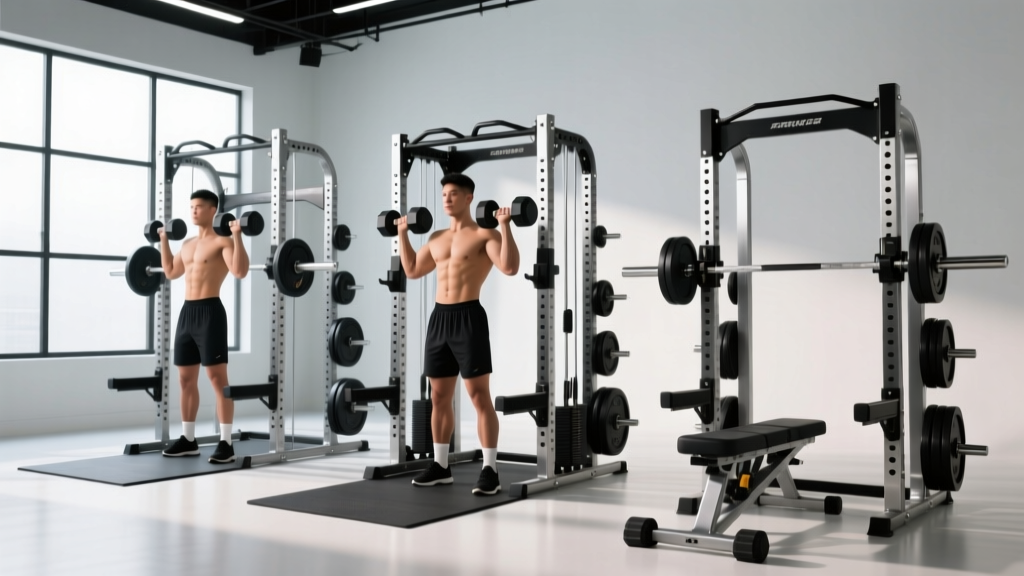
When outfitting a home gym in 2026, the debate between a full power rack, a half-rack (squat rack), and a squat stand usually centers on barbell squats and bench presses. However, true versatility requires evaluating how these structures handle dumbbell training—specifically, overhead movements that demand significant spatial freedom. The ultimate stress test for rack geometry is the standing dumbbell squeeze press. This exercise requires continuous medial adduction (pushing the dumbbells together) while pressing overhead, creating a wide, dynamic envelope of motion that exposes the design flaws of poorly chosen gym equipment.
Below, we break down the structural, spatial, and safety differences between power racks, squat racks, and squat stands, using the biomechanical demands of the standing dumbbell squeeze press as our primary benchmark.
⚠️ Overhead Clearance Warning: The standard 90-inch rack height leaves only 15 inches of clearance for a 6-foot lifter locking out dumbbells overhead. If you are taller than 6'1", performing a standing dumbbell squeeze press inside a standard 90-inch power rack will result in your hands or the dumbbells striking the pull-up bar or top crossmembers. Always opt for 108-inch uprights if your ceiling height (minimum 110 inches required) permits.Dimensional Breakdown: 2026 Market Leaders
To understand the spatial constraints, we must look at the exact dimensions of the most popular 11-gauge steel racks on the market. The interior width and depth dictate whether you can comfortably execute a standing dumbbell squeeze press without scraping your knuckles on powder-coated steel.
| Equipment Type | Model Benchmark | Interior Width | Footprint (W x D) | Avg. 2026 Price |
|---|---|---|---|---|
| Power Rack (Full Cage) | Rogue R-3 | 49 inches | 49" x 49" | $1,150 - $1,350 |
| Squat Rack (Half Rack) | Titan X-2 Half Rack | 48 inches | 53" x 24" | $649 - $750 |
| Squat Stand (Open) | Rogue SML-2 | 49 inches (Between Uprights) | 49" x 48" (Base) | $545 - $625 |
The Benchmark: Clearance and the Standing Dumbbell Squeeze Press
The standing dumbbell squeeze press is a highly effective movement for targeting the anterior deltoids and upper pectorals. According to kinesiology data from ExRx.net, the continuous adduction required to keep the dumbbells pressed together alters the natural bar path of a standard overhead press, forcing the lifter to manage a wider, more complex center of gravity.
Lateral Envelope Constraints
A 6-foot-tall lifter with an average wingspan holding 14-inch hex dumbbells requires roughly 52 to 54 inches of unrestricted lateral space at the top of the lockout to achieve a full squeeze.
- Inside a Power Rack: The 49-inch interior width of a standard cage forces the lifter to angle their body diagonally or risk scraping the dumbbells against the uprights or safety straps. This restricts the "squeeze" mechanic, reducing the effectiveness of the adduction.
- Inside a Squat Rack (Half Rack): While the front is open, the rear crossmembers and uprights still limit diagonal stepping. You are confined to the 48-inch box.
- With a Squat Stand: The open-air design provides infinite lateral space. You can step forward, angle your body, or widen your stance without any steel obstruction, allowing for a true, unimpeded standing dumbbell squeeze press.
Safety Protocols: Bailing on Overhead Dumbbell Work
Failure mechanics differ drastically between barbell and dumbbell work. If you fail a barbell back squat, you dump the bar onto the safety straps. If you fail a standing dumbbell squeeze press, you drop the bells to the floor. This is where the structural design of your rack becomes a safety hazard or a lifesaver.
Expert Insight on Failure Modes: "Dropping heavy dumbbells inside a confined 49-inch power rack cage is a primary cause of equipment damage and shin injuries in home gyms. The dumbbells often ricochet off the tight safety straps or bounce off the interior uprights. Open squat stands allow the lifter to simply step backward and drop the weights safely in front of the rack." — Equipment safety analysis via Garage Gym Reviews.
Spotter Arms vs. Strap Safeties
While Rogue Fitness and other manufacturers offer spotter arms for squat stands, they are virtually useless for standing dumbbell work. Spotter arms are designed to catch a descending barbell across a fixed plane. For a standing dumbbell squeeze press, your only reliable safety mechanism is an open floor plan and high-quality rubber horse-stall mats (minimum 3/4-inch thick) to absorb the impact of dropped iron.
Attachment Ecosystems: Beyond the Squeeze Press
While the squat stand wins for dumbbell clearance, the power rack dominates the 2026 attachment ecosystem. If your programming includes cable work, you must consider modularity.
- Power Racks: Accept full cable pulley systems, lat towers, and integrated weight storage. They are a complete gym in a single footprint.
- Squat Racks (Half Racks): Offer a middle ground. Most 2026 half-racks feature fold-down lat towers and front-mounted pull-up bars, though they lack the rear stabilization for heavy cable crossovers.
- Squat Stands: Severely limited. You are mostly restricted to band pegs, basic dip bars, and landmine attachments. If you want cable resistance, you will need to purchase a separate functional trainer.
Head-to-Head Feature Matrix
| Feature | Power Rack (Cage) | Squat Rack (Half) | Squat Stand |
|---|---|---|---|
| Dumbbell Squeeze Press Clearance | Poor (Restricted lateral/vertical) | Moderate (Open front, restricted rear) | Excellent (Unrestricted 360°) |
| Barbell Squat Safety | Maximum (Enclosed straps) | High (Front open, but deep safeties) | Low (Requires spotter arms, easy to miss) |
| Footprint Efficiency | Low (Takes up 16+ sq ft) | Moderate (Takes up ~9 sq ft) | High (Minimal visual bulk) |
| Cable/Pulley Integration | Full Integration | Partial (Fold-down towers) | None |
Final Verdict: Matching the Rack to Your Training Style
Choosing between a power rack, a squat rack, and a squat stand ultimately comes down to your primary training modality and ceiling height. The standing dumbbell squeeze press is just one movement, but it perfectly illustrates the spatial compromises inherent in home gym design.
Choose a Power Rack If:
You prioritize heavy barbell lifting (squats, bench, rack pulls) and want a fully enclosed, safe environment for training alone. You are willing to sacrifice some dumbbell overhead clearance and take your standing pressing movements outside the cage if necessary. Recommendation: Opt for a 108-inch height model if your ceilings allow, to mitigate the overhead strike issue.
Choose a Squat Rack (Half Rack) If:
You want the safety of deep barbell catchers but need an open front to easily step out with heavy dumbbells for lunges or standing presses. It is the ultimate compromise for the hybrid lifter who splits their time 50/50 between barbells and dumbbells.
Choose a Squat Stand If:
Your programming is heavily dumbbell-focused, Olympic lifting-oriented, or CrossFit-based. If executing a flawless, unimpeded standing dumbbell squeeze press is a staple in your hypertrophy blocks, the open-air geometry of a squat stand paired with heavy-duty floor mats is the superior, most cost-effective choice for 2026.
More gear to consider
All reviews
Maintaining Racks for Dumbbell Exercises with Exercise Ball Routines

Bumper vs Iron Plates: Trends in Weight Lifting with Dumbbells

Loadable Dumbbell Lower Body Layouts for Small Home Gyms

Best Adjustable Dumbbells for the Best Compound Dumbbell Exercises

Power Rack vs Squat Rack vs Stand: Proper Dumbbell Fly Form Setup
