Power Rack vs Squat Stand for Your Women's Dumbbell Workout Plan
Discover how to choose between a power rack, squat rack, and squat stand to safely elevate your women's dumbbell workout plan at home.

When designing a highly effective home gym, many lifters assume that heavy steel equipment is exclusively for barbell training. However, if you are committing to a structured women's dumbbell workout plan, choosing the right rack infrastructure is just as critical. Dumbbell training offers superior unilateral balance, joint-friendly ranges of motion, and deep muscle activation, but movements like heavy dumbbell bench presses, rack pulls, and supported Bulgarian split squats require a stable, safe foundation.
According to the Mayo Clinic, consistent resistance training is vital for increasing bone density and managing weight, making a dedicated home setup a long-term health investment. But with limited space and varying budgets, how do you choose between a full power rack, a traditional squat rack, or a minimalist squat stand? This step-by-step guide will help you match the right equipment to your specific spatial and training needs.
Beginner's Golden Rule
Never buy a rack based solely on barbell exercises you might do. Buy based on the footprint you have and the dumbbell movements you will do daily. A squat stand might save space, but a power rack provides the safety straps necessary for solo heavy dumbbell floor or bench presses.
Step 1: Define Your Dumbbell Routine's Spatial Footprint
Before comparing steel uprights, measure your available floor space. A comprehensive women's dumbbell workout plan requires room not just for the rack, but for the bench, the dumbbells, and your body's wingspan during movements like dumbbell flyes or lateral raises.
- Power Racks (Full Cages): Typically require a 48" x 48" to 49" x 49" footprint, plus an additional 24" of clearance on all sides for loading and movement. Height clearance is usually 80" to 90".
- Squat Racks (Half Racks): Often feature a 48" x 24" footprint with extended front feet for stability. They offer more open space for lateral dumbbell movements but require careful weight balancing.
- Squat Stands: The most compact, utilizing two independent uprights with a 48" x 24" base. Ideal for small apartments, but they lack the cross-member stability needed for heavy, off-center dumbbell loading.
Step 2: Compare the Core Rack Categories
Understanding the structural differences will dictate how safely you can push your dumbbell progressions to failure. Below is a direct comparison matrix of the three primary categories.
| Feature | Power Rack (Cage) | Squat Rack (Half Rack) | Squat Stand |
|---|---|---|---|
| Safety Mechanism | Enclosed; supports straps & pins | Front-facing pins or flip-downs | Basic catchers (high tip risk) |
| Upright Specs | 3x3" or 2x3" 11-gauge steel | 2x2" or 3x3" 11-gauge steel | 2x2" 11-gauge steel |
| Dumbbell Utility | Excellent (rack pulls, supported rows) | Good (open front for DB presses) | Fair (mostly for holding DBs/bench) |
| Avg. Price Range | $350 - $800+ | $300 - $600 | $150 - $350 |
Step 3: Match the Rack to Your Specific Dumbbell Movements
A well-rounded women's dumbbell workout plan incorporates pushing, pulling, and lower-body unilateral work. Here is how your rack choice impacts these specific movements.
Heavy Dumbbell Bench Pressing
If your program includes heavy incline or flat dumbbell presses, a Power Rack is non-negotiable for solo lifters. Unlike a barbell, dumbbells cannot be caught on a single pin; if you fail a rep, your arms can collapse outward, risking severe shoulder labrum tears. Power racks allow you to install nylon safety straps across the width of the cage. Straps catch the dumbbells safely without damaging the knurling or your wrists, a critical safety feature highlighted in resistance training guidelines by the CDC's physical activity recommendations for injury prevention.
Deficit Reverse Lunges & Step-Ups
For lower-body unilateral work, Squat Stands or Half Racks shine. Because they lack the rear and side cross-members of a full cage, you have unimpeded space to step backward into deep deficit reverse lunges while holding heavy dumbbells, or to perform lateral step-ups onto a plyo box placed adjacent to the uprights.
Dumbbell Rack Pulls & Supported Rows
Targeting the posterior chain is a staple of any strength program. By setting the safety pins in a Power Rack or Half Rack just below the knee, you can perform heavy dumbbell rack pulls. This reduces the lower-back shear force of pulling from the floor while overloading the glutes and traps. Furthermore, you can use the lower cross-members of a half-rack to anchor resistance bands for seated dumbbell rows.
Step 4: Select Your 2026 Equipment Models
Based on current market availability, build quality, and pricing, here are three top-tier recommendations tailored for home gyms.
1. The Space-Saver: Titan Fitness T-2 Series Power Rack (Short)
Price: ~$349 | Footprint: 49" x 49" | Height: 72"
Don't let the name fool you; this is a full 4-post cage, just shortened to fit under standard 8-foot ceilings. The 2x2" 11-gauge steel is robust enough to handle heavy dumbbell drop-sets, and the included safety catchers provide peace of mind for solo benching. It's the ultimate budget-friendly enclosure for a comprehensive dumbbell routine.
2. The Premium Open-Air: Rogue Fitness SML-2C Monster Lite Squat Stand
Price: ~$495 | Footprint: 48" x 24" | Height: 90"
Built with Rogue's signature 3x3" 11-gauge steel and 5/8" hole spacing, the SML-2C is virtually indestructible. While it is a squat stand, the massive base feet provide exceptional stability. It is perfect for lifters who use their rack primarily to store an adjustable bench and perform standing dumbbell movements, though it lacks the enclosed safeties for heavy solo pressing.
3. The Versatile Hybrid: REP Fitness PR-1100 Home Gym Rack
Price: ~$399 | Footprint: 48" x 24" (Half Rack) | Height: 84"
The PR-1100 offers the open front of a squat stand but includes a rear stabilizer and multi-grip pull-up bar. It bridges the gap perfectly, allowing you to pull an adjustable bench inside for dumbbell presses while utilizing the front safeties, and giving you ample room for dumbbell goblet squats and thrusters.
Step 5: Accessorize for Dumbbell Storage and Utility
A rack is only as good as its attachments. To keep your workout area safe and organized, consider these essential add-ons:
- Urethane Dumbbell Saddles / Cradles: Many modern 3x3" racks offer bolt-on dumbbell cradles that attach directly to the uprights. This saves floor space and keeps your heaviest pairs (e.g., 40lb and 50lb hex dumbbells) at waist height, preventing lower back strain when picking them up for heavy sets.
- Band Pegs: Essential for accommodating resistance. Looping a band from the base of a power rack to your dumbbells during floor presses adds accommodating resistance, challenging your triceps and chest at peak contraction.
- Landmine Attachments: While technically a barbell accessory, a landmine base attached to your rack allows for incredible unilateral rotational work (like landmine twists) that perfectly complements the anti-rotational core work of heavy single-arm dumbbell carries.
"Strength training isn't just about building muscle; it's about building a resilient body. Ensuring your environment is safe allows you to push closer to muscular failure, which is where the true physiological adaptations occur." — Harvard Health Publishing
Frequently Asked Questions
Can I use a squat stand for heavy dumbbell bench presses?
It is highly discouraged. Squat stands lack the lateral stability and enclosed safety mechanisms of a power rack. If you fail a heavy dumbbell rep and your arm drops to the side, the stand can tip, or you can suffer a shoulder injury. Always use a full rack or half-rack with wide safety straps for heavy solo dumbbell pressing.
Do I need a rack if my women's dumbbell workout plan only uses light weights?
If your plan strictly utilizes light neoprene or urethane dumbbells (under 20 lbs) for high-rep endurance or Pilates-style movements, a rack is unnecessary. However, if your plan involves progressive overload, heavy goblet squats, or dumbbell bench pressing to build lean muscle mass, a rack provides the necessary bench support, storage, and safety infrastructure.
What is the best bench to pair with my rack for dumbbell training?
Look for an adjustable FID (Flat/Incline/Decline) bench with a 1000 lb capacity and a 12-inch pad width. A 12-inch width is crucial for dumbbell work, as wider pads (14+ inches) can impinge your shoulder blades during deep dumbbell flyes and presses, limiting your range of motion.
More gear to consider
All reviews
Best Budget Racks for an Arm Toning Workout with Dumbbells

Rubber Hex vs Urethane: Space Design for a Dumbbell Exercise Routine
Olympic Barbell Buying Guide & Tricep Workout Routine with Dumbbells
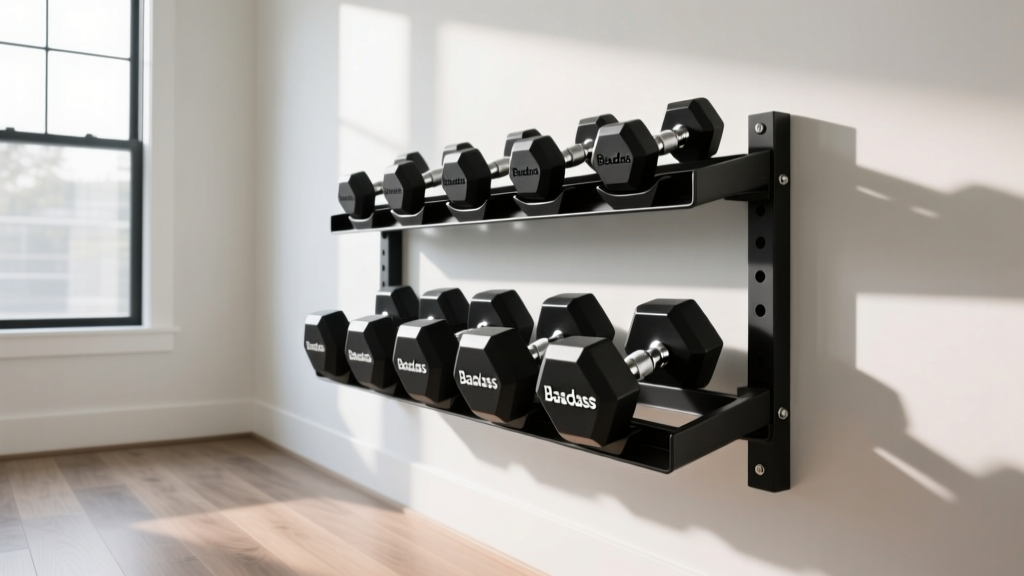
Space-Saving Racks to Organize Your Baadass Dumbbells
Beyond the Dumbbell Rear Delt Fly: 2026 Kettlebell Trends