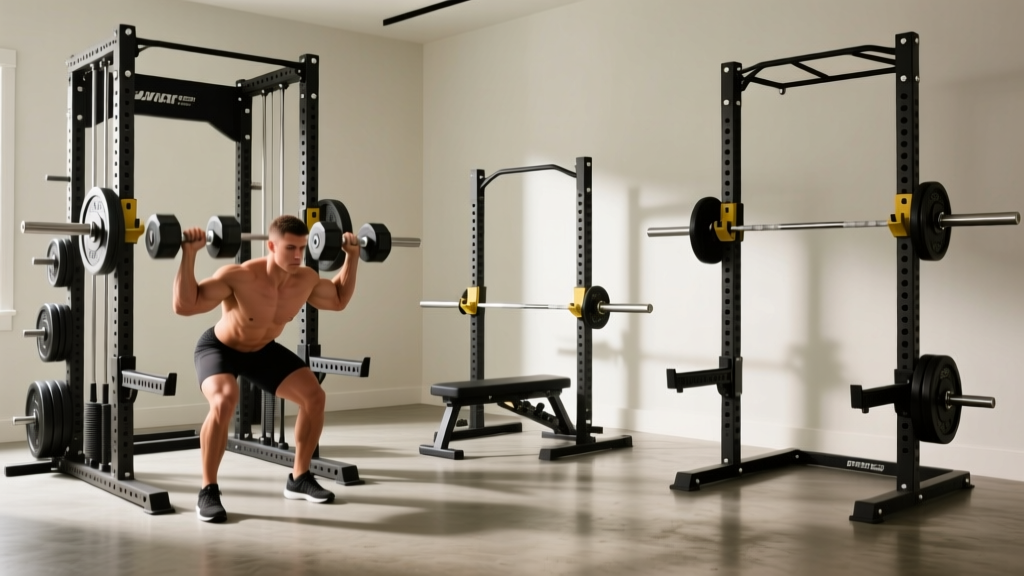
Power Rack vs Squat Rack vs Stand: Lower Back Workouts with Dumbbells
Choosing between a power rack, squat rack, or stand? Discover common mistakes to avoid when setting up for lower back workouts with dumbbells.

When outfitting a home gym, most lifters obsess over how a rack will handle heavy barbell squats and bench presses. However, a massive blind spot in equipment selection is how the rack's footprint and attachment ecosystem impacts posterior chain training. When executing lower back workouts with dumbbells—such as Romanian Deadlifts (RDLs), bent-over rows, and dumbbell good mornings—the physical dimensions of your rack dictate your safety, range of motion, and ability to modify exercises when fatigue sets in.
Choosing between a power rack, a squat rack, and a squat stand is not just a matter of budget and ceiling height; it is a biomechanical decision. In this troubleshooting guide, we break down the most common mistakes lifters make when pairing their rack setup with dumbbell lower back training, and how to fix them.
The 3 Rack Types: Footprint, Depth, and Dumbbell Clearance
Before diving into the mistakes, we must establish the baseline differences between the three primary rack categories. The interior depth and upright configuration directly affect how you maneuver heavy dumbbells around your center of gravity.
| Feature | Power Rack (e.g., Rogue RML-390F) | Squat Rack (e.g., Titan T-2) | Squat Stand (e.g., Rep SR-4000) |
|---|---|---|---|
| Average Price | $800 - $1,200 | $450 - $650 | $250 - $400 |
| Interior Depth | 30 to 41 inches | 24 to 30 inches | N/A (Open Footprint) |
| Dumbbell RDL Clearance | Excellent (if 30'+) | Poor to Moderate | Unrestricted |
| Attachment Ecosystem | Extensive (Cables, Pulleys, Belts) | Limited (Dip bars, Pull-up) | Minimal to None |
Common Mistake #1: Ignoring Interior Depth for Dumbbell RDLs
The Romanian Deadlift is a cornerstone of lower back workouts with dumbbells, targeting the erector spinae, glutes, and hamstrings. The most frequent troubleshooting issue we see in home gyms is lifters attempting heavy dumbbell RDLs inside a standard 24-inch deep squat rack.
The Biomechanical Failure Mode
During a proper hip hinge, your torso tilts forward, and your arms extend downward, slightly in front of your shins. If you are holding a pair of 50-pound hex dumbbells inside a 24-inch cage, the forward translation of the weights forces you to either:
- Shorten your range of motion to avoid smashing the dumbbells into the front uprights.
- Alter your hinge mechanics by rounding your lumbar spine to keep the weights closer to your body.
According to biomechanical analyses published by the National Institutes of Health (NIH), altering the barbell or dumbbell path away from the mid-foot during a hinge movement exponentially increases shear force on the lumbar vertebrae. By restricting your dumbbell path, a shallow squat rack inadvertently turns a safe posterior chain builder into a lower back injury risk.
Expert Troubleshooting Fix: If your primary focus includes heavy dumbbell hinges, you must either purchase a power rack with a minimum 30-inch interior depth (like the Rogue RML-390F) or perform your RDLs completely outside the footprint of a squat stand.Common Mistake #2: Missing Attachment Compatibility for Supported Rows
Bent-over dumbbell rows are exceptional for lat and rhomboid development, but they place a massive isometric demand on the lower back. A common scenario: you are halfway through your workout, your erector spinae are fatigued from deadlifts or good mornings, and you can no longer maintain a neutral spine during standing bent-over rows.
The Modification Problem
The standard troubleshooting protocol for lower back fatigue is to pivot to a chest-supported row. However, if you own a basic squat stand or a minimalist squat rack, you have no way to set this up. You cannot safely wedge an adjustable incline bench into a squat stand to create a chest-supported station, nor do you have the crossmembers required to mount a low-row cable pulley.
A full power rack solves this instantly. By setting a pair of safety spotter arms at waist height, you can rest an adjustable bench at a 45-degree angle against the uprights, creating a stable, chest-supported environment that completely unloads the lumbar spine while allowing you to continue your dumbbell rowing sets.
Common Mistake #3: Spotter Arm Limitations on Open Squat Stands
Unilateral lower body exercises like heavy dumbbell Bulgarian split squats and weighted step-ups heavily tax the lower back stabilizers as your core fights to prevent rotational twisting. Failing a rep while holding 100-pound dumbbells is a distinct possibility as you approach muscular failure.
- Power Racks feature 24-inch to 41-inch long safety spotter arms that catch the dumbbells or your torso safely if you collapse forward.
- Squat Stands typically utilize short 12-inch spotter arms designed strictly for barbell shafts. If you drop a heavy dumbbell forward during a split squat, the 12-inch arms will not catch you, and the dumbbell will crash into your knee or ankle.
'The lower back acts as a rigid transmission link during unilateral dumbbell work. When the stabilizers fail, the load transfers unpredictably. Equipment must account for the forward-falling center of mass inherent in dumbbell lunges and step-ups.'
— Biomechanics Principles in Resistance Training
Troubleshooting Lower Back Pain During Rack Workouts
If you are experiencing persistent discomfort during lower back workouts with dumbbells, the issue may not just be your rack depth—it could be how you are utilizing the rack's structural supports. The Mayo Clinic emphasizes that proper form and environmental setup are critical for managing and preventing resistance-training-induced back pain.
⚠️ Warning: Lumbar Flexion Under LoadNever use the front uprights of a squat rack as a 'stopper' for your dumbbells during RDLs. Tapping the weights against the steel uprights at the bottom of the movement encourages lumbar flexion (rounding) at the most vulnerable point of the stretch.
Step-by-Step Form & Setup Checklist
- Check Your Footwear: Are you wearing squishy running shoes? Unstable footwear forces the lower back to overcompensate for ankle instability during dumbbell good mornings. Switch to zero-drop shoes or train barefoot.
- Utilize Rack Pins for Micro-Adjustments: If your dumbbells are too heavy to safely initiate a floor pick-up for RDLs, set the safety spotter arms in your power rack just below knee height. Start the movement from a dead stop on the spotter arms (a 'rack pull' variation) to spare the lower back from the initial floor-break torque.
- Anchor Your Hips: When performing single-arm dumbbell rows, do not just lean over a bench. Grab the upright of your squat rack or power rack with your non-working hand. Pulling against the rigid steel upright engages the lats and stabilizes the pelvis, reducing rotational shear on the SI joint.
Final Verdict: Which Rack Fits Your Training Style?
The best rack for lower back workouts with dumbbells depends entirely on your spatial awareness, budget, and willingness to modify exercises. For a deep dive into specific muscle kinesiology and exercise variations, resources like ExRx.net provide excellent visual guides on how different angles impact the erector spinae.
- Choose a Power Rack (30'+ Depth) if you want maximum versatility, the ability to create chest-supported row stations, and the safety of full-length spotter arms for heavy unilateral dumbbell work.
- Choose a Squat Rack (24' Depth) only if you primarily train with barbells and are willing to step completely outside the cage to perform your dumbbell RDLs and good mornings.
- Choose a Squat Stand if you have a tiny garage gym and low ceilings, but accept that you will need to purchase a separate dedicated incline bench for chest-supported back work and must be hyper-vigilant about spotting yourself during heavy dumbbell lunges.
Ultimately, your equipment should facilitate safe biomechanics, not restrict them. Measure your floor space, test your hinge depth with a pair of dumbbells, and buy the rack that supports your posterior chain safely for years to come.
More gear to consider
All reviews
Power Rack vs Squat Rack vs Squat Stand: Triceps Pushdown with Dumbbells
Power Rack vs Squat Stand Mistakes & Dumbbell Arm Workout for Ladies
Power Rack vs Squat Rack vs Stand: Setup & Plank Rows with Dumbbells
Setup Guide: Neoprene Dumbbells & Dumbbell T Bar Row

Maintaining Gear for Heavy Dumbbell Exercises: Rubber Hex vs Urethane
