Maintaining Racks for Dumbbell Exercises with Exercise Ball Routines
Maximize the lifespan of your dumbbell racks. Learn expert maintenance tips to support your dumbbell exercises with exercise ball routines.

When designing a home or commercial gym, the focus often lands on the primary lifting platforms or cardio machines. However, the longevity and safety of your free weight storage—specifically your dumbbell racks—are paramount, especially when integrating unstable surface training. Performing dumbbell exercises with exercise ball routines requires a unique spatial layout and an unwaveringly stable storage base. If your rack wobbles when you re-rack a 70 lb hex dumbbell while balancing on a Swiss ball, you introduce a severe tipping hazard.
In this guide, we break down the exact maintenance protocols, hardware audits, and spatial arrangements required to keep your dumbbell racks in pristine condition for years to come.
The Hidden Wear and Tear of High-Volume Dumbbell Storage
Dumbbell racks endure immense point-loading and impact shock. A standard 3-tier rack holding 10 pairs of rubber-coated dumbbells (ranging from 10 to 50 lbs) supports over 600 lbs of dead weight. Over time, the repetitive action of dropping or aggressively placing dumbbells onto the shelves causes micro-vibrations that loosen structural hardware.
'Equipment failure rarely happens catastrophically; it is almost always the result of ignored micro-failures in hardware and contact surfaces.' — National Strength and Conditioning Association (NSCA) Facility Guidelines.
For athletes frequently transitioning between heavy tiered racks and exercise balls, the act of picking up and putting away weights is often done with a compromised center of gravity. A rack with degraded UHMW plastic liners or stripped bolts will shift, potentially causing the dumbbell to slip and the user to fall.
Maintenance Matrix: Horizontal Tier Racks vs. Vertical A-Frames
Not all storage solutions degrade at the same rate. Your maintenance schedule must adapt to the specific geometry of your rack. Below is a comparative matrix outlining the primary failure points and care intervals for the two most common storage designs.
| Feature | Horizontal 3-Tier Rack (e.g., Rogue, Rep Fitness) | Vertical A-Frame Tree (e.g., CAP Barbell) |
|---|---|---|
| Primary Stress Point | Shelf welds and UHMW liner compression | Central spine base plate and prong bending |
| Hardware Audit Frequency | Every 3 months (M8/M10 bolts) | Every 6 months (Base anchor bolts) |
| Contact Surface Care | Replace UHMW strips when gouges exceed 2mm | Wrap prongs in vinyl or replace rubber caps annually |
| Best For Ball Workouts? | Yes (Lower center of gravity, wider base) | No (High tipping risk if bumped by the ball) |
The 2026 Longevity Protocol: Step-by-Step Rack Care
To maximize the lifespan of your investment (with premium 3-tier racks currently retailing between $350 and $550 in 2026), implement this strict maintenance protocol.
1. Quarterly Hardware Torquing
Vibration is the enemy of threaded fasteners. Every 90 days, use a calibrated torque wrench to check all structural bolts. Most commercial racks use M8x20mm or M10x25mm button-head bolts. Tighten these to 25–30 ft-lbs (34–40 Nm). Do not overtighten, as this can strip the threads on the welded nuts inside the steel uprights.
2. UHMW Liner Inspection and Replacement
Ultra-High Molecular Weight (UHMW) polyethylene liners protect your dumbbells from chipping and reduce noise. However, aggressive knurling on steel dumbbells acts like sandpaper against UHMW. Inspect the liners monthly. If you see deep gouges exposing the steel shelf beneath, order replacement strips. Most are attached with 3M VHB double-sided tape or countersunk screws. Cleaning these surfaces requires a pH-neutral cleaner; avoid bleach-based wipes, which accelerate the oxidation of the underlying zinc or powder coat.
3. Rust Prevention on Cast Iron and Steel
If your rack is stored in a garage or non-climate-controlled space, humidity will attack the steel tubing. Wipe down the rack's uprights with a light coating of 3-IN-ONE oil or a specialized rust-inhibitor spray every six months. Avoid WD-40, as it is a solvent that strips away existing protective lubricants.
Spatial Layout: Protecting Gear During Ball Workouts
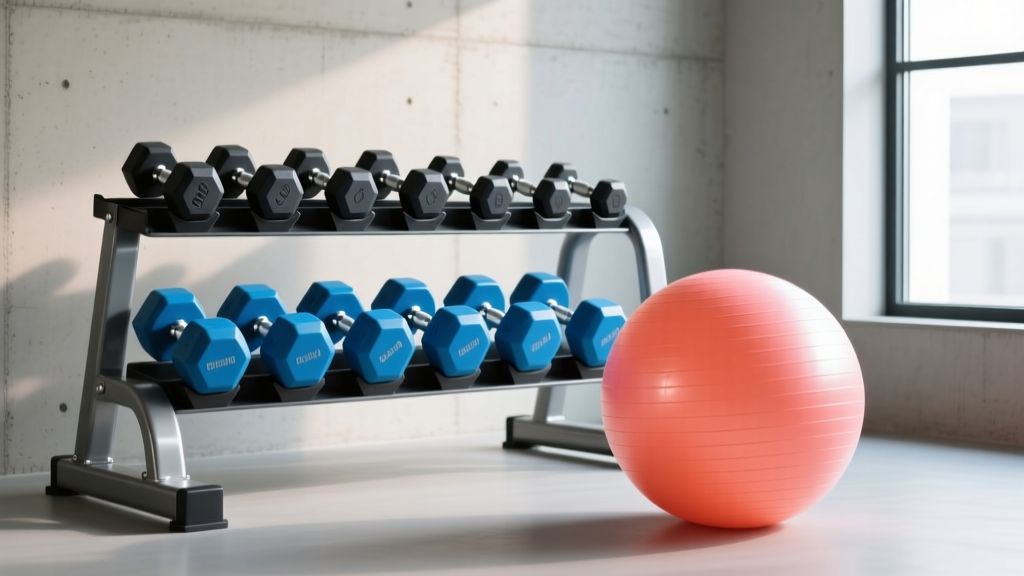
Integrating an exercise ball into your routine changes your spatial footprint. When performing dumbbell exercises with exercise ball setups—such as stability ball chest presses or hamstring curls—the ball can easily roll 3 to 4 feet from your center of mass.
Pro-Tip: The 360-Degree Clearance RuleAlways position your dumbbell rack at least 6 feet away from your primary exercise ball zone. If a user loses balance and the ball shoots backward, it should not strike the base of the dumbbell rack. Striking the base of a vertical tree stand with a loaded Swiss ball generates enough lateral force to tip a 400 lb rack, leading to catastrophic equipment damage and severe injury.
Cross-Contamination: Managing Dumbbell Coating Residue on Racks
The longevity of your rack is also tied to the condition of the dumbbells stored upon it. Virgin rubber and cheap neoprene dumbbells often degrade, leaving a sticky, black residue on the UHMW liners and steel shelves. This residue traps moisture against the metal, accelerating localized rust.
Safe Removal Techniques
- Isopropyl Alcohol (70%): Effective for breaking down rubber off-gassing residue without harming powder-coated finishes. Apply to a microfiber cloth, never spray directly onto the rack to avoid seepage into bolt threads.
- Mild Dish Soap & Warm Water: For urethane dumbbells that leave behind sweat and chalk buildup. Urethane is highly durable and won't degrade, but the chalk acts as an abrasive paste when pressed into the rack's shelving.
- Avoid Petroleum Solvents: Never use mineral spirits or paint thinners to clean rubber residue off your rack. These chemicals will strip the powder coat and degrade the UHMW plastic, causing it to become brittle and crack.
Expert Troubleshooting: Identifying Micro-Failures
How do you know if your rack is nearing the end of its structural life? Look for these specific edge-case warning signs:
- Visible Weld Cracking: Inspect the T-joints where the horizontal shelves meet the vertical uprights. Hairline fractures in the powder coat around the weld bead indicate metal fatigue. Stop using the rack immediately and contact the manufacturer for warranty replacement.
- Asymmetric Shelf Sag: Place a straight edge or a taut string across the front lip of the shelf. If the center deflects more than 3mm under no load, the steel tubing has permanently yielded and lost its structural integrity.
- Wobbling on Level Floors: If your rack rocks despite having adjustable rubber foot cups fully extended, the base frame may have twisted from uneven loading (e.g., storing all 100 lb dumbbells on one side). Rotate your stock to ensure even weight distribution across the rack.
Conclusion
Proper storage is the unsung hero of gym safety and equipment longevity. By maintaining your hardware, replacing worn UHMW contact points, and respecting the spatial requirements of dynamic movements, you ensure that your facility remains safe. Whether you are executing heavy presses or balancing through complex dumbbell exercises with exercise ball routines, a meticulously maintained rack guarantees that your gear is always ready, stable, and secure.
More gear to consider
All reviews
Olympic vs Standard Plates: Curing Wrist Pain From Dumbbell Curls

Olympic vs Standard Plates: Setup for the Lying Dumbbell Bicep Curl

Olympic vs Standard Plates: Setup & Dumbbell Slicey Guide
Dumbbell Rack Storage: Organophosphate Solvents to Avoid
Power Rack vs Squat Rack vs Stand for Compound Dumbbell Exercises