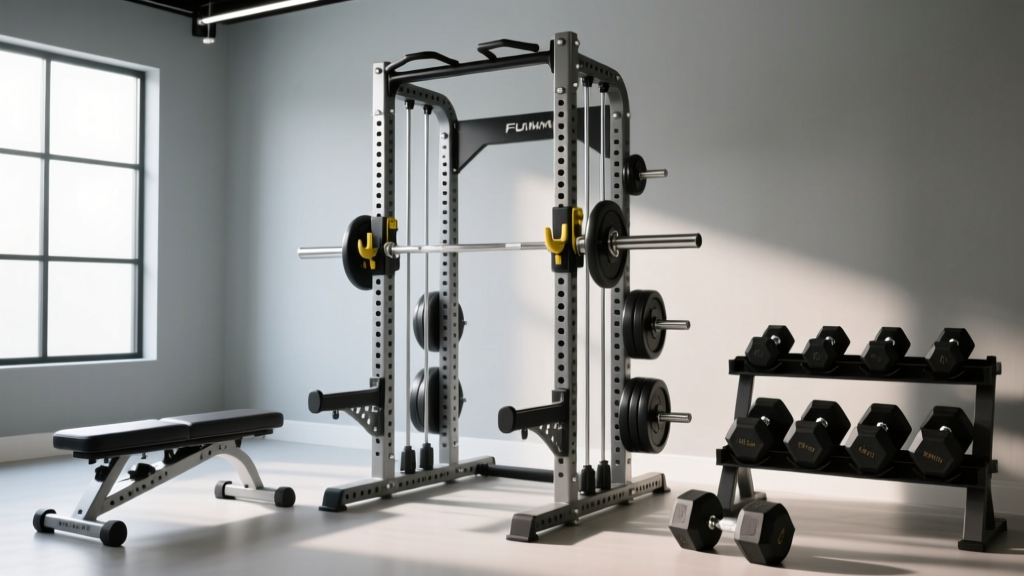
Power Rack vs Squat Stand: Best Dumbbell Lunge Alternative Setups
Compare power racks, squat racks, and squat stands to find the safest, most versatile setup for heavy leg days and dumbbell lunge alternatives.

The Leg Day Dilemma: Rack Footprints vs. Unilateral Movement
When outfitting a home gym in 2026, the debate between a power rack, a half squat rack, and minimalist squat stands usually centers on heavy bilateral lifts like the back squat. But a massive gap in home gym programming arises when athletes seek a highly effective dumbbell lunge alternative. Why move away from dumbbells? Because grip fatigue and stabilizer burnout often limit standard dumbbell lunges before your quads and glutes reach true mechanical failure.
To overload the lower body unilaterally, lifters transition to rack-based alternatives: Safety Squat Bar (SSB) split squats, barbell reverse lunges, or heavy elevated Bulgarian split squats. However, not all racks support these movements safely. A fully enclosed power rack might trap a barbell during a reverse lunge, while squat stands might lack the lateral safety catch area required for a failed SSB split squat. This guide breaks down the exact structural differences between power racks, squat racks, and squat stands to help you choose the safest, most versatile rig for unilateral leg training.
Defining the Contenders: Footprints and 2026 Baselines
Before analyzing movement compatibility, we must define the three primary categories of squatting equipment available on the current market, noting their average footprints and price ranges.
- Power Racks (Full Cages): Four-upright systems with front and rear crossmembers. Footprints typically range from 47"x47" to 53"x53". Pricing: $600–$1,500+.
- Half Racks (Squat Racks): Two main uprights with a rear stabilizer and weight storage horns. Footprints are usually 48" deep by 48" wide. Pricing: $450–$900.
- Squat Stands: Two independent or lightly braced uprights with minimal to no rear footprint. Footprints can be as small as 24"x48". Pricing: $200–$450.
Comparison Matrix: Unilateral Versatility and Safety
How do these three setups handle the biomechanical demands of lunge variations? The following table compares their utility for advanced unilateral training.
| Feature / Requirement | Power Rack (e.g., Titan T-3, Rep PR-4000) | Half Rack (e.g., Rogue HRX) | Squat Stand (e.g., Rogue SML-2C) |
|---|---|---|---|
| Barbell Reverse Lunge Clearance | Poor to Fair (Front crossmembers block bar path; requires stepping out of the cage) | Excellent (Open front allows seamless backward stepping) | Excellent (Zero footprint obstruction) |
| SSB Split Squat Safety | Excellent (Enclosed sandwich spotter arms catch forward/lateral dumps) | Good (Long spotter arms required to catch lateral shifts) | Poor (Narrow catch area; high risk of missing the spotter on failure) |
| Heavy DB/Kettlebell Floor Work | Fair (Interior space is limited by upright depth; bumping into crossmembers) | Good (Open front provides ample floor space for DB walking lunges) | Excellent (Unrestricted 360-degree floor access) |
| Weight Storage Integration | High (Rear and side storage keeps heavy DBs within reach) | High (Rear horns act as counterbalance and storage) | Low to None (Requires separate DB racks; stands can tip if overloaded) |
Top Dumbbell Lunge Alternatives and Rack Compatibility
To understand which rack you need, we must look at the specific mechanics of the best dumbbell lunge alternatives and how they interact with gym hardware. According to kinesiology data cataloged by ExRx.net, static and reverse lunges heavily target the quadriceps and gluteus maximus while reducing the shear force on the patellar tendon compared to forward walking lunges.
1. Safety Squat Bar (SSB) Split Squats
The SSB shifts the load anteriorly and sits higher on the traps, removing the grip and upper-back stabilization bottleneck of dumbbells. You can load an SSB split squat well over 200 lbs, far exceeding most lifters' dumbbell capacity.
⚠️ The Hip-Drop Failure Mode: When you fail a heavy SSB split squat, you don't drop straight down. Your front hip gives out, causing you to dump the bar forward and laterally. Squat stands are incredibly dangerous for this movement unless you are using 24-inch extended spotter arms. A Power Rack with 11-gauge steel sandwich-style safety straps or UHMW plastic-lined spotter arms is the only truly safe enclosure for max-effort SSB unilateral work.2. Barbell Reverse Lunges
Barbell reverse lunges allow for progressive overload without the grip limitations of heavy dumbbells. However, they require you to step backward 3 to 4 feet with a loaded barbell on your back.
- The Power Rack Problem: If you unrack inside a standard 47-inch deep power rack, the front crossmember will trip you as you step back. You must unrack and walk the bar out of the cage entirely, negating the benefit of having a cage.
- The Squat Stand Solution: Squat stands (like the Rogue SML-2C Monster Lite) paired with flip-down safety spotter arms are the gold standard here. You unrack, step back into open floor space, and if you fail, you simply dump the bar forward and step away.
3. Deficit Bulgarian Split Squats
Elevating the front foot on a 45lb bumper plate or a specialized wedge increases the range of motion, mimicking the deep stretch of a deficit reverse lunge. As noted in biomechanical analyses of Bulgarian Split Squats, the increased hip flexion demands greater glute engagement. This movement requires significant lateral floor space to prevent your elbow or dumbbell from clipping the uprights of a narrow squat stand. Half racks provide the best balance of open lateral space and structural stability for heavy dumbbell or kettlebell variations.
2026 Equipment Recommendations by Training Style
Based on current market offerings and structural engineering updates in 2026, here are the optimal configurations for different types of lifters.
The Heavy Unilateral Powerlifter: Rep Fitness PR-4000 Power Rack
If your primary dumbbell lunge alternative is the SSB split squat or heavy pin-squat lunge variations, you need a cage. The Rep Fitness PR-4000 ($899 base) features 1-inch hole spacing through the entire working zone, allowing you to set safety spotter arms at the exact micro-increment needed to catch a split-squat failure just below your lowest hip depth. Its optional no-front-crossmember configuration also allows you to perform barbell reverse lunges from inside the rack footprint.
The Olympic Weightlifter & Athlete: Rogue SML-2C Squat Stands
For athletes who use lunges as an accessory to cleans and snatches, open space is paramount. The Rogue SML-2C ($395) with the bolt-together base provides enough stability for re-racking heavy barbells, while the flip-down safeties allow for immediate escape during barbell walking or reverse lunges. Note: You must purchase separate dumbbell storage, as loading heavy plates onto the stand's base horns can create a tipping hazard during dynamic movements.
The Garage Gym Generalist: Titan Fitness T-2 Half Rack
Priced around $499, the T-2 Half Rack offers the rear weight storage necessary to keep 100lb+ dumbbells within arm's reach for heavy goblet lunges, while leaving the front completely open for barbell reverse lunges and walking variations. The 24-inch safety spotter arms provide adequate coverage for lateral failures during split squats.
Critical Safety Upgrades for Unilateral Lifts
Regardless of which rack you choose, performing lunge alternatives requires specific hardware upgrades to ensure safety in 2026:
- UHMW Plastic Liners: Unilateral failures are rarely vertical drops; they are violent, twisting dumps. Metal-on-metal contact between a knurled barbell and steel spotter arms will destroy your bar and risk a bounce-off. Ensure your safeties feature UHMW plastic liners.
- Sandwich-Style J-Cups and Safeties: Traditional L-bracket spotter arms have a narrow catch profile. Sandwich-style arms (which wrap around the upright) offer a 2-to-3-inch wider catch area, crucial for the lateral sway inherent in lunges and split squats.
- Spotter Arm Length: If using squat stands or half racks, never use standard 12-inch spotter arms for lunges. Upgrade to 18-inch or 24-inch arms to account for the forward momentum of a failed lunge.
Final Verdict: Which Rack Fits Your Leg Day?
Finding the right dumbbell lunge alternative is only half the battle; executing it safely requires the correct hardware. If your programming relies heavily on barbell reverse lunges and walking variations, abandon the power rack and invest in high-quality squat stands or a half rack to maximize floor clearance and escape routes. However, if you are chasing hypertrophy through max-effort SSB split squats and heavy static lunges, the enclosed safety of a power rack with micro-adjustable sandwich safeties is non-negotiable. Match your rack to your failure modes, and your leg days will be both more intense and infinitely safer.
More gear to consider
All reviews
Home Gym Setup: Plate Types & Lat Pulldown Alternative with Dumbbells

EZ Curl Bar vs Straight Bar: Trends & Barbell Row Dumbbell Shifts

EZ Bar vs Straight Bar Care for Your Dumbbell Functional Workout

Are Dumbbell Flyes Good? Protecting Gear With Proper Rack Storage

Loadable Dumbbell Care & Dumbbell Bench to Barbell Bench Calculator
