Power Rack vs Squat Rack vs Stand: Quick Upper Body Dumbbell Workout
We compare power racks, squat racks, and squat stands to find the best footprint for heavy barbell lifts and a quick upper body dumbbell workout.

The Hybrid Home Gym Dilemma: Heavy Steel vs. Dumbbell Agility
Building a home gym in 2026 requires balancing two competing needs: the absolute safety of heavy barbell lifting and the spatial freedom required for high-volume accessory work. When you are designing a space that must accommodate a 400-pound back squat but also seamlessly transition into a quick upper body dumbbell workout, the type of rack you choose dictates your entire training flow. A cumbersome cage can turn a fast-paced dumbbell superset into a frustrating game of bumper-car with steel uprights, while a minimalist stand might leave you vulnerable during heavy bench presses.
In this head-to-head comparison, we break down the Power Rack, the Half Squat Rack, and the Squat Stand. We will analyze exact dimensions, 2026 pricing, structural failure modes, and how each setup supports hybrid training routines.
Head-to-Head Comparison Matrix
| Feature | Power Rack (Rep PR-4000) | Half Rack (Titan T-3) | Squat Stand (Rogue SML-2C) |
|---|---|---|---|
| Footprint | 48' x 48' (Standard) | 48' x 34' (Open Front) | 30' x 24' (Minimalist) |
| Steel Gauge & Tubing | 11-Gauge, 3x3' | 11-Gauge, 3x3' | 11-Gauge, 3x3' |
| Avg. Price (2026) | $1,699 - $2,200 | $1,299 - $1,499 | $595 - $650 |
| Dumbbell Clearance | Restricted (Lateral) | Moderate (Front Open) | Unrestricted (360°) |
| Safety Spotting | Enclosed (Safest) | Front Spotter Arms | External Spotter Arms |
| Attachment Ecosystem | Massive (Cables, Pulleys) | High (Dip bars, Monolifts) | Low (J-cups, Spotter arms) |
The Power Rack: The Fortress of Solitude
Power racks, like the highly regarded Rep Fitness PR-4000, are four-post enclosed cages. They offer unparalleled safety for solo lifters because the barbell is contained within the uprights. If you fail a rep, the bar drops onto safety straps or pin-pipes without you having to roll it away.
The Dumbbell Workflow Constraint
While power racks are king for barbell work, they introduce a significant bottleneck for a quick upper body dumbbell workout: lateral clearance. Standard power racks have an interior width of about 42 inches and a depth of 24 to 48 inches. When you lay an adjustable bench inside the cage to perform dumbbell chest flyes or wide-grip dumbbell presses, your elbows or the dumbbell heads will frequently strike the rear or side uprights.
Expert Warning: Never perform explosive dumbbell movements inside a standard 24-inch deep power rack. The restricted ROM (Range of Motion) forces you to tuck your elbows unnaturally, shifting the biomechanical load away from the pectorals and onto the anterior deltoids.The Half Squat Rack: The Open-Front Compromise
Half racks, such as the Titan Fitness T-3 Series Half Rack, utilize two main front uprights supported by a heavy rear stabilizer base. This design removes the front cage barrier, creating an open training area.
Optimizing for Hybrid Workouts
The half rack is the ultimate bridge between heavy barbell safety and dumbbell freedom. By pulling your adjustable bench just six inches in front of the uprights, you gain complete lateral clearance for dumbbell flyes, Arnold presses, and lateral raises. Furthermore, half racks often feature weight storage horns on the rear stabilizer, allowing you to keep your hex or urethane dumbbells within arm's reach, minimizing rest times during high-density supersets.
- Pro: Open front allows for unhindered dumbbell arcs and easy entry/exit with heavy dumbbells.
- Con: Front-mounted spotter arms can become a tripping hazard if you are doing lunges or Bulgarian split squats in the same footprint.
The Squat Stand: The Minimalist's Canvas
Squat stands, like the Rogue SML-2C Squat Stands, are essentially two independent uprights. They possess the smallest footprint and the lowest price point, making them ideal for garage gyms under 150 square feet.
Unrestricted Dumbbell Training
When it comes to executing a quick upper body dumbbell workout, squat stands are vastly superior because they impose zero spatial limitations. You can position your bench at any angle, anywhere in the room. After finishing your heavy barbell squats, you simply rack the bar, push the bench out three feet, and you have a wide-open studio for your dumbbell circuit.
'The greatest advantage of squat stands isn't just the floor space you save; it's the mental separation of training zones. You use the stands for heavy CNS-taxing barbell lifts, and the open floor for metabolic dumbbell conditioning.' — Home Gym Engineering Principles, 2025
The Test: Executing the Quick Upper Body Dumbbell Workout
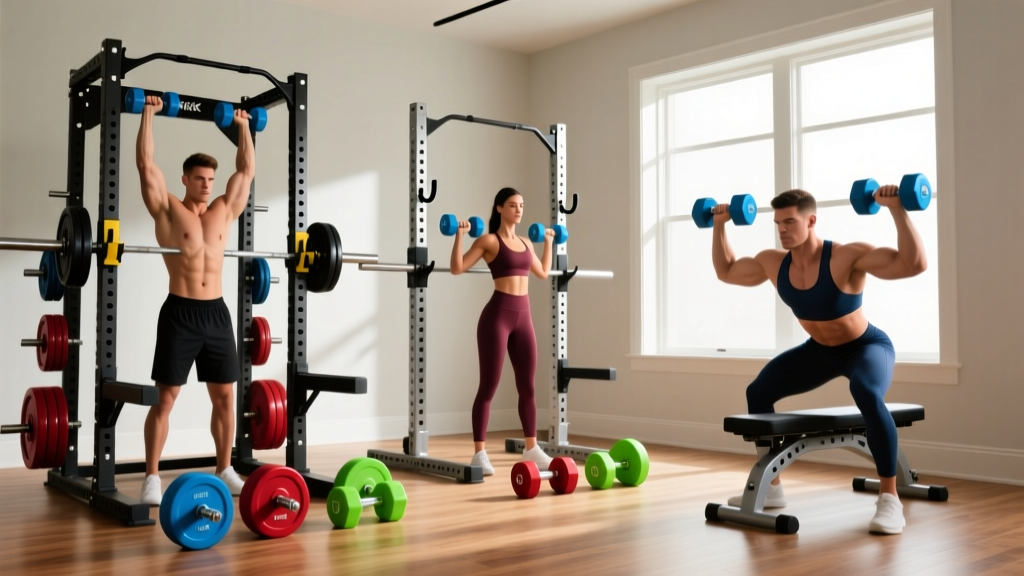
To truly evaluate these rigs, we must test them against a real-world scenario. Below is a 20-minute high-density upper body dumbbell workout designed to be paired with heavy barbell days. Here is how each rack handles the transition.
The Routine (4 Rounds, Minimal Rest)
- Heavy Dumbbell Bench Press: 6-8 reps (Requires bench positioning and heavy DB clean-to-knee).
- Incline Dumbbell Chest Flye: 10-12 reps (Requires wide lateral arm sweep).
- Seated Dumbbell Z-Press: 10 reps (Requires sitting flat on the floor, pressing overhead).
- Single-Arm Dumbbell Row: 8 reps per side (Requires bracing against a surface).
Rack Performance Breakdown
Power Rack: Grade: C-. Getting 80lb dumbbells into position for the bench press inside a cage is awkward. The incline flyes will hit the uprights unless you use a very narrow bench angle. The Z-Press is impossible inside the cage due to the overhead crossmembers. You must drag the bench out of the rack entirely, defeating the purpose of the setup.
Half Rack: Grade: A-. You can leave the bench just outside the uprights. The storage horns keep your dumbbells organized. You can use the rack's pull-up bar or uprights to brace for single-arm rows. Overhead pressing is clear as long as you step one foot forward.
Squat Stand: Grade: A+. Total freedom. You use the stands for your barbell work, then move to the center of the room for the dumbbell circuit. You can use the heavy steel base of the squat stand as a bracing point for your single-arm rows without worrying about scratching a powder-coated cage.
Safety, Failure Modes, and Edge Cases
While spatial freedom is critical for dumbbell work, we cannot ignore the primary purpose of a rack: keeping you alive under a barbell.
Edge Case: The Tipping Hazard
If you choose Squat Stands, you must understand the physics of racking a heavy barbell. If you rack a 300lb barbell aggressively on the J-cups, the forward momentum can tip the stands forward if they are not bolted to a platform or equipped with extended rear spotter arms and heavy weight storage. Conversely, Power Racks are virtually tip-proof due to their 4-post ground contact and massive footprint, but they present a 'shin-strike' hazard if you attempt dynamic footwork or agility drills inside the cage.
Final Verdict: Which Should You Buy?
Your decision ultimately hinges on the ratio of your barbell-to-dumbbell training and your available square footage.
- Buy the Power Rack if: You train alone 100% of the time, regularly max out on bench and squats, and plan to buy cable-pulley attachments. You are willing to sacrifice dumbbell fluidity for maximum barbell safety.
- Buy the Half Squat Rack if: You want the 'Goldilocks' solution. It provides enough enclosure for safe solo benching while offering the open-front clearance necessary for a seamless quick upper body dumbbell workout.
- Buy the Squat Stand if: You are on a strict budget (under $700), have a small garage, and prioritize functional fitness, dumbbell circuits, and Olympic lifting variations over heavy, solo powerlifting.
By matching your rack's geometry to your actual training habits, you eliminate friction from your workouts, ensuring that whether you are grinding out a 1-rep max or sweating through a rapid-fire dumbbell circuit, your equipment facilitates the work rather than obstructing it.
More gear to consider
All reviews
Barbell Collar vs Clamp: Securing One Dumbbell Exercises for Biceps

Comparing Space-Saving Types of Dumbbells: Loadable Sets

Calf Raises with Dumbbells: Adjustable Set Reviews & Setup Guide

Collar & Clamp Comparison: Dumbbell Single Leg Deadlift to Row

Power Rack vs Squat Rack: Wrist Curl Dumbbell Station Setup