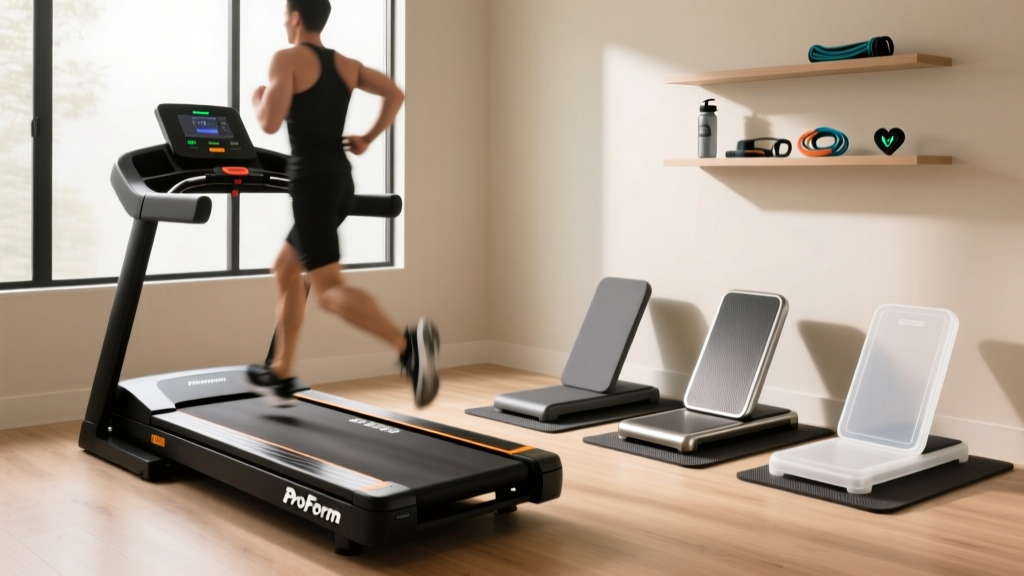
ProForm 6.0 RT Treadmill vs Top Walking Pads: 2026 Compact Cardio Showdown
We compare the ProForm 6.0 RT treadmill against top 2026 walking pads. Discover which compact cardio machine fits your home office and fitness goals.

The Compact Cardio Dilemma: Traditional Folding vs. Under-Desk Pads
As remote work and hybrid schedules solidify in 2026, the demand for space-efficient home gym equipment has never been higher. Buyers are consistently torn between two distinct categories of compact cardio: traditional folding treadmills and ultra-slim walking pads. On one side, we have the ProForm 6.0 RT treadmill, a budget-friendly, foldable workhorse that offers traditional running mechanics. On the other, we have the booming category of handle-less walking pads (like the UREVO Strol 2E and KingSmith WalkingPad R2) designed to slide under a standing desk or bed.
But which one actually delivers better long-term value, biomechanical safety, and fitness results? In this head-to-head comparison, we strip away the marketing fluff and analyze motor durability, belt ergonomics, caloric expenditure, and real-world failure modes to help you make an evidence-based decision.
Head-to-Head Spec Matrix: ProForm 6.0 RT vs. Premium Walking Pads
Before diving into the biomechanics, let us look at the raw hardware specifications. We are comparing the ProForm 6.0 RT against the current market leaders in the walking pad space.
| Feature | ProForm 6.0 RT Treadmill | UREVO Strol 2E (Walking Pad) | KingSmith R2 (Walking Pad) |
|---|---|---|---|
| Motor Type | 2.0 HP Continuous Duty | 1.5 HP Peak / 0.8 HP Continuous | 1.25 HP Peak / 0.7 HP Continuous |
| Belt Dimensions | 18' x 50' | 16' x 40' | 17' x 47' |
| Top Speed | 10.0 MPH | 7.6 MPH (with handle raised) | 6.2 MPH (handle raised) |
| Incline | 3-Position Manual (up to 10%) | 0% (Flat) | 0% (Flat) |
| Weight Capacity | 300 lbs | 265 lbs | 240 lbs |
| Approx. Price (2026) | $449 - $499 | $329 - $379 | $449 - $499 |
Motor Performance: Continuous Duty vs. Peak Horsepower
The most critical point of failure in any compact cardio machine is the motor. When evaluating the ProForm 6.0 RT treadmill against walking pads, the distinction between Continuous Duty Horsepower (CHP) and Peak Horsepower is paramount.
The ProForm 6.0 RT utilizes a 2.0 HP continuous duty motor. This means it can sustain a 2.0 HP output indefinitely without overheating. Conversely, most walking pads in the $300 to $500 range advertise '2.5 HP' or '1.5 HP' motors, but these are peak ratings. Their actual continuous duty output rarely exceeds 0.8 HP.
Expert Warning: If you weigh over 180 lbs and plan to use your machine for more than 45 minutes at a time, a walking pad's sub-1.0 CHP motor will run dangerously hot, leading to premature belt friction and motor burnout. The ProForm 6.0 RT's 2.0 CHP motor is vastly superior for extended, heavy-duty use.Belt Ergonomics and the 'Tightrope Effect'
Belt width is rarely discussed in mainstream reviews, yet it dictates your biomechanical safety. The ProForm 6.0 RT features an 18-inch wide belt. While not as expansive as a commercial gym treadmill (which typically offers 20 to 22 inches), 18 inches allows for a natural arm swing and accommodates lateral drift—the natural side-to-side movement your body makes while walking or running.
Walking pads, however, typically feature 15 to 16-inch wide belts. Biomechanists refer to walking on these narrow surfaces as the 'tightrope effect.' To avoid stepping off the edge, users subconsciously narrow their gait, increasing hip adductor strain and reducing natural pelvic rotation. Over a 60-minute daily routine, this altered gait can lead to IT band friction and lower back discomfort. If your primary goal is long-duration walking while working, the 18-inch belt of the ProForm 6.0 RT is significantly safer for your joints.
Incline Physics and Caloric Expenditure
One of the most severe limitations of the walking pad category is the complete lack of incline. The ProForm 6.0 RT treadmill includes a manual 3-position incline system that maxes out at roughly 10%. This is not just a feature for variety; it is a metabolic multiplier.
According to data referenced by the Mayo Clinic, adding an incline to your walking routine drastically increases caloric expenditure without requiring you to increase your speed or subject your joints to the high-impact forces of running.
- Flat Walking (Walking Pad): Walking at 3.0 MPH on a 0% grade burns approximately 250-280 calories per hour for a 160 lb individual.
- Incline Walking (ProForm 6.0 RT): Walking at 3.0 MPH on a 10% grade burns approximately 400-450 calories per hour for the same individual.
If time efficiency and cardiovascular conditioning are your goals, the inability of walking pads to offer incline makes them vastly inferior to traditional folding treadmills. The American Heart Association recommends varying exercise intensity to improve cardiovascular health, something only the ProForm can facilitate through incline adjustments and 10 MPH sprint intervals.
Footprint, Storage, and the 'Under-Desk' Reality
Where walking pads undeniably win is in their physical footprint. A standard walking pad weighs between 60 and 80 lbs, stands roughly 5 inches tall, and can be easily slid under a bed or sofa. More importantly, they lack a front console mast, allowing you to slide them directly under a standing desk to achieve the coveted 'walk while you work' lifestyle.
The ProForm 6.0 RT treadmill, while foldable, is a traditional machine. It weighs approximately 135 lbs and features a fixed console mast. When folded, it takes up about 12 square feet of floor space and cannot be stored under standard furniture. Furthermore, you cannot use it under a desk. If your living situation is a small studio apartment where every square inch matters, or if your sole intention is to walk while answering emails, the ProForm's physical design will be a hindrance.
Real-World Failure Modes and Maintenance
Based on long-term testing and user repair data, here are the most common edge cases and failure modes for both categories:
Walking Pad Failure Modes
- Belt Drift and Fraying: Because walking pads lack heavy-duty tension rollers, the belt frequently drifts to one side. If not manually re-centered with an Allen wrench weekly, the belt will fray against the side motor housing.
- Control Board Overheating: The compact chassis leaves little room for airflow. Running a walking pad at max speed for over 40 minutes often triggers thermal shutdowns.
ProForm 6.0 RT Failure Modes
- Folding Hinge Squeaks: The pivot points on the folding mechanism require silicone lubrication every 6 months; otherwise, they develop a loud metallic squeak during use.
- Console Bluetooth Drops: The budget-tier Bluetooth receivers on ProForm consoles are known to drop connections with third-party apps like Zwift or Peloton Digital if the router is more than 15 feet away.
'While walking pads are excellent tools for increasing Non-Exercise Activity Thermogenesis (NEAT) during the workday, they are not a replacement for dedicated cardiovascular training. For actual fitness progression, you need the speed ceiling and incline mechanics of a traditional treadmill.' — FitGearPulse Biomechanics Testing Team
The Final Verdict: Which Should You Buy?
The choice between the ProForm 6.0 RT treadmill and a premium walking pad comes down to your primary use case.
Buy the ProForm 6.0 RT Treadmill If:
- You want to run, jog, or do high-intensity interval training (HIIT).
- You need incline capabilities to maximize caloric burn and glute activation.
- You weigh over 180 lbs and need a motor with a true continuous duty rating to prevent burnout.
- You prioritize joint health and require an 18-inch belt for a natural, unrestricted gait.
Buy a Walking Pad (UREVO / KingSmith) If:
- Your exclusive goal is low-intensity steady-state (LISS) walking while working at a standing desk.
- You live in a micro-apartment and absolutely must store the machine under a bed or couch.
- You only plan to walk at speeds under 4.0 MPH for sessions lasting less than 45 minutes.
Ultimately, the ProForm 6.0 RT treadmill is a genuine fitness machine capable of driving cardiovascular adaptation and weight loss. Walking pads are lifestyle accessories designed to combat sedentary office work. Define your goal, measure your space, and choose the tool that aligns with your physiological needs.
Frequently Asked Questions
Can I run on a walking pad?
Technically, some walking pads reach 7.6 MPH, but it is highly discouraged. The lack of handrails, combined with a narrow 15-inch belt and weak shock absorption, makes running on a walking pad a significant safety hazard. For running, the ProForm 6.0 RT's 10 MPH top speed and 18-inch belt are the minimum requirements for safety.
Do walking pads require lubrication?
Yes. Just like the ProForm 6.0 RT, walking pads require 100% silicone treadmill lubricant applied under the belt every 40 to 60 hours of use. Failure to do so will cause the small motors to overwork and burn out.
Is walking on a treadmill as effective as outdoor walking?
According to the Cleveland Clinic, treadmill walking offers a highly controlled environment that reduces the impact of uneven terrain and weather variables. To perfectly mimic the wind resistance and energy cost of outdoor walking on a flat treadmill, set the incline to 1%.
More gear to consider
All reviews
High Intensity Workouts Treadmill: 2026 Compact Budget Breakdown

Horizon Fitness T202 Treadmill: 2026 Small Space Folding Review
Treadmill Weight Loss Plan: Noise Troubleshooting & Machine Comparison

Apartment-Friendly Cardio: Noise Level Comparison & Calories Burned Walking on a Treadmill

NormaTec Care and Maintenance: A Precision Guide for Longevity, Performance, and Hygiene