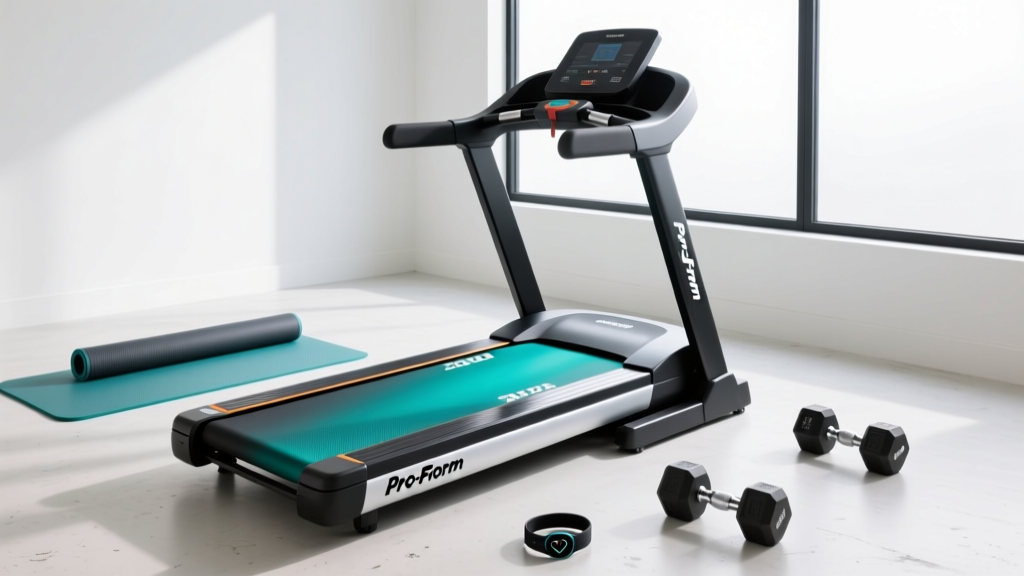
Pro-Form Treadmill Manual: 2026 Belt Maintenance Trends
Explore 2026 market trends in cardio maintenance. Our Pro-Form treadmill manual analysis covers belt lubrication, friction sensors, and deck care.

The Evolution of Home Treadmill Maintenance
If you have ever thumbed through a legacy Pro-Form treadmill manual, you likely noticed a recurring, often-ignored directive: lubricate the walking belt every 130 miles or three months. For years, this was the gold standard of home cardio maintenance. However, as we navigate the 2026 fitness equipment market, the paradigm of treadmill belt maintenance and lubrication has fundamentally shifted. Driven by advancements in materials science and the integration of smart-home telemetry, the gap between what older manuals prescribe and what modern machines actually require has never been wider.
According to market analyses reported by Club Industry, the home cardio sector has seen a massive pivot toward 'low-friction' and 'maintenance-free' technologies, trickling down from commercial health clubs to consumer-grade living rooms. Yet, millions of legacy and mid-tier Pro-Form models (such as the Performance 800 and early SMART Pro series) remain in active use, relying on traditional phenolic decks and silicone lubrication. Understanding the intersection of legacy manual guidelines and 2026 diagnostic trends is critical for maximizing equipment lifespan and avoiding catastrophic motor burnout.
2026 Market Matrix: Legacy vs. Next-Gen Deck Technologies
To understand where maintenance is heading, we must first analyze the hardware currently dominating the market. The traditional Pro-Form treadmill manual was written for MDF (Medium-Density Fiberboard) or basic phenolic resin decks. Today's premium models utilize advanced composites that drastically alter lubrication schedules.
| Feature | Legacy Decks (Pre-2022 Models) | 2026 Smart/Composite Decks |
|---|---|---|
| Core Material | MDF with Phenolic Coating | Polyurethane-Infused Composites |
| Lubricant Type | 100% Liquid Silicone | Factory Wax-Impregnated / Dry |
| Friction Tracking | Manual Mileage Tracking | Real-Time Motor Amperage Sensors |
| Maintenance Interval | Every 130 miles / 3 months | 10,000+ miles / Lifecycle |
| Failure Mode | Heat warping, belt delamination | Edge-fraying, sensor calibration drift |
As highlighted by iFIT Support (the parent company and software provider for Pro-Form), newer models equipped with advanced telemetry can now detect micro-changes in motor draw, alerting the user via the companion app exactly when lubrication or belt tensioning is required, effectively rendering the static mileage intervals found in older manuals obsolete.
Decoding the Pro-Form Treadmill Manual for Legacy Models
For owners of the ProForm Carbon TL, SMART Pro 2000, or similar legacy models, the original manual remains your primary baseline. However, the manuals often lack the granular, real-world execution details required for optimal results. Here is the expert-level breakdown of the lubrication process that goes beyond the printed page.
The Chemistry of Silicone: What to Use and What to Avoid
The manual specifies 'silicone lubricant.' It does not always emphasize the catastrophic risk of using the wrong variant. You must use 100% pure liquid silicone (specifically formulated for treadmill decks).
- Never use WD-40 or Petroleum Distillates: These will instantly dissolve the phenolic coating on the deck and degrade the rubber backing of the walking belt, leading to a $200+ replacement cost.
- Avoid Aerosol Sprays with Propellants: Many generic 'silicone sprays' contain butane or propane propellants that dry out the belt. Always use liquid silicone with an applicator wand.
- Cost Expectation: A high-quality 4oz bottle of 100% treadmill silicone (such as the official iFIT/Pro-Form brand or Horizon Fitness equivalent) costs between $12 and $18 in 2026. This is enough for 8 to 10 applications.
Step-by-Step Precision Application
- Loosen the Belt: Using the provided Allen wrench, turn the rear roller adjustment bolts counter-clockwise. Count the exact number of turns (usually 3 to 4 full rotations) so you can re-tension it accurately later.
- The Applicator Wand: Slide the lubricant wand under the belt, starting from the center of the deck and moving outward toward the left edge.
- Exact Dosage: Squeeze exactly 0.5 ounces (15 ml) of silicone in a zig-zag pattern. Repeat for the right side. Over-lubrication is a common error; excess silicone will sling out onto the motor hood and floor, creating a slip hazard and attracting dust that forms an abrasive paste.
- Re-tension and Distribute: Tighten the bolts clockwise by the exact number of turns you loosened them. Power the machine on to 3.0 MPH and walk on the belt for 5 minutes to distribute the silicone evenly across the deck.
Advanced Diagnostics: The Amperage & Tug Tests
In 2026, relying purely on a calendar or mileage tracker is considered an outdated maintenance strategy. Domain experts and commercial technicians now rely on physical and electrical diagnostics to determine belt health, an approach increasingly endorsed by fitness equipment certification bodies like ACE Fitness.
The Clamp Meter Amperage Test
The most accurate way to read the 'invisible' friction of your treadmill is by measuring the motor's electrical draw. If your Pro-Form model has an exposed motor compartment or a diagnostic port:
- Normal Walking Draw (3.0 MPH): 3 to 6 Amps.
- Warning Zone (Needs Lubrication): 8 to 10 Amps. The motor is working 40% harder than necessary, generating excess heat that will warp the deck.
- Critical Zone (Immediate Shutdown): 12+ Amps. At this level, the thermal breaker will trip, or the motor control board (MCB) will suffer permanent thermal damage. A replacement MCB for a ProForm SMART Pro 2000 costs upwards of $350.
The 'Tug Test' vs. The 'Slip Test'
Users frequently confuse belt slippage with high friction. If you are running at 7.0 MPH and the belt stutters or 'skips' under your foot, your first instinct might be to lubricate. This is often a mistake.
'Slippage is a tension issue, not a lubrication issue. If the front motor roller is turning but the belt is not, adding silicone will only act as a release agent, making the slippage worse and potentially causing the user to fall.' — Commercial Cardio Technician Guidelines, 2025.
To verify tension, perform the Tug Test: With the machine off, reach under the side of the belt at the midpoint. You should be able to lift the belt exactly 1.5 to 2 inches off the deck. If you can lift it 3 inches or more, it is too loose and requires a half-turn clockwise on both rear tension bolts. If you cannot lift it at least an inch, it is over-tensioned, which will destroy the rear roller bearings within 50 miles.
Cost Analysis: Preventative Maintenance vs. Reactive Repair
Viewing treadmill maintenance through a financial lens reveals why the 2026 market is aggressively pushing toward self-lubricating decks. However, for the millions of existing manual-lube machines, the math heavily favors strict adherence to the Pro-Form treadmill manual's guidelines.
| Component | Preventative Cost (Annual) | Reactive Replacement Cost (2026 Pricing) |
|---|---|---|
| Silicone Lubricant | $15 - $25 | N/A |
| Walking Belt & Deck Kit | N/A | $180 - $280 (plus 2 hours labor) |
| Drive Motor | N/A | $350 - $500 |
| Motor Control Board | N/A | $250 - $400 |
A $20 annual investment in high-grade silicone and tension checks insures against nearly $1,000 in potential drivetrain failures. Furthermore, a poorly lubricated belt forces the motor to draw excess current from your home's electrical supply, subtly increasing your energy consumption—a factor that matters more in 2026 as global energy prices fluctuate.
Future Outlook: The End of the Manual Schedule?
As we look toward the next generation of Pro-Form and iFIT-integrated treadmills, the physical act of applying liquid silicone is being engineered out of the user experience. Prototype models showcased at recent fitness expos feature micro-reservoirs embedded within the deck rails that automatically release microscopic amounts of dry PTFE (Teflon) dust based on real-time friction telemetry.
Until these commercial-grade innovations become standard in sub-$1,500 consumer models, the traditional Pro-Form treadmill manual remains a vital document. However, by augmenting the manual's baseline instructions with modern amperage testing, precise chemical selection, and tension diagnostics, home users can achieve commercial-level reliability and extend the functional lifespan of their cardio equipment well beyond the standard warranty period.
More gear to consider
All reviews
AirGo Curve Treadmill vs Motorized: Troubleshooting Guide

Best 2-in-1 Walking Pads 2026: Treadmill Magnetic Key Compared

Walking Pad vs Treadmill Setup & ProForm Treadmill Belt Lube Guide

2026 Trends: The Folding Interval Running Workout Treadmill Review

Treadmill or Exercise Bike? Motor Size & Setup Guide
