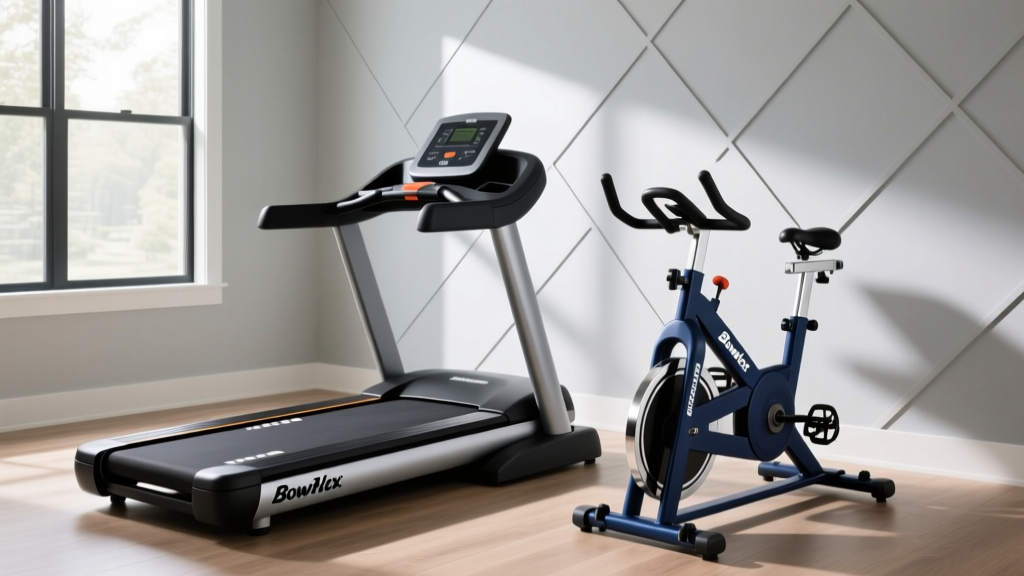
Space Layouts: Bowflex 216 Treadmill & Stationary Bike Types
Optimize your home gym layout. Compare footprints of the Bowflex 216 treadmill and stationary bike types (upright, recumbent, spin) for space-saving designs.

The Spatial Dilemma: Anchoring Your 2026 Home Gym
Designing a functional home gym is less about buying the most expensive equipment and more about mastering spatial geometry. When your cardio arsenal includes a heavy-duty anchor piece like the Bowflex 216 treadmill alongside secondary cycling equipment, poor layout planning can lead to cramped workflows, tripping hazards, and violated safety clearances. According to ACE Fitness, inadequate equipment spacing is a leading cause of home gym injuries and reduced workout consistency.
The Bowflex 216 treadmill is a premium, high-output machine featuring a 60-inch running belt and a robust 3.5 CHP motor. While it offers exceptional performance, its physical footprint demands respect. Pairing it with the right stationary bike requires a strategic approach to space optimization. In this guide, we break down how to integrate the Bowflex 216 treadmill with various stationary bike types (upright, recumbent, and spin) to maximize your floor plan without sacrificing safety or ergonomics.
Footprint Matrix: Equipment Dimensions and Clearances
Before moving a single piece of equipment, you must map the 'active footprint'—the physical dimensions of the machine plus the mandatory safety clearance required for mounting, dismounting, and emergency egress. Below is a comparative matrix for 2026's standard cardio configurations.
| Equipment Type | Model Example | Base Footprint (L x W) | Mandatory Safety Clearance | Total Active Zone |
|---|---|---|---|---|
| Treadmill (Anchor) | Bowflex 216 treadmill | 78' x 34' | 24' sides / 30' rear | 126' x 82' |
| Upright Bike | Schwinn IC4 / Bowflex C6 | 48' x 21' | 12' all sides | 72' x 45' |
| Recumbent Bike | Nautilus R618 | 65' x 28' | 15' sides / 20' front | 85' x 58' |
| Spin / Indoor Cycle | Peloton Bike+ / Keiser M3i | 48' x 24' | 12' sides / 18' front | 72' x 48' |
Deep Dive: Stationary Bike Types in Tight Layouts
Choosing between stationary bike types—upright, recumbent, and spin—drastically alters your room's traffic flow. Each type interacts differently with the spatial dominance of a treadmill.
Upright Bikes: The Vertical Advantage
Upright bikes mimic traditional outdoor cycling geometry. Because the pedals are positioned directly beneath the user's center of gravity, the base footprint is remarkably compact. Space Optimization Strategy: Upright bikes are ideal for 'dead zones' in your gym, such as the corner adjacent to the treadmill's front motor hood. Since the user mounts from the side or rear, you can tuck an upright bike into a 3x4 foot alcove, provided the handlebars do not clip the treadmill's console when turned.
Recumbent Bikes: Managing the Horizontal Sprawl
Recumbent bikes feature a bucket seat and forward-mounted pedals, offering superior lumbar support but demanding a massive horizontal footprint. Space Optimization Strategy: Never place a recumbent bike parallel to the Bowflex 216 treadmill in a narrow room; it will create a 'bowling alley' effect that restricts movement. Instead, use an L-shaped layout. Place the treadmill on the primary long wall, and position the recumbent bike on the perpendicular wall, facing the center of the room. This allows the user to mount the recumbent bike from the open side without stepping into the treadmill's rear egress zone.
Spin Bikes: High-Density Placement
Spin bikes (indoor cycles) are heavy, rigid, and feature a small footprint dominated by the flywheel. Space Optimization Strategy: Spin bikes are the most layout-friendly option to pair with the Bowflex 216 treadmill. Because they do not require electrical outlets (if magnetic/manual) and feature transport wheels, they can be stored in a closet or pushed flush against a wall when not in use. During active use, they can be positioned at a 45-degree angle in the corner opposite the treadmill, maximizing central floor space for stretching or dumbbell work.
Blueprint Scenarios: Real-World Room Layouts
Let's apply these dimensions to two common home gym spaces to see how the Bowflex 216 treadmill and stationary bike types coexist.
Scenario 1: The 12x12 Spare Bedroom (144 Sq. Ft.)
A 12x12 room is the absolute minimum viable space for this combination.
- Treadmill Placement: Center the Bowflex 216 treadmill on the North wall. This leaves exactly 27 inches of clearance on either side (assuming a standard 144-inch wall), satisfying the 24-inch side clearance rule.
- Bike Selection: You must choose a Spin Bike or a compact Upright Bike. A recumbent bike will consume the remaining egress path.
- Bike Placement: Place the spin bike in the Southeast corner, angled toward the West wall. This keeps the bike out of the 30-inch rear egress zone of the treadmill and leaves the center of the room open for a yoga mat.
Scenario 2: The Garage Corner Bay (10x20 Usable)
Garages offer length but limited width.
- Treadmill Placement: Run the Bowflex 216 treadmill parallel to the long (20-foot) wall, leaving 3 feet of space behind the belt for a doorway or workbench.
- Bike Selection: Any stationary bike type works here, including a recumbent.
- Bike Placement: Position the recumbent bike perpendicular to the treadmill, near the garage door, creating a dedicated 'cycling zone' that benefits from natural light and cross-breeze ventilation.
Critical Infrastructure: Electrical and Flooring Clearances
Space optimization isn't just about square footage; it's about infrastructure mapping. The American Heart Association emphasizes creating a safe, dedicated environment for cardiovascular training to prevent environmental hazards.
Electrical Load Mapping:
The Bowflex 216 treadmill draws significant current, typically requiring a dedicated 15-amp or 20-amp 120V circuit. If you plug a smart upright bike (like the Bowflex C6 or Schwinn IC4) into the same outlet strip, you risk tripping the breaker mid-workout when the treadmill motor surges during an incline sprint. Rule of thumb: Map your treadmill to a dedicated wall outlet, and route smart bikes to a separate circuit or a verified low-draw power strip on an adjacent wall.
Sub-Flooring and Vibration Dampening:
When placing heavy cardio machines in multi-story homes or over hardwood, vibration transfer is a major spatial constraint (as it dictates where you can't put the gear).
- Under the Bowflex 216 treadmill: Use a 3/4-inch thick, high-density vulcanized rubber horse stall mat. Standard 3/8-inch EVA foam will compress under the 250+ lb machine and cause the deck to wobble.
- Under Spin/Upright Bikes: A 1/4-inch PVC equipment mat is sufficient to catch sweat and prevent the bike's leveling feet from denting hardwood floors.
Frequently Asked Questions
Can I fold the Bowflex 216 treadmill to make room for a recumbent bike?
While the Bowflex 216 treadmill features a folding deck mechanism, folding it only reduces the length footprint, not the width or height. Furthermore, daily folding and unfolding of a premium treadmill accelerates wear on the hydraulic lift struts. For space optimization, treat the treadmill as a permanent fixture and design the bike's layout around its active, unfolded dimensions.
Which stationary bike type is easiest to move for cleaning?
Spin bikes and magnetic upright bikes are generally equipped with front-mounted transport wheels. By tilting the frame back, you can easily roll them out of the way to vacuum or mop. Recumbent bikes lack transport wheels and possess a low, sprawling center of gravity, making them notoriously difficult to move without scratching the floor or straining your lower back.
How much overhead clearance do I need above the treadmill and bikes?
Measure the height of the tallest user in your home, then add 18 inches. For the Bowflex 216 treadmill, the deck sits approximately 8 to 10 inches off the ground, and the incline mechanism can raise the front hood by another 6 inches. If your ceiling is a standard 8 feet (96 inches), a user taller than 6'2' will risk head strikes during high-incline sprints. Stationary bikes require less overhead clearance, but ensure ceiling fans or pendant lights are at least 24 inches above the highest handlebar position.
More gear to consider
All reviews
Curved vs Motorized Treadmills: Silicone Based Lubricant Needs

Stepper or Treadmill? 2026 Home Stair Climber Guide

Rowing Machine Buying Guide & Technique: NordicTrack Commercial 1750 Treadmill Dimensions Compared
Walking Pad vs Treadmill: Mistakes During an Hour on the Treadmill

Motor Size Guide: Is It OK to Run Barefoot on a Treadmill?
