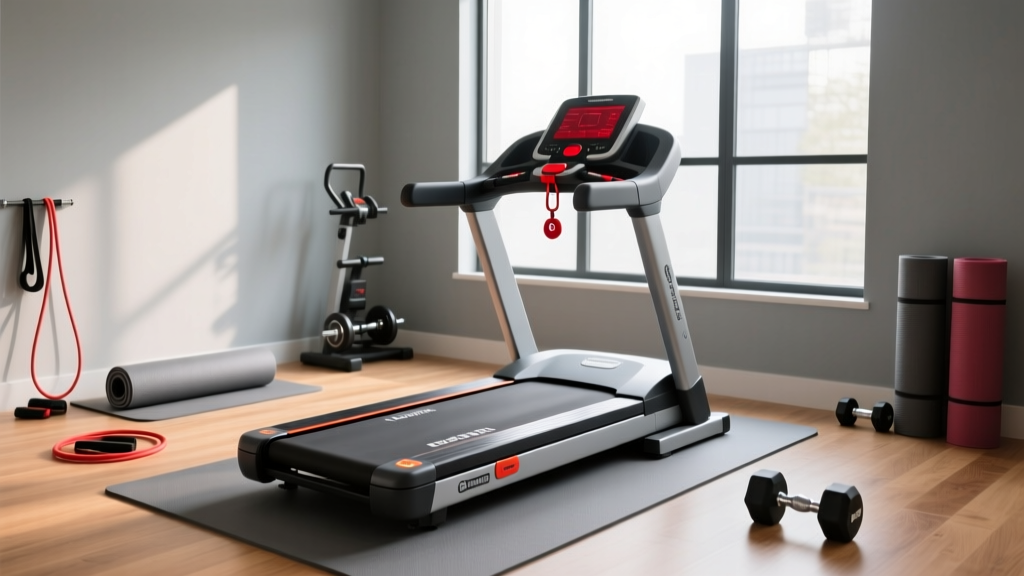
Prevent Treadmill Accidents: Beginner's Guide to Safety Features
Learn how to prevent treadmill accidents with our beginner's step-by-step buying guide. Compare safety features, motors, and belts to buy with confidence.

Why Treadmill Safety Must Dictate Your Purchase
When shopping for your first home cardio machine, it is easy to get distracted by touchscreen displays and built-in streaming apps. However, ignoring mechanical safety features is a primary reason why treadmill accidents remain a leading cause of home gym injuries. According to the U.S. Consumer Product Safety Commission (CPSC), treadmills are responsible for roughly 22,500 emergency room visits annually, with friction burns, sudden speed mismatches, and motor stalls accounting for the majority of incidents.
If you are a beginner stepping into the home fitness market, this step-by-step buying guide will teach you how to compare treadmill safety features. By understanding the mechanics beneath the hood, you can confidently select a machine that protects you and your family.
⚠️ Critical Warning for Beginners: Never assume all treadmills stop the same way. A sudden belt stop or unexpected acceleration due to a cheap motor controller is a leading mechanical cause of treadmill accidents. Always test the emergency stop mechanism before buying.Step 1: Decode the Emergency Stop Mechanisms
The first feature to compare is how the machine halts when you lose your footing. There are two primary technologies on the market in 2026:
1. The Traditional Magnetic Lanyard
Found on 90% of budget to mid-range treadmills (like the Horizon T101, priced around $599), this system uses a physical red magnetic key attached to a clip. You clip it to your shirt; if you drift backward, the key pulls out, cutting power to the motor.
Pros: Foolproof, mechanical, requires no software updates.
Cons: The cord can snag on loose clothing, and users often forget to clip it, rendering the safety feature useless.
2. Camera-Based Auto-Pause Technology
Pioneered by premium brands and now standard on machines like the Peloton Tread+ ($2,495), this system uses an infrared depth sensor or camera to monitor your position on the deck. If you step off the belt or drift too far back, the software automatically ramps the speed down to 0 mph over 3 seconds.
Pros: No physical tether required; highly intuitive.
Cons: Can occasionally trigger false pauses if a pet walks behind the machine; relies on software stability.
Step 2: Analyze Belt Ply and Deck Friction
Slipping is a major contributor to treadmill accidents, often caused by a worn or poorly manufactured running belt. When comparing treadmills, look closely at the belt's ply rating and thickness.
- 1-Ply Belts: Usually found on sub-$400 walking pads. These are thin (around 1.2mm), prone to stretching, and can slip under the foot during sudden acceleration.
- 2-Ply Belts (The Beginner Minimum):strong> Standard on reliable mid-range models like the Sole F63 ($999). These belts are roughly 2.0mm to 2.5mm thick, featuring a woven cotton/polyester underside that grips the deck and a textured rubber top that grips your shoes.
- 4-Ply / Commercial Belts: Found on $2,000+ machines. They are incredibly durable but require heavy-duty motors to drive them.
Expert Tip: Check the deck lubrication system. The American Academy of Orthopaedic Surgeons (AAOS) notes that improper deck friction causes erratic belt movement. Look for treadmills with pre-lubricated silicone decks or easy-access side bolts for tensioning, ensuring the belt doesn't drift left or right while you run.
Step 3: Match Motor CHP to Your Body Weight
This is the most misunderstood specification in treadmill buying guides, and ignoring it leads to a dangerous failure mode known as the "stall and jolt."
The "Stall and Jolt" Failure Mode
If a 220 lb user runs at 7 mph on a treadmill with an underpowered 2.0 HP (Horsepower) motor, the motor may struggle to push the belt under the user's weight. The belt momentarily slows down (stalls), the motor controller senses the voltage drop and surges power to compensate, causing the belt to suddenly lurch forward (jolt). This sudden speed mismatch throws the user off balance, resulting in severe treadmill accidents.
How to Compare Motor Specs:
Always look for CHP (Continuous Horsepower), not Peak HP. Peak HP only measures the motor's output for a fraction of a second.
The CHP Rule of Thumb for 2026
- Walkers (Under 180 lbs): 2.0 CHP minimum.
- Joggers (180 - 220 lbs): 2.75 CHP minimum (e.g., NordicTrack T Series 10, ~$799).
- Runners (Over 220 lbs): 3.25 CHP minimum (e.g., Sole F80, ~$1,199).
Step 4: Evaluate Handrail Ergonomics and Console Reach
While the Consumer Reports Treadmill Buying Guide heavily emphasizes motor and deck size, beginners often overlook the physical geometry of the console. If you have to lean forward excessively to change the speed or incline, you shift your center of gravity, increasing the risk of a foot catching the front motor hood.
What to look for:
1. Quick-Dial Knobs: Models with physical speed/incline dials on the handrails (like those found on Life Fitness and high-end Sole models) allow you to adjust settings without letting go of the rails or leaning forward.
2. Sweat-Resistant Grips: Rubberized, textured handrails prevent your hands from slipping if you need to brace yourself suddenly.
2026 Safety Feature Comparison Matrix
To help you visualize how these features stack up across different price points, here is a comparison of three popular beginner-to-intermediate treadmills, evaluated strictly on safety and stability metrics.
| Feature / Model | Horizon T101 ($599) | Sole F63 ($999) | NordicTrack 1750 ($1,799) |
|---|---|---|---|
| Motor (CHP) | 2.5 CHP (Good for walking/light jogging) | 3.0 CHP (Excellent for steady running) | 3.5 CHP (Commercial grade, zero jolt) |
| Belt Construction | 1-Ply (Requires frequent tension checks) | 2-Ply (High grip, low slip risk) | 2-Ply Commercial (Maximum durability) |
| Emergency Stop | Magnetic Lanyard | Magnetic Lanyard + Auto-Shutoff | Magnetic Lanyard + Smart Pause |
| Handrail Controls | None (Console only) | Speed & Incline Buttons | Speed Dials & Incline Rockers |
| Accident Risk Level | Moderate (if user exceeds weight limit) | Low | Very Low |
Step 5: Post-Purchase Calibration and Maintenance
Buying a safe treadmill is only half the battle. The CPSC strongly recommends regular maintenance to prevent mechanical failures that lead to treadmill accidents. As a beginner, add these three steps to your calendar immediately after assembly:
- The 30-Day Tension Check: New belts stretch as the fibers break in. After 30 days, use the included Allen wrench to tighten the rear roller bolts exactly one-quarter turn on each side to prevent lateral drifting.
- Silicone Lubrication: Unless your manual explicitly states the deck is "maintenance-free," apply 100% pure silicone treadmill lubricant under the belt every 150 miles. Dry decks create massive friction, which can overheat the motor controller and cause sudden shutdowns.
- Clearance Zone Enforcement: Establish a strict 3-foot clearance zone behind the treadmill. If a user falls, sliding into a wall or furniture piece turns a minor scrape into a severe impact injury.
Final Expert Takeaway: Do not compromise on the motor or the belt ply to save $100 on a touchscreen. The most effective way to prevent treadmill accidents is to buy a machine with a 3.0 CHP motor and a 2-ply belt, ensuring the hardware can physically handle your momentum without software intervention.
By following this step-by-step comparison guide, you can look past the marketing hype and evaluate the mechanical realities of home cardio equipment. Prioritize grip, continuous power, and reliable stopping mechanisms, and you will build a home gym that is as safe as it is effective.
More gear to consider
All reviews
Calibrating a Good Speed for Treadmill & Stationary Bike Types Care

Under Desk Treadmill for Office Use: Animated Treadmill Reviews

ProForm 2000 Treadmill Review: Curved vs Motorized Mistakes

Is Treadmill Bad for Knees? Curved vs Motorized Guide (2026)

How to Lose Weight on a Treadmill Fast: Compact Portable Picks
