Power Rack vs Squat Rack vs Stand: Cable Lateral Raise vs Dumbbell
Compare power rack vs squat rack vs squat stand. Discover which rig supports heavy squats and cable lateral raise vs dumbbell isolation workouts.

The Foundation of Your Home Gym: Rack Taxonomy in 2026
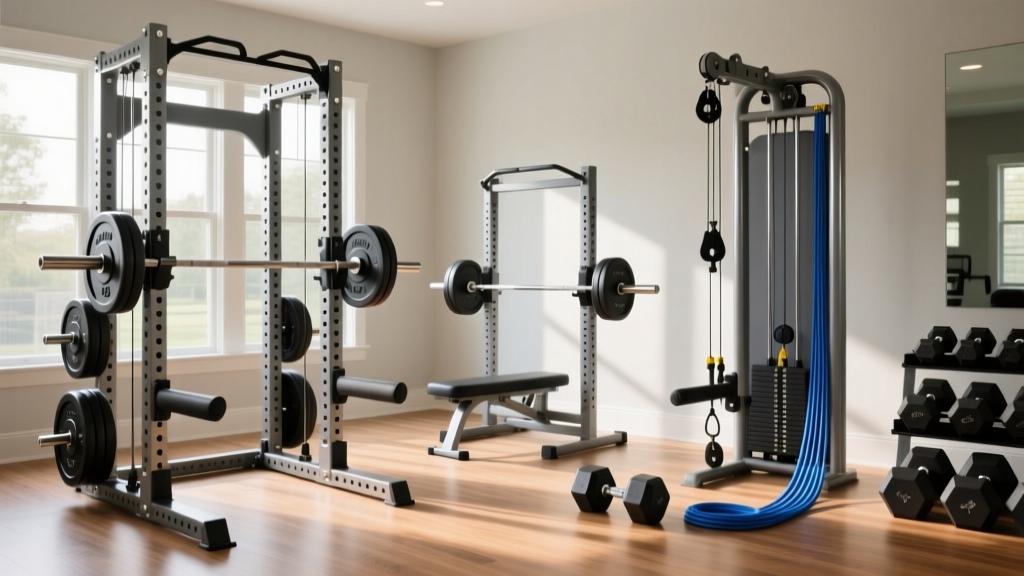
Choosing the right squatting apparatus is the most critical financial and spatial decision you will make for your home gym. In 2026, the market is saturated with options, but they all boil down to three primary categories: the fully enclosed power rack, the open-front squat rack (often called a half rack), and the minimalist squat stand. Your choice dictates not only your safety during heavy compound lifts but also your ability to integrate specialized attachments—such as functional trainers that completely change the biomechanics of isolation movements.
At FitGearPulse, we evaluate racks not just on their static weight capacities, but on their dynamic utility. A rack is an ecosystem. Below, we break down the exact specifications, failure modes, and attachment compatibilities of each rack type, culminating in a detailed analysis of how your rack choice impacts the ongoing hypertrophy debate of cable lateral raise vs dumbbell variations.
Power Racks: The Heavy-Duty Standard
Power racks (or full cages) feature four main uprights connected by crossmembers, creating an enclosed space for the lifter. They are the undisputed kings of safety and versatility.
- Material & Dimensions: Premium 2026 models like the Rogue RML-390F and REP Fitness PR-4000 utilize 11-gauge, 3x3-inch steel tubing. Budget options like the Titan T-2 use 14-gauge, 2x3-inch tubing.
- Hole Spacing: Look for 'Westside' hole spacing (1-inch spacing in the bench press and squat zones) for micro-adjusting safety spotter arms. Standard 2-inch spacing is only acceptable for the upper pull-up and storage zones.
- Safety Mechanisms: Enclosed racks utilize flip-down safety straps or pull-pin spotter arms. Because the barbell is caught inside the footprint of the rack, the risk of the rack tipping forward during a failed lift is virtually zero, provided the rack is properly assembled.
- Pricing: Expect to pay between $550 (budget 14-gauge) and $1,300+ (premium 11-gauge with sandwich J-cups and UHMW plastic lining).
Squat Racks (Half Racks): The Space-Saving Compromise
Squat racks, commonly referred to as half racks, feature two main front uprights and a rear storage base. The lifter squats 'outside' the rack, pulling the barbell out of the J-cups to perform the movement.
- Footprint & Space: Half racks save valuable floor space in the lifting zone, making them ideal for garages where vehicles share the space. The rear uprights often double as weight plate storage, which acts as a counterbalance.
- The Tipping Hazard: Because you rack the barbell on the front of the uprights, a forward failure or aggressive re-racking can cause the rack to tip. You must bolt a half rack to a concrete floor or heavily load the rear storage pegs to prevent catastrophic tipping.
- Spotter Arm Limitations: Spotter arms extend outward. If you fail a squat and drop the bar forward, the leverage applied to the extended arms can bend lower-grade steel or stress the welds.
Squat Stands: Minimalist but Risky
Squat stands consist of two independent, freestanding uprights. Models like the Rogue S-2 or Titan X-2 are incredibly popular for apartment gyms, CrossFit affiliates, and lifters on a strict budget.
- Pros: Unbeatable price point ($300–$450), highly portable, and easy to fold away or store in a closet.
- Cons: Zero inherent safety. If you fail a rep, you must dump the barbell backward or forward onto the floor. Furthermore, if the J-cups are set too high, racking the bar can easily tip the stand backward onto the lifter.
- Attachment Compatibility: Non-existent. You cannot mount lat pulldowns, functional trainers, or heavy band pegs to standard squat stands.
Comparison Matrix: Footprint, Price, and Safety
| Feature | Power Rack (e.g., REP PR-4000) | Half Rack (e.g., Rogue HR-2) | Squat Stand (e.g., Titan X-2) |
|---|---|---|---|
| Base Price (2026) | $1,099 - $1,400 | $850 - $1,100 | $350 - $450 |
| Lifting Footprint | 49' x 49' (Enclosed) | 48' x 36' (Open Front) | 24' x 24' (Independent) |
| Safety Rating | Excellent (Internal Catch) | Good (Requires Bolting) | Poor (Dumping Required) |
| Cable Attachment Support | Full Functional Trainer | Lat Pulldown Only | None |
The Attachment Ecosystem: Cable Lateral Raise vs Dumbbell Integration
When outfitting a modern power rack, buyers must evaluate the attachment ecosystem. This directly impacts your isolation training, specifically the ongoing biomechanical debate of cable lateral raise vs dumbbell variations. If you opt for a premium power rack like the REP PR-4000 or Rogue Monster series, you can bolt on a functional trainer or lat pulldown module ($600–$900 extra). This unlocks cable-based isolation work that squat stands simply cannot support.
Biomechanical Breakdown: Tension Curves
According to biomechanical directories like ExRx, the traditional dumbbell lateral raise suffers from a fundamental flaw: the resistance curve. Gravity only pulls straight down. When your arms are resting at your sides (0 degrees of abduction), the tension on the lateral deltoid is virtually zero. The muscle only experiences peak load when the arm is parallel to the floor, meaning 50% of the range of motion provides sub-optimal hypertrophic stimulus.
Conversely, the cable lateral raise allows you to manipulate the force vector. By setting the cable pulley at wrist height or below on your power rack's functional trainer, you maintain continuous, unyielding tension on the lateral deltoid from the very bottom of the movement through the peak contraction. This constant mechanical tension is a primary driver of muscle hypertrophy.
'If your home gym goals include advanced bodybuilding and hypertrophy, the ability to perform cable lateral raises via a rack-mounted functional trainer is a non-negotiable upgrade over relying solely on dumbbells.' — FitGearPulse Hypertrophy Analysis, 2025
Space Considerations for Cable Work
To perform unilateral cable lateral raises effectively, you need lateral clearance. A standard 49-inch wide power rack with a functional trainer attached requires a total width clearance of about 8 to 9 feet. If you are working in a narrow bay of a two-car garage, a half rack with a standalone cable crossover machine might be a better spatial fit, though it sacrifices the safety of the enclosed cage.
Real-World Buying Scenarios for 2026
- The Hypertrophy & Powerlifting Hybrid: You need heavy squats and precise isolation. Buy an 11-gauge Power Rack with a Functional Trainer attachment. This allows you to safely bail on heavy squats inside the cage and immediately transition to high-tension cable lateral raises for shoulder development.
- The CrossFit / Olympic Lifting Garage: You need open space for snatches and cleans. Buy a Half Rack or Folding Wall-Mount Rack. You do not need cable attachments, and the open footprint allows for dynamic barbell cycling.
- The Budget Apartment Lifter: You have low ceilings, thin floors, and a $500 budget. Buy Squat Stands and a set of adjustable dumbbells. You will be forced to use dumbbells for lateral raises, but you can mitigate the poor tension curve by performing 'lean-away' dumbbell lateral raises using a doorframe for leverage.
Frequently Asked Questions
Can I add a cable pulley system to a squat stand?
No. Squat stands lack the structural crossmembers and upright height required to house a weight stack or manage the lateral torque generated by cable pulleys. Attempting to rig a DIY pulley to a squat stand is a severe tipping hazard.
Are cable lateral raises strictly better than dumbbells?
For pure hypertrophy and constant tension, yes. Cables allow for a customized resistance profile that matches the strength curve of the deltoid. However, dumbbells are still highly effective for building raw stabilizer strength and are essential if your rack setup does not support cable attachments.
What is the best hole spacing for bench pressing?
1-inch Westside spacing is mandatory for serious bench pressers. It allows you to set the safety spotter arms exactly 1 inch below your chest lockout, ensuring you can escape a failed rep without having to flatten your ribcage or roll the bar down your sternum.
For more detailed reviews on functional trainer attachments and rack configurations, explore our complete rack and rig directories to compare current 2026 manufacturing specs.
More gear to consider
All reviews
Best Dumbbell Racks to Store Weights for Dumbbell Sit-Ups (2026)

Best Dumbbell Racks for Weight Bench Dumbbell Exercises (2026)

Beyond Amazon Basic Dumbbells: Olympic Barbell Buying Guide

Cast Iron vs Competition Kettlebells & Seated Deadlift with Dumbbells
Maintaining Loadable Dumbbells for Flawless Cross Body Dumbbell Curls