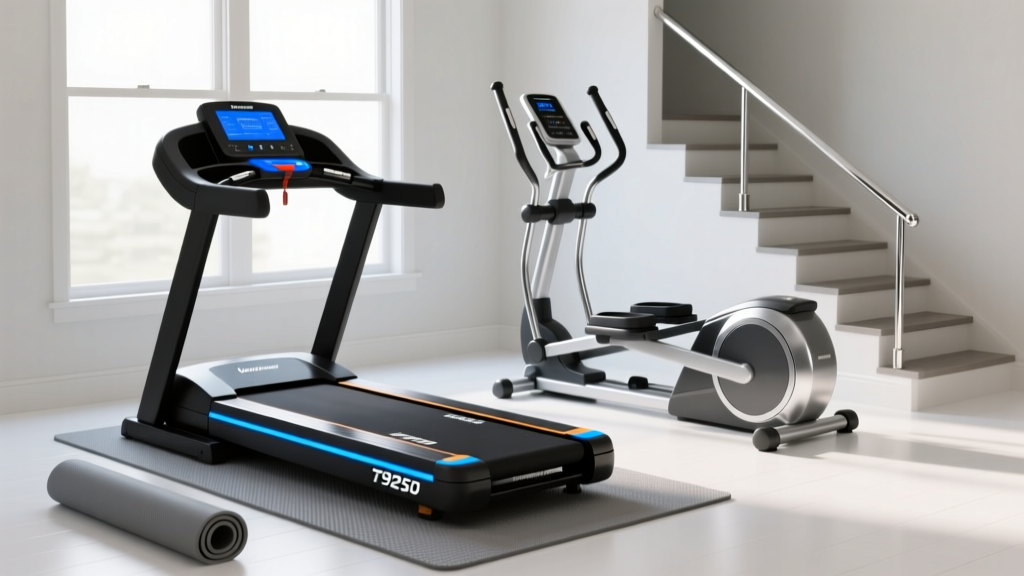
Soul Treadmills vs Stair Climbers: 2026 Home Buying Guide
Transitioning from soul treadmills? Our 2026 stair climber buying guide compares StepMills, mini-steppers, and hybrid climbers for home gyms.

The Cardio Shift: Moving Beyond Soul Treadmills
Over the past few years, the home fitness market has seen a massive surge in the popularity of 'soul treadmills'—a category of ultra-quiet, low-impact walking pads and boutique treadmills designed for mindful movement, meditation, and under-desk use. While these machines are exceptional for NEAT (Non-Exercise Activity Thermogenesis) and low-decibel steady-state cardio, they hit a hard metabolic ceiling. If your goal is to maximize VO2 max, trigger posterior chain hypertrophy, and burn maximum calories in minimal time, you must look to vertical resistance. This brings us to the ultimate home gym upgrade: the stair climber machine.
Transitioning from the horizontal plane of soul treadmills to the vertical grind of a stair climber fundamentally changes your cardiovascular and muscular stimulus. According to the Cleveland Clinic, stair climbing requires 23% more oxygen than running at the same speed on a flat surface, making it one of the most metabolically demanding cardio modalities available for home use.
The Biomechanical ROI of Vertical Climbing
When you walk on a flat treadmill, the hamstrings and calves do a significant amount of the propulsive work. Stair climbing shifts this burden dramatically. The vertical step-up motion forces the gluteus maximus, gluteus medius, and quadriceps to lift your entire body weight against gravity with every repetition.
Expert Insight: 'The eccentric and concentric loading on the knee and hip extensors during stair climbing mimics the mechanics of heavy barbell step-ups, bridging the gap between traditional cardio and lower-body strength training.' — American Council on Exercise (ACE)
The Ceiling Clearance Trap: A Critical Edge Case
⚠️ Warning: The Headroom Miscalculation
The number one reason home stair climbers are returned or sold second-hand is ceiling height. Unlike soul treadmills which keep your head at a standard walking height, StepMills elevate your base stance by 10 to 14 inches.
The Math: If you are 6'0' tall, your head is at 72'. Add a 14' machine base and a 10' step elevation at the top of the stride, and your head is now at 96' (8'0'). You need a minimum of 6 inches of clearance to avoid claustrophobia and ceiling strikes. Minimum Ceiling Requirement: 8'6' for users under 6'0', and 9'0'+ for taller users.
2026 Stair Climber Comparison Matrix
Not all climbers are built equally. The market is split into three distinct categories: the commercial-grade revolving StepMill, the hybrid stepper/elliptical, and the hydraulic mini-stepper. Below is our 2026 benchmark matrix for the top performers in each category.
| Model | Type | Drive System | Footprint | Price Range (2026) |
|---|---|---|---|---|
| StairMaster Gauntlet Pro | Revolving StepMill | Direct Drive AC | 54' x 33' | $7,899 - $8,499 |
| Bowflex Max Trainer M9 | Hybrid Climber | Magnetic Belt | 49' x 30' | $2,299 |
| NordicTrack FS14i | Freestyle Elliptical/Climber | Magnetic Flywheel | 58' x 29' | $2,499 |
| Sunny Health SF-S0851 | Hydraulic Mini-Stepper | Dual Hydraulic | 16' x 12' | $75 - $99 |
Anatomy of the Drive System: Where Machines Fail
When investing thousands of dollars into a home cardio machine, understanding the internal mechanics is vital. The drive system dictates the machine's noise profile, maintenance schedule, and lifespan.
1. Chain Drive (Legacy & Commercial)
Older StepMill models and some budget commercial climbers use heavy-duty roller chains. While virtually indestructible under normal use, they require periodic lubrication and tensioning. Failure Mode: If the chain stretches beyond 2% of its original length, it will begin to skip teeth on the drive sprocket, causing a dangerous 'stutter' in the step rotation mid-stride.
2. Belt Drive (Premium Home)
Machines like the Bowflex Max series utilize reinforced Kevlar or poly-V belts. These are whisper-quiet, making them ideal for apartments or shared living spaces where the noise of a motorized treadmill or soul treadmill might still bleed through floors. Failure Mode: Belt dust accumulation. Over 18-24 months, micro-abrasions create a fine black dust that coats the optical sensors, leading to erratic RPM readings and console errors.
3. Hydraulic Resistance (Mini-Steppers)
Found in sub-$150 models, hydraulic cylinders provide resistance via fluid compression. Failure Mode: Heat degradation. Hydraulic fluid thins as it heats up during a 20+ minute workout, causing the resistance to noticeably drop the longer you exercise. Furthermore, the O-rings inside the cylinders frequently blow out after 300-500 hours of use, resulting in fluid leaks on your flooring.
Real-World Troubleshooting & Maintenance Protocol
To protect your investment and ensure a smooth transition from low-impact walking to high-intensity climbing, implement this quarterly maintenance checklist:
- Optical Sensor Purge: Use compressed air and a microfiber swab dipped in 90% isopropyl alcohol to clean the RPM sensors located near the main flywheel or drive axle.
- Pedal Grip Replacement: The abrasive tape on stair pedals wears down, becoming a slip hazard when sweaty. Replace with standard skateboard grip tape (cut to size) every 18 months.
- Side Rail Tension Check: Users often lean heavily on the side rails, which loosens the mounting bolts. Tighten all console and rail hex bolts with a 5mm Allen key to prevent catastrophic console wobble during high-cadence intervals.
- Static Grounding Verification: Stair climbers generate immense static electricity due to the friction of the revolving steps. Ensure your home gym mat is not blocking the machine's grounding footpads, otherwise, static shocks will eventually fry the console's PCB board.
Frequently Asked Questions
Can I use a stair climber if I have knee issues?
Unlike the repetitive heel-strike impact of running on traditional treadmills, stair climbing is a closed-chain, low-impact exercise. However, it requires deep knee flexion. If you suffer from patellofemoral pain syndrome, you must avoid 'bottoming out' the step. Keep your cadence high enough that the step never fully drops before you initiate the next push-off.
How does the calorie burn compare to my walking pad?
A 160 lb individual walking at 3.0 mph on a flat soul treadmill will burn approximately 240 calories per hour. That same individual on a StepMill at a moderate cadence (level 6-8) will burn between 650 and 800 calories per hour, due to the vertical displacement of body weight and the recruitment of the body's largest muscle groups.
Do hybrid climbers like the Bowflex Max simulate real stairs?
Not exactly. Hybrid climbers use an elliptical path with a steep vertical trajectory. They eliminate the 'dead spot' at the bottom of a real stair step and reduce ankle dorsiflexion requirements. They are superior for joint preservation and HIIT intervals, but lack the specific sport-transferability of a revolving StepMill for hikers and mountaineers.
More gear to consider
All reviews
Compact Portable Cardio: Hands-On Johnson Treadmill Review

ProForm XP Trainer 580 Treadmill Motor Guide: Horsepower Explained
Incline on Treadmill Meaning vs Stationary Bike Types: 2026 Trends
Air Bike vs Assault Bike & Horizon Treadmill Lubricant Guide

Upgrade Your Treadmill Walk: Rowing Machine Setup & Buying Guide