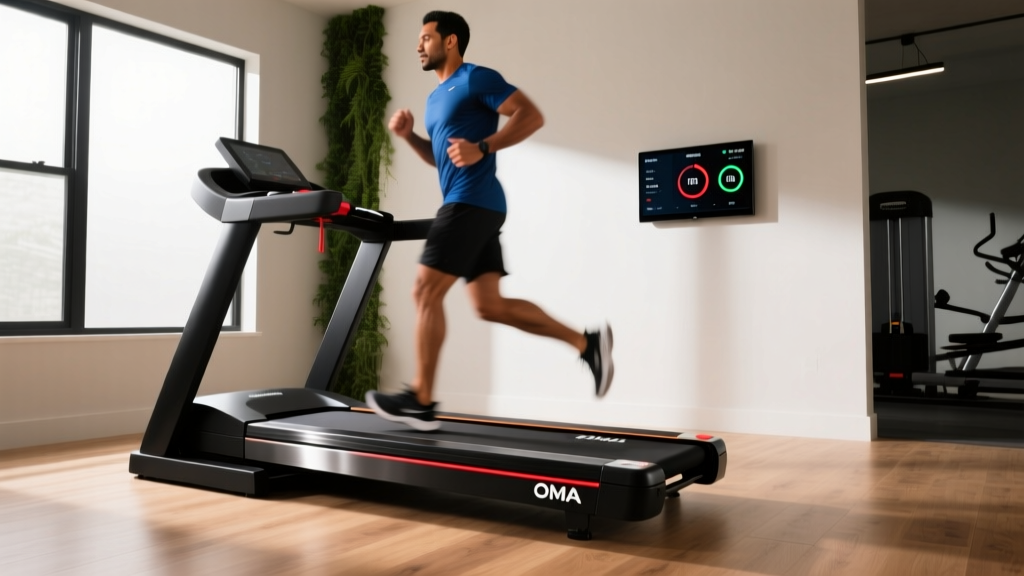
OMA Treadmill Review: Motor Size and Horsepower Guide
Read our in-depth OMA treadmill review focusing on motor size and horsepower. Learn how to choose the right CHP for your weight and running style.

The Horsepower Illusion: Peak vs. Continuous Duty (CHP)
When shopping for budget-friendly home cardio equipment, the OMA brand frequently dominates search results on platforms like Amazon and Walmart. However, navigating the specifications of these machines requires a critical eye, particularly regarding motor sizing. In this comprehensive OMA treadmill review, we bypass the marketing fluff to focus on the most critical component of any cardio machine: the motor. Understanding the difference between Peak Horsepower and Continuous Duty Horsepower (CHP) is the difference between a machine that lasts five years and one that burns out in five months.
⚠️ The Peak HP Marketing Trap: Many budget treadmill manufacturers advertise 'Peak Horsepower' (e.g., 4.0 Peak HP). This metric only measures the maximum power the motor can draw for a fraction of a second before the circuit breaker trips. For real-world usage, you must exclusively look at Continuous Duty Horsepower (CHP), which measures the power the motor can sustain indefinitely during a standard workout.Most home treadmills utilize Direct Current (DC) motors. Unlike the Alternating Current (AC) motors found in commercial gym equipment (like Life Fitness or Precor), DC motors are quieter and more compact, but they are highly susceptible to thermal degradation when pushed beyond their CHP rating. According to safety and engineering guidelines outlined by the U.S. Food and Drug Administration (FDA), electrical component overheating is a primary cause of treadmill failure and potential fire hazards in home environments.
OMA Treadmill Motor Analysis: 5108EB vs. 1012EB
To provide an actionable OMA treadmill review, we must look at their two most popular chassis configurations and how their motors handle real-world biomechanical loads.
1. OMA 5108EB (2.5 CHP Motor)
The OMA 5108EB is typically priced between $399 and $450. It features a 2.5 CHP motor and a stated weight capacity of 300 lbs. While 2.5 CHP is adequate for walking and light jogging, pairing it with a 300 lbs weight capacity is an engineering stretch. When a 250+ lbs user runs at 6.0 mph on a 10% incline, the motor must draw excessive amperage (often exceeding 14 amps) to overcome the gravitational load and belt friction. This sustained high-amp draw generates immense heat in the motor windings, eventually degrading the insulation and tripping the internal thermal cutoff switch.
2. OMA 1012EB (3.0 CHP Motor)
Priced closer to $550, the OMA 1012EB upgrades to a 3.0 CHP motor. This is a significantly more robust setup for home runners. The larger copper windings and improved heat dissipation fins allow the motor to sustain a 200 lbs runner at 8.0 mph without the Pulse Width Modulation (PWM) controller overheating. However, it still falls short of the 3.5 CHP standard set by premium mid-tier competitors like the Sole F80.
The FitGearPulse CHP Sizing Matrix
How do you know if an OMA motor (or any treadmill motor) is correctly sized for your physiology? Use the matrix below to determine your minimum CHP requirement. This data synthesizes user weight, activity intensity, and the mechanical strain of incline training.
| User Weight | Primary Activity | Minimum Required CHP | Recommended OMA Model Tier |
|---|---|---|---|
| Under 150 lbs | Walking (2.0 - 4.0 mph) | 2.0 CHP | Entry-Level (2.0 - 2.25 CHP) |
| 150 - 200 lbs | Jogging (4.0 - 6.0 mph) | 2.5 CHP | OMA 5108EB (2.5 CHP) |
| 200 - 250 lbs | Running (6.0 - 8.0 mph) | 3.0 CHP | OMA 1012EB (3.0 CHP) |
| 250+ lbs | Running / High Incline | 3.5+ CHP | Upgrade Required (e.g., Sole F80) |
Adhering to these guidelines ensures your motor operates at roughly 60-70% of its maximum capacity during a workout, which is the optimal efficiency zone for DC motor longevity. For broader context on how much cardiovascular activity you should be aiming for weekly, the Centers for Disease Control and Prevention (CDC) recommends at least 150 minutes of moderate-intensity aerobic activity, meaning your machine must be reliable enough to handle 30-45 minute daily sessions without thermal throttling.
The Hidden Failure Point: Lower Control Boards and PWM
In our OMA treadmill review teardowns, the motor itself is rarely the first component to fail. The true weak link in budget treadmills is the Lower Control Board, specifically the PWM (Pulse Width Modulation) controller. The PWM regulates the voltage sent to the DC motor based on the speed you select on the console.
When a treadmill belt is under-lubricated, friction between the belt and the deck increases. The motor demands more torque to pull the belt, which causes a spike in amperage. This spike is routed through the PWM capacitors. On budget boards, these capacitors are often rated just above the motor's baseline draw. A sustained friction spike will literally pop the capacitors, killing the control board long before the motor burns out.
Real-World Troubleshooting: The Amp-Draw Test
You can diagnose motor and belt health using a multimeter or an inline amp meter. Here are the benchmark thresholds for a standard 2.5 CHP OMA treadmill:
- Walking (No User): 2 to 4 amps. (Indicates baseline mechanical friction).
- Walking (180 lb User): 6 to 8 amps. (Normal operating range).
- Running (180 lb User): 10 to 12 amps. (Normal operating range).
- Danger Zone: If walking draws over 10 amps or running draws over 15 amps, your belt is experiencing severe friction, or the motor bearings are failing. Stop use immediately and lubricate the deck.
Maintenance Protocol: Extending Your OMA Motor's Lifespan
If you purchase an OMA treadmill, strict adherence to a maintenance schedule is non-negotiable to protect the motor and PWM board. Budget treadmills rarely feature the advanced wax-impregnated decks found on $3,000+ commercial machines.
💡 The 100% Silicone Rule: Never use WD-40, petroleum-based lubricants, or household oils on your treadmill belt. These will dissolve the PVC backing of the belt and cause catastrophic deck friction. You must use 100% pure liquid silicone treadmill lubricant. Apply 1 oz under the belt every 150 miles (or every 3 months for daily users).Step-by-Step Lubrication Guide
- Unplug the treadmill from the wall outlet to prevent accidental startup or electrical shock.
- Loosen the rear roller adjustment bolts using an Allen wrench (usually 6mm) by exactly three full turns on each side. Mark the bolt head with a Sharpie to ensure you return it to the exact same tension later.
- Lift the edge of the belt and insert the silicone applicator tube, squeezing a line of lubricant in a zig-zag pattern across the center third of the deck.
- Retighten the rear roller bolts to your marked lines.
- Plug the machine in and run it at 2.0 mph for 3 minutes to evenly distribute the silicone.
Final Verdict: Is an OMA Treadmill Right for Your Home Gym?
Our comprehensive OMA treadmill review reveals a brand that offers exceptional value, provided you respect the physical limitations of its motors. The 2.5 CHP models are fantastic for walkers and light joggers under 200 lbs who are mindful of their deck maintenance. However, if you are a heavier runner, plan to utilize the 15% incline frequently, or want a machine that can survive a decade of daily abuse without capacitor replacements, you must look at the 3.0 CHP OMA models or step up to a premium brand with a 3.5+ CHP motor and an AC drive system.
By prioritizing Continuous Duty Horsepower over marketing gimmicks and keeping your belt friction low, you can extract years of reliable cardiovascular training from your equipment investment.
More gear to consider
All reviews
Treadmill Motor HP Guide: Powering Your 10 Minute Workout

Elliptical vs Treadmill: The Rise of Omnidirectional Treadmills

Is Treadmill Bad for Knees? Curved vs Motorized Guide (2026)
Walking Pad Review: Belt Care & NordicTrack Treadmill Belt Lubricant
2026 Review: Folding Treadmills From Commercial Treadmill Brands