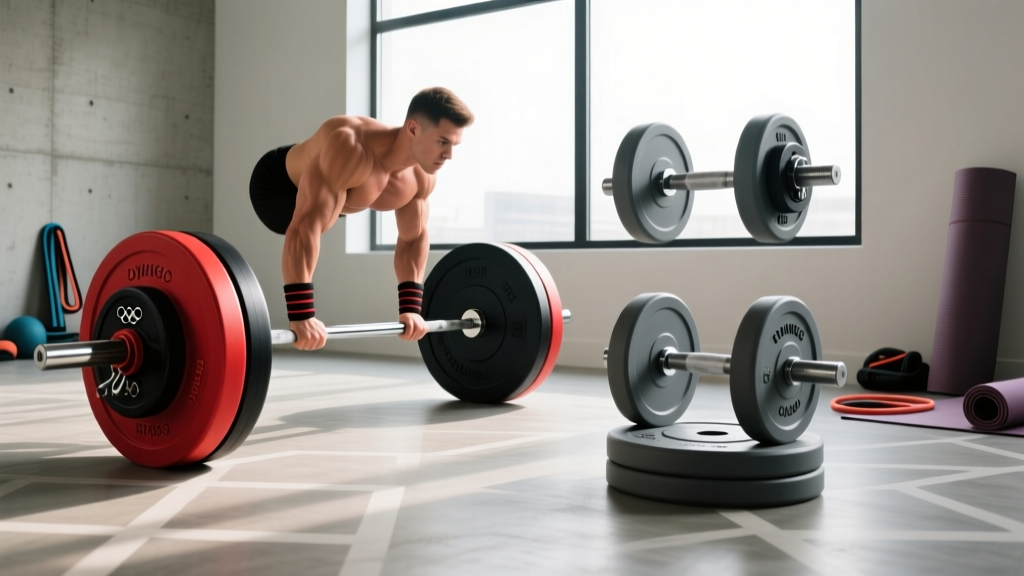
Olympic vs Standard Setup: Bicep Exercises with Dumbbells at Home
Master your home gym setup with our Olympic vs standard weight plates guide, optimizing gear for bicep exercises with dumbbells at home and heavy lifts.

The Core Dilemma: 1-Inch Standard vs. 2-Inch Olympic Ecosystems
Building a comprehensive home gym in 2026 requires making a foundational decision that will dictate every subsequent equipment purchase: choosing between standard (1-inch) and Olympic (2-inch) weight plate ecosystems. While many beginners default to standard plates due to their lower upfront cost, this choice often creates severe limitations when configuring your space for targeted isolation work. When you are setting up your equipment to perform bicep exercises with dumbbells at home, the physical dimensions, sleeve compatibility, and material density of your plates become critical factors that directly impact your range of motion and joint safety.
Standard plates feature a 25mm (1-inch) center hole and are typically paired with lightweight, spin-lock dumbbell handles. Olympic plates feature a 50mm (2-inch) center hole, designed for heavy-duty barbell sleeves and specialized loadable dumbbell handles. Understanding the mechanical differences between these two systems is the first step in a successful home gym installation walkthrough.
Quick Spec Comparison
- Standard Plates: 1-inch (25mm) hole, usually cast iron or cement-filled vinyl, max capacity per handle typically 50-80 lbs.
- Olympic Plates: 2-inch (50mm) hole, cast iron, rubber, or urethane, max capacity per handle easily exceeds 120+ lbs.
- Best For: Standard is for light, budget-friendly starter kits; Olympic is for lifelong scalability and biomechanical clearance.
Step-by-Step Setup: Assembling Your Plate-Loaded Dumbbell Station
To effectively execute bicep exercises with dumbbells at home using plate-loaded gear, you must assemble a dedicated dumbbell station. Unlike fixed-weight dumbbells, plate-loaded handles require a precise setup workflow to ensure safety and balance during dynamic movements like hammer curls and supinated concentration curls.
- Step 1: Select the Correct Handle Length. For standard 1-inch setups, a 14-inch handle (like the Titan Fitness 14-inch Standard Handle) provides roughly 6.5 inches of loadable sleeve space. For Olympic setups, the Rogue Loadable Dumbbell Handles (20-inch total length) offer 10 inches of sleeve space, allowing you to load heavier 45lb plates if necessary.
- Step 2: Calculate Symmetrical Loading. Always load plates symmetrically. If you need 25 lbs per hand, do not use a single 25lb plate. Instead, use a 10lb and a 15lb plate, or two 10lb plates and a 5lb plate. This keeps the center of gravity close to the handle's knurling, reducing wrist strain during the eccentric phase of a bicep curl.
- Step 3: Secure with the Right Collars. This is where most home gym setups fail. Standard spin-lock collars frequently loosen during the wrist supination required for bicep curls. Upgrade to spring-clamp collars for standard bars. For Olympic handles, install locking jaw collars (such as the Rogue HG 2.0 Collars) which clamp down with 150 lbs of lateral force, ensuring the plates never shift mid-rep.
- Step 4: Integrate with Weight Storage. Install a vertical weight tree or a wall-mounted plate rack adjacent to your dumbbell handles. Storing 2.5lb and 5lb fractional plates at eye level prevents the bending and lifting fatigue that occurs when picking them up from the floor between high-volume bicep drop-sets.
Biomechanics and Clearance: How Plate Diameter Impacts Your Curls
According to biomechanical principles emphasized in certification standards by ACE Fitness, isolation exercises require an unhindered path of motion to maximize muscle fiber recruitment. When performing bicep exercises with dumbbells at home, the physical diameter of the weight plates you load onto your handles can actually block your range of motion.
If you are using standard cement-filled vinyl plates, a mere 10lb plate can have a diameter of up to 11 inches. When you attempt a hammer curl or a cross-body curl, the bulky edges of these standard plates will collide with your forearms or thighs before your bicep reaches full contraction. Conversely, a 10lb cast-iron Olympic plate has a compact diameter of roughly 6 inches, providing total clearance for deep, unhindered muscle contractions.
| Plate Type (10lb Example) | Material | Approx. Diameter | Bicep Curl Clearance |
|---|---|---|---|
| Standard Vinyl | Cement/Iron Sand | 11.0 inches | Poor (Blocks forearms) |
| Standard Cast Iron | Solid Iron | 8.5 inches | Fair (Slight restriction) |
| Olympic Cast Iron | Solid Iron | 6.0 inches | Excellent (Full ROM) |
| Olympic Urethane | Urethane/Iron | 6.2 inches | Excellent (Full ROM) |
2026 Cost Analysis and Space Footprint
Setting up an Olympic ecosystem requires a higher initial capital expenditure, but the long-term cost-per-pound and space efficiency heavily favor the 2-inch standard. As of 2026, standard cast iron plates average $1.50 to $1.75 per pound, while Olympic cast iron hovers around $2.00 to $2.50 per pound. Premium Olympic urethane plates, which protect home gym flooring and reduce noise, range from $3.50 to $4.50 per pound.
Expert Insight: While standard plates are cheaper per pound, the 1-inch dumbbell handles max out at around 80 lbs before the sleeves run out of space. If you plan to progress to heavy weighted squats or high-resistance bicep exercises with dumbbells at home, you will eventually be forced to buy an entirely new Olympic set, doubling your lifetime equipment costs.
From a spatial perspective, Olympic plates are generally thinner and denser than standard plates (especially compared to cement-filled variants). A 300lb Olympic plate tree occupies roughly 2.5 square feet of floor space, whereas a 300lb standard plate tree requires a wider, more cumbersome base to support the bulkier, lower-density plates, making Olympic storage vastly superior for garage gyms and spare bedrooms.
Expert Troubleshooting: Common Setup Failures
Even with the right gear, improper setup can derail your training. Here are the most common failure modes when assembling a plate-loaded dumbbell station for arm isolation work:
Failure Mode 1: Sleeve Rattle and Knurling Tear
When using standard 1-inch handles, the threaded sleeves often feature sharp, unfinished metal burrs from the manufacturing process. Over time, these burrs tear the inner rings of your vinyl or rubber plates. The Fix: Before your first workout, take a metal file or high-grit sandpaper to the threads of your standard handles to smooth out the burrs, preserving your plates and ensuring smooth loading.
Failure Mode 2: Imbalanced Wrist Torque
When loading an Olympic loadable dumbbell handle for bicep exercises with dumbbells at home, users often push all the plates flush against the inner collar. This leaves a gap at the end of the sleeve, causing the plates to shift and rattle during the concentric phase of the curl, creating dangerous wrist torque. The Fix: Always use a combination of plate sizes that completely fills the 10-inch sleeve, or use a specialized sleeve spacer to eliminate lateral play before clamping your jaw collars down.
Failure Mode 3: Incompatible Rack Storage
Many home gym owners buy standard 1-inch plates but attempt to store them on a commercial power rack with integrated 2-inch Olympic pegs. The plates will slide too far back, hitting the rack uprights and making removal difficult. The Fix: Purchase snap-in 2-inch to 1-inch adapter sleeves (available for roughly $15-$20 a pair from major suppliers like Rogue Fitness or Rep Fitness) to safely bridge the gap between your standard plates and your Olympic storage rack.
By carefully selecting your plate ecosystem and meticulously setting up your loadable handles, you create a scalable, biomechanically sound environment. Whether you are loading up heavy cast iron for compound lifts or dialing in fractional plates for high-rep bicep exercises with dumbbells at home, a properly installed Olympic setup guarantees safety, full range of motion, and lifelong progression.
More gear to consider
All reviews
Cast Iron vs Competition Kettlebells & Pulldown With Dumbbells Guide
Neoprene Dumbbell Magnet Setup: Installation & Safety Walkthrough

Bumper Plate vs Iron Plate Trends & The Side Lying Dumbbell Raise

Bumper vs Iron Plates & Standing Dumbbell External Rotation
Front Rack Dumbbell Squat Trends: 2026 Storage & Rack Analysis
