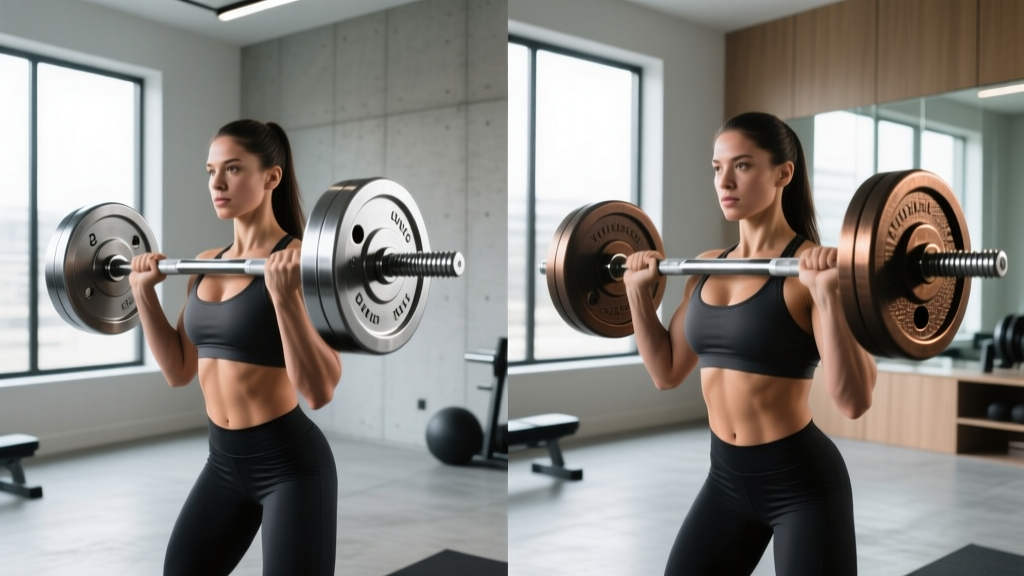
Olympic vs Standard Plates for Standing Dumbbell Chest Exercises
Discover how Olympic vs standard weight plates impact loadable dumbbells for standing dumbbell chest exercises, safety, and biomechanics.

The Biomechanics of Standing Dumbbell Chest Work
When building a home gym focused on functional hypertrophy, standing dumbbell chest exercises are a staple. Unlike seated or supine variations, performing a standing dumbbell squeeze press, standing flye, or upward chest scoop forces your body to manage multi-planar instability. According to a landmark study published in the Journal of Strength and Conditioning Research, standing pressing movements elicit significantly higher core and stabilizer muscle activation compared to seated or bench variations.
However, executing these movements safely at home usually requires adjustable, loadable dumbbell handles rather than fixed rubber hex dumbbells, which are cost-prohibitive in full sets. This introduces a critical hardware dilemma: Should you pair your loadable handles with 1-inch Standard plates or 2-inch Olympic plates?
Data Highlight: The Core Activation Advantage
Research demonstrates that standing overhead and chest presses require up to 30% greater rectus abdominis activation and significantly higher erector spinae engagement than bench-supported variations. Because your core is managing the kinetic chain, any micro-shift in the dumbbell's weight distribution (caused by loose plates) will immediately disrupt your mind-muscle connection and compromise spinal stability.
The Core Conflict: 1-Inch Standard vs. 2-Inch Olympic Plates
To understand which plate type is superior for standing dumbbell chest exercises, we must evaluate them through the lens of loadable dumbbell handles—the bridge between the plate and your hand. As of 2026, the market is split between budget 14-inch standard spin-lock handles and premium Olympic loadable handles (such as the Rogue Loadable Dumbbell Handles).
Standard Plates (1-Inch): The Budget Spin-Lock Route
Standard plates feature a 1-inch center hole and are typically paired with threaded spin-lock dumbbell handles. They are the entry-point for most home gyms.
- Cost Efficiency: Standard cast iron or vinyl-coated plates average $1.00 to $1.50 per pound.
- The Tolerance Problem: Standard plates are mass-cast with loose manufacturing tolerances. A 1-inch hole might actually measure 1.08 inches. On a barbell, this slop is negligible. On a short dumbbell sleeve, it creates rotational inertia shifts.
- Collar Failure Risk: Spin-lock nuts rely entirely on thread friction. During dynamic standing dumbbell chest exercises like standing flyes, the rapid deceleration at the top of the movement generates sheer force that can back the nut off the threads, leading to catastrophic plate slippage.
Olympic Plates (2-Inch): The Loadable Premium
Olympic plates feature a precisely machined 2-inch center hole, designed for use with high-end loadable dumbbell handles that secure via spring collars or machined aluminum clamps.
- Precision Machining: As detailed in comprehensive equipment roundups by Garage Gym Reviews, quality Olympic plates maintain a center hole tolerance of +/- 0.01 inches. This eliminates the 'clank and shift' effect.
- Superior Collar Security: Olympic loadable handles use external clamps or heavy-duty spring collars. The sheer surface area of a 2-inch sleeve combined with a clamp collar makes accidental plate dislodgement during explosive standing chest movements virtually impossible.
- Compact Footprint: Urethane Olympic grip plates (like 10lb or 15lb fractional plates) have a much smaller diameter than their standard cast-iron counterparts, allowing the dumbbell to clear your torso during deep standing flyes or tight Svend presses.
Head-to-Head Comparison Matrix
| Feature | Standard Plates (1-Inch) | Olympic Plates (2-Inch) |
|---|---|---|
| Center Hole Tolerance | Low (High slop) | High (Precision machined) |
| Average Cost (2026) | $1.00 - $1.50 / lb | $2.80 - $4.50 / lb |
| Collar Mechanism | Threaded Spin-Lock Nut | Spring Collar / Clamp |
| Max Load per Handle | ~45 lbs (Limited by sleeve) | 100+ lbs (Loadable handles) |
| Safety for Swing Movements | Poor (Nut loosening risk) | Excellent (Clamp secured) |
Exercise-Specific Plate Performance
How do these two plate ecosystems actually perform during specific standing dumbbell chest exercises? Let us break down the physics of the three most common standing chest movements.
1. The Standing Svend Press (Squeeze Press)
This movement requires you to press two dumbbells together in front of your chest, squeezing the pectorals isometrically while extending the arms.
The Standard Plate Flaw: Vinyl-coated standard plates tend to become sticky or squeak when rubbed together under pressure, disrupting the smooth extension of the press. Furthermore, the thick profile of standard spin-lock nuts forces your hands into an awkward, supinated angle.
The Olympic Advantage: Urethane Olympic plates have a slight tactile grip that locks the two dumbbells together beautifully during the squeeze. Machined loadable handles sit flush against the plates, allowing for a neutral, ergonomic wrist position.
2. Standing Dumbbell Flyes
Performing flyes while standing requires a slight forward hinge, challenging the lower back and hamstrings while the pecs manage the transverse adduction.
The Standard Plate Flaw: This is where standard plates become a genuine safety hazard. The rapid eccentric lowering and forceful concentric contraction generate momentum. The rotational torque applied to the dumbbell sleeve frequently backs standard spin-lock nuts off their threads. If a 25lb plate slides off mid-flye, the sudden asymmetrical load can cause severe rotator cuff strain.
The Olympic Advantage: Olympic loadable handles utilize smooth sleeves secured by heavy-duty spring collars. The rotational torque of a standing flye has zero effect on a properly seated spring collar, guaranteeing the weight distribution remains static throughout the set.
3. Standing Upward Chest Scoop
A lower-chest focused movement where the dumbbells are scooped upward and inward from the hips to eye level.
The Standard Plate Flaw: To achieve a 30lb dumbbell using standard plates, you must stack multiple 10lb and 5lb cast-iron plates. Standard 10lb plates have a massive diameter relative to their weight. This creates a bulky, wide dumbbell profile that physically collides with your thighs and torso during the bottom of the scoop.
The Olympic Advantage: Olympic grip plates are designed with compact, ergonomic profiles. A 10lb Olympic grip plate is significantly narrower and easier to manipulate, allowing the dumbbell to clear the body seamlessly during deep, standing hip-to-chest scoops.
The Verdict: Which Should You Buy?
If your primary goal is to build a functional, injury-free home gym centered around standing dumbbell chest exercises, the data overwhelmingly favors the Olympic plate and loadable handle ecosystem.
While the initial buy-in is higher—expect to spend roughly $180 on a pair of quality Olympic loadable handles and $3.50 per pound for urethane grip plates—the return on investment regarding safety, biomechanical stability, and equipment longevity is unmatched. Standard plates and spin-lock handles are acceptable for slow, controlled, seated isolation work (like bicep curls), but they lack the mechanical security required for the dynamic, multi-planar forces generated by standing chest flyes and presses. Do not compromise your rotator cuffs or your core stability to save a dollar per pound on cast iron.
Frequently Asked Questions
Can I use standard plates for standing dumbbell presses if I tighten the nuts with a wrench?
While using a wrench to tighten standard spin-lock nuts will temporarily prevent slippage, it strips the zinc threads on the handle over time. Furthermore, it makes adjusting weights between sets incredibly tedious, destroying your workout density and rest-period timing.
Are loadable Olympic dumbbell handles too long for standing exercises?
Premium loadable handles (like those from Rogue or Titan Fitness) feature sleeves that are typically 6 to 7 inches long. When loaded with compact urethane grip plates, the overall profile is nearly identical to a commercial fixed-weight rubber hex dumbbell, making them perfect for standing movements.
Do Olympic plates rust easier than standard vinyl plates?
Standard plates are often coated in vinyl or cheap paint that chips and rusts. Modern Olympic plates are typically encased in virgin urethane or high-density rubber, which is entirely impervious to moisture, sweat, and oxidation, making them vastly superior for garage gyms.
More gear to consider
All reviews
Barbell Collar Comparison and Seated Dumbbell Raise Fixes
Kettlebell Value: Cast Iron vs Competition & Seated Alternating Dumbbell Curl

Cast Iron vs Competition Kettlebells vs Dumbbells for Glutes (2026)
Incline Bench Dumbbell Trends 2026: Urethane vs Rubber Hex

Olympic vs Standard Plates for Plate-Loaded Dumbbell Leg Workouts
