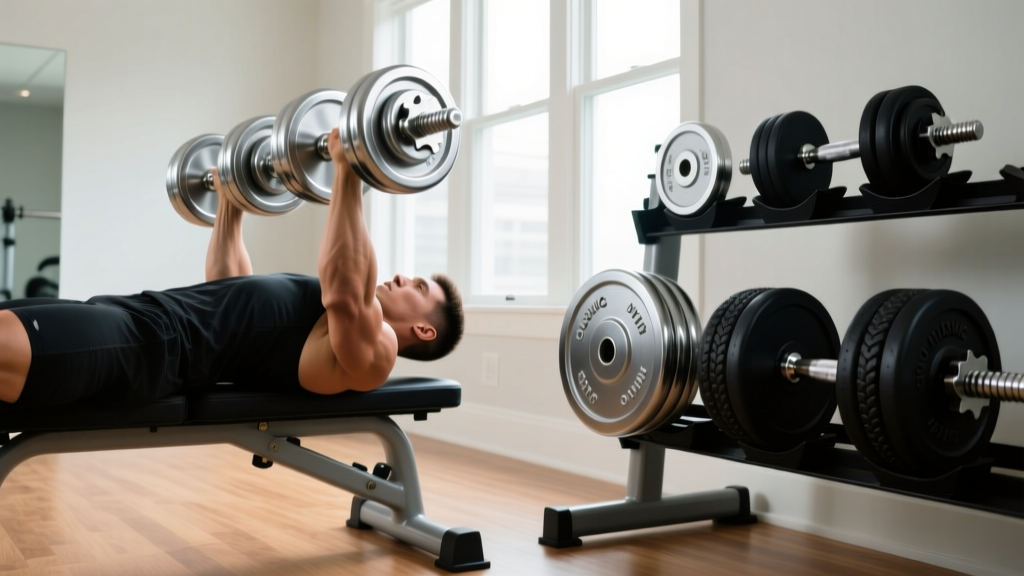
Olympic vs Standard Plates: Guide to Back Extensions with Dumbbells
Compare Olympic vs standard weight plates for your home gym. Discover how plate types impact loadable dumbbells and back extensions with dumbbells.

The Core Divide: 1-Inch vs. 2-Inch Sleeves
When outfitting a home gym in 2026, the choice between Olympic and standard weight plates is the foundational decision that dictates your entire equipment ecosystem. The primary difference lies in the center hole diameter: standard plates feature a 1-inch (25mm) hole, while Olympic plates are built with a 2-inch (50mm) hole to fit the sleeves of Olympic barbells and specialized loadable dumbbell handles. While standard plates are often marketed as budget-friendly entry points, understanding the long-term implications of this 1-inch difference is critical for both heavy compound lifts and targeted accessory work.
Quick Summary: Standard plates (1-inch) are cheaper and more compact but severely limit your maximum load and dumbbell handle options. Olympic plates (2-inch) are the global industry standard, offering superior durability, precise calibration, and compatibility with high-end loadable dumbbell handles essential for advanced accessory training.Head-to-Head Specification Matrix
To visualize the engineering differences, we have broken down the core specifications of both plate types based on current manufacturing standards.
| Feature | Standard Plates | Olympic Plates |
|---|---|---|
| Center Hole Diameter | 1 inch (25mm) | 2 inches (50mm) |
| Max Plate Size (Typical) | 25 lbs (due to sleeve length limits) | 45 lbs / 55 lbs (or larger) |
| Material Options | Basic Cast Iron, Cement-filled Vinyl | Cast Iron, Urethane, Rubber Bumper, Calibrated Steel |
| Weight Accuracy | +/- 5% to 10% variance | +/- 1% (Standard) to +/- 0.25% (Calibrated) |
| Average 2026 Cost | $1.00 - $1.50 per lb | $2.00 - $4.50 per lb |
For a deeper dive into the manufacturing tolerances of these plates, Barbend's comprehensive guide on weight plate standards highlights why Olympic plates remain the undisputed choice for serious lifters who require precise progressive overload.
The Dumbbell Handle Ecosystem & Accessory Work
Many lifters focus entirely on barbell movements when selecting plates, forgetting that plate diameter dictates the dumbbell handles you can purchase. Standard 1-inch plates require standard spin-lock dumbbell handles (like the ubiquitous 14-inch CAP Barbell models). These handles typically feature a 4-inch loadable sleeve and a thin, unknurled grip. Olympic plates, however, unlock the world of premium loadable dumbbell handles, such as the Rogue S-4 or Titan Fitness Olympic Dumbbell Handles, which feature thick, knurled shafts and secure lock-jaw collars.
Why Grip and Balance Matter for Back Extensions with Dumbbells
This equipment divergence becomes glaringly obvious during unilateral or accessory movements. When programming back extensions with dumbbells, you typically hold a single heavy dumbbell vertically against your chest or horizontally across your hips to load the erector spinae and glutes. According to the ExRx biomechanics database for the dumbbell back extension, maintaining a neutral spine and a secure grip is paramount to preventing shear force injuries.
If you are using a standard 1-inch dumbbell for this exercise, several issues arise:
- Collar Interference: The threaded ends and bulky plastic or metal spin-lock nuts of standard handles frequently dig into the sternum or ribs when held vertically against the chest.
- Center of Gravity: Because standard sleeves are short, you must stack multiple smaller plates (e.g., four 10lb plates) to reach 40 lbs. This creates a wide, unbalanced implement that shifts during the hip hinge.
- Grip Fatigue: Standard handles lack knurling and are often only 1 inch thick, causing grip fatigue to outpace lower back fatigue.
Conversely, an Olympic loadable dumbbell handle allows you to slide on two 20lb Olympic iron plates. The result is a compact, perfectly balanced weight with a flush collar that sits comfortably against the torso, allowing you to focus entirely on the mind-muscle connection during back extensions with dumbbells.
2026 Pricing & Cost-Per-Pound Analysis
While standard plates win on initial cost, the long-term value proposition heavily favors Olympic setups. Let us break down the cost of a 300 lb plate set in the current 2026 market:
Standard 300 lb Set
Cost: ~$350 - $450
Includes: 1-inch cast iron plates, two 5-foot standard bars, two 14-inch standard dumbbell handles.
Hidden Costs: Frequent replacement of bent dumbbell handles and stripped spin-lock collars.
Olympic 300 lb Set
Cost: ~$600 - $850 (e.g., Titan Fitness or Rogue Echo Iron)
Includes: 2-inch machined cast iron or urethane plates. (Barbell and handles sold separately).
Long-Term Value: Lifetime durability, high resale value, and compatibility with commercial-grade racks.
As noted in Garage Gym Reviews' 2026 testing on weight plate durability, urethane-coated Olympic plates, while more expensive upfront ($3.50+ per lb), completely eliminate the rust, chipping, and floor-damage issues associated with cheap standard cast iron.
Failure Modes: Where Standard Plates Fall Short
Beyond aesthetics and price, standard plates possess inherent structural failure modes that Olympic plates have engineered away:
- Sleeve Bending: Standard 1-inch dumbbell handles are prone to bending when loaded past 60 lbs per hand. This bending warps the sleeve, making it impossible to slide plates on or off smoothly.
- Drop Shattering: Standard cast iron plates are brittle. If you drop a standard dumbbell from the top of a heavy row or lunge, the 1-inch plates are highly susceptible to cracking or shattering upon impact with a concrete garage floor.
- Rack Incompatibility: Standard plates cannot be used on modern power racks, lat pulldown weight stacks, or sleds, severely limiting your ability to expand your gym footprint over time.
Warning: Never attempt to use 1-inch standard plates on a 2-inch Olympic barbell using plastic adapter bushings. Under heavy axial loads (like squats or deadlifts), these bushings compress and crack, leading to catastrophic plate slippage and severe injury.
The Final Verdict: Building Your Home Gym
If you are strictly buying equipment for light rehabilitation, casual toning, or a child's starter fitness kit, standard 1-inch plates and their accompanying handles are adequate. However, for any lifter serious about progressive overload, strength building, and safe accessory programming, Olympic plates are the only logical investment.
The ability to utilize high-quality Olympic loadable dumbbell handles transforms your training. It ensures that when you are performing demanding isolation movements like back extensions with dumbbells, your equipment supports your biomechanics rather than compromising them. Invest in the 2-inch standard, and your home gym will be equipped to handle everything from a 400-lb deadlift to the most precise accessory work for decades to come.
More gear to consider
All reviews
Power Rack vs Squat Rack vs Stand: Dumbbell Oblique Crunch Setup
Bumper vs Iron Plates: Fund the Best Glute Exercises with Dumbbells

Gold Dumbbell Storage: 2026 Rack Budget & Value Analysis
From Starter Dumbbell Weight for Women to Olympic Barbell Knurling

Best Neoprene Weights for a Dumbbell Routine for Beginners
