Lower Chest Dumbbell Workout Mistakes Using Neoprene Weights
Struggling to build your pecs at home? Discover common lower chest dumbbell workout mistakes when using neoprene weights and how to troubleshoot them.

The Neoprene Dilemma: Why Your Lower Chest Is Not Growing
When building a home gym on a budget, a rack of neoprene-coated dumbbells is often the first purchase. Brands like CAP Barbell and Amazon Basics offer these fixed-weight sets at an accessible price point (typically $1.20 to $1.80 per pound). They are excellent for high-repetition lateral raises, light aerobic circuits, and physical therapy. However, when lifters attempt a dedicated lower chest dumbbell workout using these same neoprene weights, progress inevitably stalls. The issue is rarely a lack of effort; it is a fundamental mismatch between the equipment's physical properties and the biomechanical requirements of the sternal head of the pectoralis major.
In this troubleshooting guide, we will dissect the exact mechanical, material, and programming mistakes home-gym athletes make when targeting the lower pecs with neoprene dumbbells, and provide actionable frameworks to fix them without immediately spending hundreds of dollars on new gear.
Mistake 1: Relying on Mechanical Tension with Light Loads
The lower chest fibers (costal fibers of the pectoralis major) are heavily involved in shoulder adduction and extension from a flexed position. According to kinesiology data from ExRx, maximizing recruitment requires moving heavy loads through a converging arc, typically on a 15 to 30-degree decline bench.
The primary failure mode with neoprene dumbbells is weight limitation. Most home sets cap out at 20 or 25 pounds per hand. Once your chest adapts to pressing 25 pounds for 12 reps, you can no longer generate the mechanical tension required for myofibrillar hypertrophy. Lifters mistakenly try to compensate by simply doing 50 reps of standard decline presses, which shifts the stimulus entirely to muscular endurance rather than growth.
The Fix: Shift to Metabolic Stress and Time Under Tension
Since you cannot increase the load, you must manipulate the tempo to induce metabolic stress—the secondary driver of muscle hypertrophy. A study published by the American Council on Exercise (ACE) highlights that altering exercise execution can significantly change muscle activation patterns. For your lower chest dumbbell workout, implement a 4-1-1-0 tempo:
- 4 Seconds Eccentric: Lower the dumbbells slowly, feeling the stretch in the lower pec fibers.
- 1 Second Pause: Hold the dumbbells at the bottom of the movement, eliminating the stretch reflex.
- 1 Second Concentric: Press and squeeze the weights together at the top.
- 0 Second Rest: Immediately begin the next rep.
This turns a manageable 20-pound dumbbell into a brutal stimulus that will force the lower chest to adapt.
Mistake 2: The 'Slip and Tear' Decline Fly Hazard
Neoprene is a synthetic rubber that provides a soft, comfortable grip during dry conditions. However, it is highly susceptible to moisture. When you perform a lower chest dumbbell workout on a decline bench, gravity pulls sweat down your forearms and directly onto the dumbbell handles. Neoprene becomes dangerously slick when wet.
Attempting a heavy decline fly or press with sweaty hands and slick neoprene handles forces your forearms and grip stabilizers to overwork. Worse, if a dumbbell slips at the bottom of a decline fly—where the shoulder joint is in maximum extension and highly vulnerable—it can lead to a severe pec tear or rotator cuff strain.
The Fix: Grip Modifications and Angle Adjustments
If you are committed to using your current neoprene set, you must troubleshoot the grip hazard. Avoid using chalk, as magnesium carbonate will permanently stain and degrade the porous neoprene coating. Instead, use cotton lifting straps looped around the handles for pressing movements to secure the weight to your wrists. For flyes, switch to a neutral-grip floor press with a glute bridge. By elevating your hips into a bridge on the floor, you mimic the 15-degree decline angle while keeping your back flat against a stable surface, eliminating the overhead slip risk entirely.
Equipment Matrix: Neoprene vs. Urethane vs. Adjustable
If you have outgrown your neoprene set, it is crucial to understand what to upgrade to. Below is a troubleshooting matrix comparing common home-gym dumbbell materials for heavy chest training.
| Feature | Neoprene (e.g., CAP Barbell) | Urethane (e.g., Rogue Urethane) | Adjustable (e.g., PowerBlock Elite EXP) |
|---|---|---|---|
| Cost per Pound | $1.20 - $1.80 | $3.50 - $5.50 | ~$4.00 (Blended average) |
| Max Weight Available | Usually caps at 20-50 lbs | Up to 150+ lbs | Up to 90 lbs (with expansion kits) |
| Grip Texture | Smooth, slick when wet | Medium knurl, excellent grip | Caged design, secure but bulky |
| Durability | Low (tears, degrades with sweat) | Extremely High (commercial grade) | High (internal steel plates) |
| Best For Lower Chest? | No (Beginners/Rehab only) | Yes (Ideal for heavy decline work) | Yes (Best for progressive overload) |
As noted in equipment material analyses by Rep Fitness, urethane vastly outperforms standard rubber and neoprene in odor resistance, durability, and grip integrity, making it the gold standard for dedicated home gym chest training if budget allows.
Mistake 3: Hex-Edge Wrist Impingement
Most budget neoprene dumbbells feature a hexagonal (hex) head design to prevent them from rolling off the floor. While practical for storage, the hex shape creates a significant ergonomic issue during a lower chest dumbbell workout. When you perform a decline press or fly, the natural path of the wrist requires slight extension and ulnar deviation at the bottom of the movement. The sharp, rubber-coated edges of a hex dumbbell will dig directly into the carpal tunnel and the heel of the palm, causing nerve compression and wrist pain long before the chest muscles reach failure.
The Fix: The Parallette Deficit Push-Up Alternative
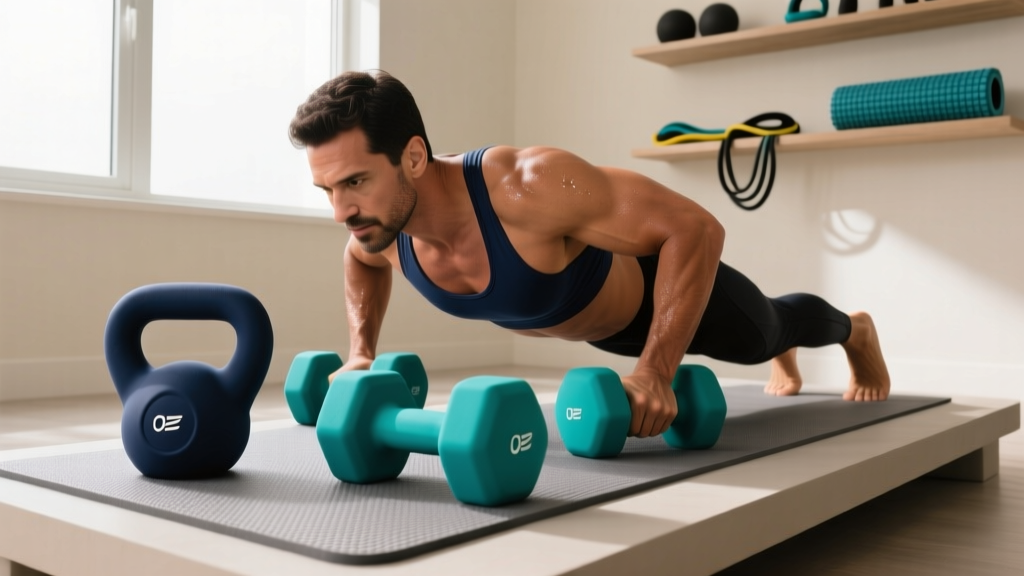
If hex-edge impingement is ruining your decline presses, abandon the bench temporarily. Use your 20-pound neoprene hex dumbbells as parallettes on the floor. Place them shoulder-width apart, grip the flat sides (avoiding the sharp top edges), and perform deficit push-ups with your feet elevated on a chair or bed. The elevation shifts the bias to the lower chest, while the dumbbell handles allow for a deeper stretch at the bottom without the wrist impingement caused by the hex heads pressing against your palms.
The 'Maxed-Out' Neoprene Lower Chest Protocol
Use this troubleshooting routine when you are stuck with a light pair of neoprene dumbbells (15-25 lbs) and need to stimulate the lower pecs without adding external load. Rest exactly 45 seconds between sets.
- Decline Glute-Bridge Floor Flyes (3 sets to failure): Elevate hips, maintain a 1-second pause at the bottom stretch. Focus on the mind-muscle connection in the costal fibers.
- Myo-Rep Dumbbell Decline Press (2 sets): Perform 15 reps on a decline bench. Rack the weights for 10 seconds (take 5 deep breaths). Perform 5 more reps. Rack for 10 seconds. Perform 5 more reps. This clusters the reps to maximize metabolic pooling.
- Isometric Squeeze Crossovers (2 sets of 45 seconds): Stand with a slight forward lean. Press the dumbbells together in front of your hips and squeeze as hard as possible without moving the weight. The continuous isometric tension will flood the lower chest with metabolites.
Maintenance: Preventing Neoprene Degradation
Human sweat is acidic and contains salts that actively break down the chemical bonds in synthetic neoprene over time. If your dumbbells are becoming sticky, discolored, or flaking, the coating is failing. To extend the life of your equipment, wipe the handles down with a microfiber cloth dampened with a 50/50 mix of distilled water and white vinegar after every workout. Never use bleach or harsh alcohol-based sanitizers, which will instantly dry out and crack the neoprene.
Expert Troubleshooting Tip: If your neoprene dumbbells have already become sticky and degraded, you can salvage them by wearing neoprene weightlifting gloves. This creates a barrier between your skin and the degrading rubber, allowing you to finish out your lower chest dumbbell workout safely while you save up for a urethane or adjustable upgrade.
Final Thoughts on Equipment Progression
A lower chest dumbbell workout is only as effective as the stimulus it provides. Neoprene dumbbells serve a valuable purpose in the fitness ecosystem, but they are not built for the heavy, progressive overload required to build a thick, well-developed chest. By recognizing the limitations of your equipment—whether it is the lack of mechanical tension, the slip hazard on a decline, or the wrist impingement of hex edges—you can intelligently manipulate tempo, angles, and metabolic stress to keep making gains. Once you consistently max out the metabolic protocols outlined above, it is time to retire the neoprene and invest in a serious set of adjustable or urethane dumbbells.
More gear to consider
All reviews
Budget Dumbbell Racks for Good Lat Workouts with Dumbbells

Dumbbell Romanian Deadlift Care: Cast Iron vs Competition Kettlebells

Bumper Plate vs Iron Plate & The Best Tricep Workout with Dumbbells

Barbell Knurling Errors & Dumbbell Pullover for Serratus Anterior

Bumper vs Iron Plates: Budgeting for Dumbbell Back Lunges & Squats