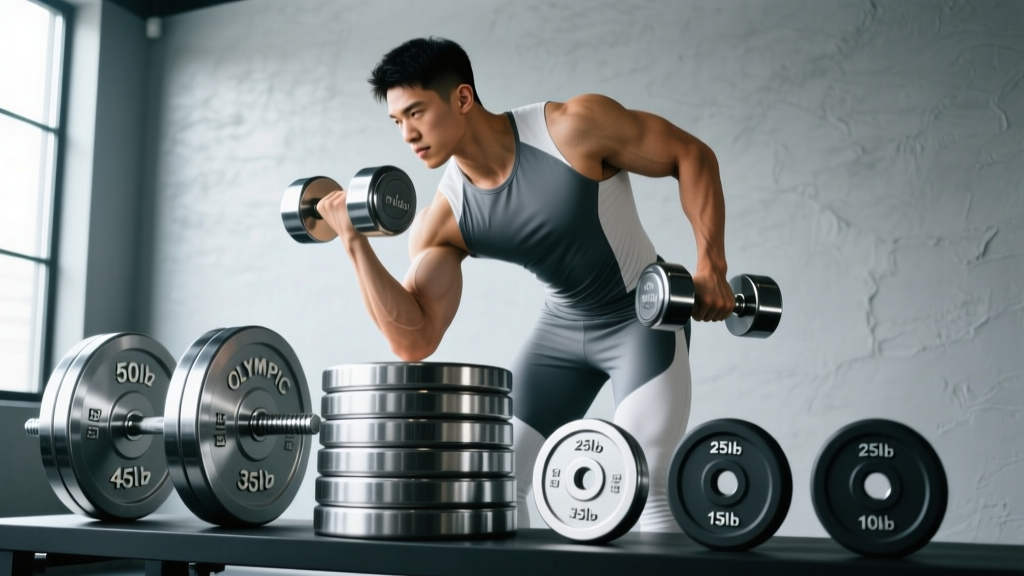
Olympic vs Standard Plates: Arm Workouts for Men with Dumbbells
Discover the differences between Olympic and standard weight plates. Learn how to choose the right gear to elevate your arm workouts for men with dumbbells.

The Foundation of Arm Hypertrophy: Choosing Your Plates
When searching for the most effective arm workouts for men with dumbbells, most beginners focus entirely on exercise selection—hammer curls, skull crushers, and concentration curls. However, the foundational hardware you choose dictates your long-term progress. If you are building a home gym in 2026 and opting for plate-loaded dumbbells over fixed or adjustable dial models, you will immediately face a critical fork in the road: Standard vs. Olympic weight plates.
Choosing the wrong plate ecosystem can lead to bent handles, stripped collar threads, and a hard ceiling on your progressive overload. According to equipment guidelines from ExRx.net, matching your sleeve diameter to your training intensity is paramount for joint safety and biomechanical efficiency. This step-by-step beginner guide will walk you through the exact differences, pricing, and hardware configurations you need to build the ultimate plate-loaded arm training arsenal.
Step 1: Decode the Diameter (The 1-Inch vs 2-Inch Rule)
The entire weight plate ecosystem is divided by a single measurement: the center hole diameter. This determines which bars and dumbbell handles you can use.
- Standard Plates: Feature a 1-inch (25.4 mm) center hole. They are designed for lightweight, entry-level home gym equipment.
- Olympic Plates: Feature a 2-inch (50 mm) center hole. They are the global standard for commercial gyms, powerlifting, and serious bodybuilding.
Quick Comparison Matrix
| Feature | Standard Plates (1-Inch) | Olympic Plates (2-Inch) |
|---|---|---|
| Hole Diameter | 1 inch (25.4 mm) | 2 inches (50 mm) |
| Handle Compatibility | Standard 1" spin-lock handles | Olympic 2" hex-lock/spring handles |
| Max Load Capacity | Low (typically 50-80 lbs per hand) | Extremely High (150+ lbs per hand) |
| 2026 Avg. Cost (Cast Iron) | $1.20 - $1.80 per lb | $2.50 - $4.00+ per lb |
| Best For | Beginners, tight budgets, light isolation | Heavy compounds, advanced arm overload |
Step 2: Select the Right Plate-Loaded Dumbbell Handles
To execute heavy arm workouts for men with dumbbells using plates, you need the correct handles. The handle you choose drastically alters the biomechanics of your grip and the safety of the lift.
The Standard Handle Dilemma
Standard 14-inch dumbbell handles (like the popular CAP Barbell or Yes4All models) usually cost between $15 and $25 per pair. They use a threaded spin-lock collar. While excellent for beginners doing light lateral raises or tricep kickbacks, they possess a critical failure mode: thread stripping and shaft bending. If you load a standard 14-inch handle with more than 60 lbs of cast iron, the 1-inch solid steel shaft can subtly bend under the torque of a heavy dumbbell row or skull crusher, causing the spin-lock collars to loosen mid-rep.
The Olympic Handle Advantage
Olympic dumbbell handles (such as the Rogue Olympic Dumbbell Handles or Titan Fitness 20-inch models) cost between $90 and $160 per pair. They feature 2-inch solid steel sleeves and secure with heavy-duty hex-lock nuts or spring collars. Pro-Tip for Arm Hypertrophy: Olympic dumbbell handles feature a much thicker grip (often 35mm compared to the standard 28mm). When performing arm workouts for men with dumbbells, this thicker grip forces your forearm flexors and brachioradialis to work significantly harder during stabilizing movements like hammer curls, leading to greater overall arm development without needing extra isolation exercises.
Step 3: Choose Your Plate Material and Budget
Once you have selected your handle ecosystem, you must buy the plates. The American Council on Exercise (ACE) recommends considering your flooring and noise tolerance when selecting plate materials for home gyms.
- Cement/Vinyl Standard Plates: The cheapest option ($0.80 - $1.20/lb). They are bulky, prone to cracking if dropped, and take up too much sleeve space on a dumbbell handle. Avoid these for arm training, as the bulkiness restricts your range of motion on deep bicep curls.
- Cast Iron Standard/Olympic: The gold standard for durability ($1.50 - $3.00/lb). Cast iron plates are compact, allowing you to load more weight onto a 14-inch or 20-inch dumbbell sleeve. They will last a lifetime but will damage concrete floors if dropped.
- Rubber/Urethane Olympic Grip Plates: Ideal for quiet home gyms ($3.00 - $5.00/lb). Models like the Rogue Echo Grip Plates feature built-in handles, making it incredibly easy to swap weights between your barbell and your Olympic dumbbell handles during supersets.
Step 4: Implement Micro-Loading for Arm Hypertrophy
The biceps and triceps are relatively small muscle groups. Unlike a barbell deadlift where you can add 10 lbs a week, your bicep curl strength will stall quickly if you only have 5 lb or 10 lb plates. This is where fractional plates become your secret weapon.
For standard setups, you can buy 1.25 lb and 0.5 lb standard washer plates for under $20. For Olympic setups, you will need Olympic fractional change plates (like the Titan Elite Steel Change Plates). By adding just 1 lb to each dumbbell every two weeks, you ensure continuous progressive overload—the primary driver of muscle hypertrophy—without overwhelming your elbow tendons.
Step 5: Secure Your Storage and Safety Setup
Plate-loaded dumbbells require meticulous organization. Leaving standard or Olympic plates scattered on the floor is a tripping hazard and degrades the equipment.
- Standard Weight Trees: Usually feature 1-inch pegs. They are lightweight and can tip over if loaded unevenly with heavy 50 lb standard plates. Always bolt them to the floor or a wall stud.
- Olympic Weight Trees: Feature 2-inch steel pegs and a wide, heavy base. A quality 6-peg Olympic tree (like the REP Fitness PR-4000 attachment) can hold over 500 lbs safely and keeps your gym space optimized for rapid weight changes during intense arm supersets.
Frequently Asked Questions
Can I use Olympic plates on standard dumbbell handles?
No. Olympic plates have a 2-inch hole, and standard handles have a 1-inch sleeve. The plates will simply slide off. While you can buy plastic adapters to put standard plates on Olympic bars, there is no safe adapter to put Olympic plates on standard handles.
Are standard plates good enough for arm workouts?
For absolute beginners, yes. Standard cast iron plates paired with 14-inch spin-lock handles are highly cost-effective for learning the mind-muscle connection on tricep extensions and preacher curls. However, once your dumbbell curl exceeds 50 lbs per hand, you must upgrade to Olympic hardware to prevent equipment failure and sleeve bending.
Do I need bumper plates for arm training?
No. Bumper plates (designed to be dropped from overhead during Olympic weightlifting) are far too thick to fit more than one or two on a dumbbell handle. Stick to thin cast iron or rubber grip plates to maximize the weight you can load onto your dumbbells for heavy arm isolation work.
The Bottom Line: If your budget allows and you have the space, investing in an Olympic plate ecosystem and 2-inch Olympic dumbbell handles is the superior choice for 2026. It future-proofs your home gym, allows for heavier loads, and provides the thicker grip necessary to maximize forearm and bicep activation during your arm workouts for men with dumbbells.
More gear to consider
All reviews
Optimizing Space With an American Dumbbell Loadable System

Bumper vs Iron Plates: Rack Setup & Chest Rows Dumbbell Guide

Rubber Hex vs Urethane Care: Back Shoulder Workout with Dumbbells
Power Rack vs Squat Rack vs Stand: Back Exercise Using Dumbbell Routines
Kettlebell Care: Cast Iron vs Competition & Dumbbell Reverse Crunch
