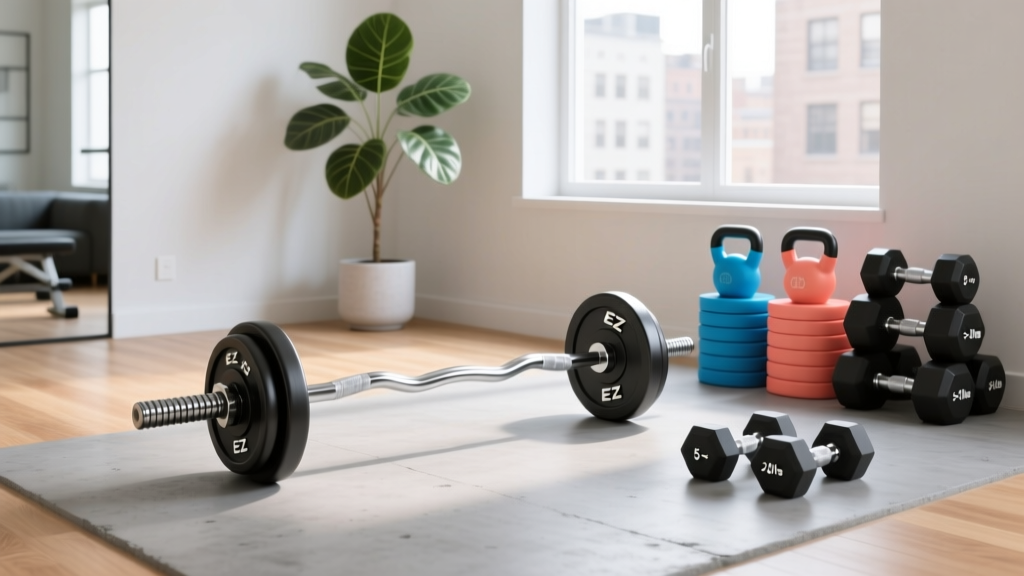
EZ Curl Bar vs Straight Bar: 2026 Trends & 45-Min Dumbbell Workouts
Analyze 2026 market trends comparing the EZ curl bar vs straight bar. Learn how to integrate these tools to upgrade your 45-minute dumbbell workout routine.

The 2026 Home Gym Shift: Beyond the 45-Minute Dumbbell Workout
Over the past few years, the home fitness landscape has been dominated by space-saving, high-efficiency routines. The classic 45 minute dumbbell workout has remained the undisputed cornerstone of time-efficient hypertrophy for busy professionals and home gym owners alike. Dumbbells offer unparalleled unilateral stimulus, joint-friendly articulation, and minimal spatial requirements. However, as we move through 2026, a distinct market trend has emerged among intermediate and advanced lifters: the hypertrophy plateau.
While a well-structured 45 minute dumbbell workout provides exceptional muscular endurance and symmetrical development, it often lacks the absolute load capacity required to push past advanced sticking points in arm specialization. This realization has triggered a massive surge in specialty barbell purchases. According to recent fitness equipment market analyses, sales of specialized upper-body bars have outpaced standard Olympic barbell purchases by 22% in the home gym sector this year. The most hotly debated purchase among upgrading home gym owners is the EZ curl bar vs straight bar comparison. Which tool offers the best return on investment for arm hypertrophy, and how do they integrate into an existing dumbbell-heavy regimen?
📊 2026 Market Trend Alert: The Ergonomic Shift
Industry data indicates a 34% year-over-year increase in ergonomic specialty bar sales. Aging millennial lifters and hybrid athletes are prioritizing joint longevity over pure powerlifting metrics. The traditional straight bar, once the default for arm days, is increasingly being relegated to commercial gym racks, while urethane-coated, precision-knurled EZ curl bars are becoming the centerpiece of modern home garage gyms.
Biomechanical Breakdown: Wrist Angles and Muscle Activation
To understand the market shift, we must look at the kinesiology of the elbow flexors. The primary difference between an EZ curl bar and a straight bar lies in the grip angle and its downstream effect on the wrist, elbow, and shoulder joints. According to the ExRx.net kinesiology database, the biceps brachii functions optimally as a supinator and elbow flexor when the forearm is fully supinated (palms facing up).
The Straight Bar: Maximum Supination, Maximum Stress
A standard Olympic straight bar forces the lifter into 100% supination. While this position theoretically maximizes the activation of the short head of the biceps brachii, it ignores human anatomical variance. Many lifters possess a natural carrying angle (cubitus valgus) that makes full supination under heavy load highly stressful on the medial epicondyle and the triangular fibrocartilage complex (TFCC) in the wrist. Over time, heavy straight-bar curling frequently leads to medial epicondylitis (golfer's elbow), forcing lifters to abandon the movement entirely.
The EZ Curl Bar: The Biomechanical Compromise
The EZ curl bar introduces angled grips that place the wrists in approximately 15 to 30 degrees of valgus (semi-supination). This slight adjustment aligns the barbell with the natural carrying angle of the arms, drastically reducing torque on the wrists and elbows. While it slightly reduces the isolation of the biceps brachii short head, it significantly increases the recruitment of the brachioradialis and brachialis. The result? Lifters can handle heavier absolute loads with less joint pain, leading to greater overall mechanical tension—the primary driver of muscle hypertrophy.
| Feature | Olympic Straight Bar | Standard EZ Curl Bar |
|---|---|---|
| Grip Angle | Fully Supinated (0°) | Semi-Supinated (15° - 30°) |
| Primary Muscle Focus | Biceps Brachii (Short Head) | Brachioradialis, Brachialis, Biceps |
| Joint Stress | High (Wrists & Medial Elbow) | Low to Moderate |
| Average Weight | 45 lbs (Standard Olympic) | 15 lbs - 35 lbs (Model Dependent) |
| Best For | Strict Isolation, Advanced Lifters | Heavy Overload, Joint Preservation |
2026 Equipment Pricing & Model Analysis
The market for specialty bars has matured significantly. In the early 2020s, supply chain issues inflated the prices of basic iron. Today, the market has stabilized, and manufacturers are competing on knurl quality, shaft diameter, and sleeve construction. Here is a breakdown of the top-tier options dominating home gyms in 2026:
- Rogue Fitness Curl Bar ($245.00): The gold standard for premium home gyms. Weighing in at 35 lbs, it features a 15.9mm shaft diameter that allows for excellent whip and grip comfort. The knurl is deep and aggressive, and the urethane-coated sleeves protect expensive rubber bumper plates from scuffing. It is an investment piece designed to outlast the lifter.
- Titan Fitness EZ Curl Bar ($129.99): The undisputed king of the budget-to-mid-tier market. At just 18 lbs, it is significantly lighter than the Rogue, making it ideal for beginners or those focusing on high-rep tricep extensions. The 1.2-inch diameter sleeves accommodate standard Olympic plates, though the chrome finish requires regular maintenance to prevent oxidation in humid garage gyms.
- CAP Barbell 6-Foot Olympic Straight Bar ($140.00): For those who insist on the straight bar for strict preacher curls or reverse curls, this 28mm grip bar offers a solid, no-frills solution. It weighs 45 lbs and features a medium-depth knurl. However, the sleeve rotation relies on basic bushings rather than needle bearings, making it less suitable for explosive Olympic lifts.
Programming: Integrating Bars into Dumbbell Routines
How do you effectively introduce these bars without abandoning the efficiency of your favorite routines? According to programming guidelines supported by the American Council on Exercise (ACE), hybridizing equipment within a single session can optimize both mechanical tension and metabolic stress.
If your foundational programming relies on a 45 minute dumbbell workout, you can strategically substitute specific movements to leverage the unique benefits of specialty bars. For example, dumbbell hammer curls are excellent for the brachioradialis, but they are limited by grip strength and the physical size of heavy dumbbells bumping into each other. Swapping this movement for heavy EZ curl bar reverse curls allows for a continuous load increase without spatial interference.
"The most effective hypertrophy programs in 2026 do not rely on a single modality. They use dumbbells for unilateral stabilization and stretch-mediated hypertrophy, while utilizing specialty bars like the EZ curl bar for heavy, stable, bilateral mechanical overload."
— Biomechanics & Hypertrophy Review, 2025
Sample Hybrid Arm Specialization Protocol
Here is how a lifter might structure the final 15 minutes of their 45 minute dumbbell workout to incorporate the EZ curl bar for maximum arm growth:
- Pre-Exhaust (Dumbbells): Incline Dumbbell Curls (3 sets x 12 reps) – Focuses on the long head of the bicep in the stretched position.
- Heavy Overload (EZ Curl Bar): Weighted EZ Bar Curls (4 sets x 6-8 reps) – Utilizes the semi-supinated grip to move maximum load safely, targeting the brachialis and overall arm thickness.
- Tricep Finisher (EZ Curl Bar): Lying EZ Bar Skullcrushers (3 sets x 10-12 reps) – The angled grip saves the wrists during heavy tricep isolation, a common failure point when using heavy dumbbells.
Final Verdict: Which Bar Belongs in Your Rack?
The debate of EZ curl bar vs straight bar ultimately comes down to your anatomical structure and training age. If you possess excellent wrist mobility, lack a history of elbow tendonitis, and prioritize strict biceps brachii isolation, a high-quality straight bar remains a viable tool. However, the 2026 market trends heavily favor the EZ curl bar for the average home gym owner. Its ergonomic design allows for heavier loading, reduced joint stress, and greater exercise versatility (excelling at both curls and skullcrushers).
For lifters looking to break through the plateaus inherent in a strict 45 minute dumbbell workout, investing $130 to $250 in a premium EZ curl bar is currently the highest-ROI equipment upgrade available in the free weights category. It bridges the gap between the stabilizing benefits of dumbbells and the absolute load capacity of traditional barbells, ensuring your home gym remains a place of continuous progress.
For more in-depth comparisons on specialty barbells and rack configurations, consult BarBend's comprehensive equipment analysis to find the exact knurl and shaft specifications that match your lifting style.
More gear to consider
All reviews
Rack Troubleshooting: Dumbbell Low Row & Power Rack vs Squat Stand

Adjustable Dumbbell Setup for a Safe Oblique Dumbbell Workout

Neoprene Dumbbells for Rotator Cuff Exercises: 2026 Comparison
Best Neoprene Dumbbells for an Underarm Workout with Dumbbells
Collar and Clamp Types Comparison for the Unilateral Dumbbell Row
