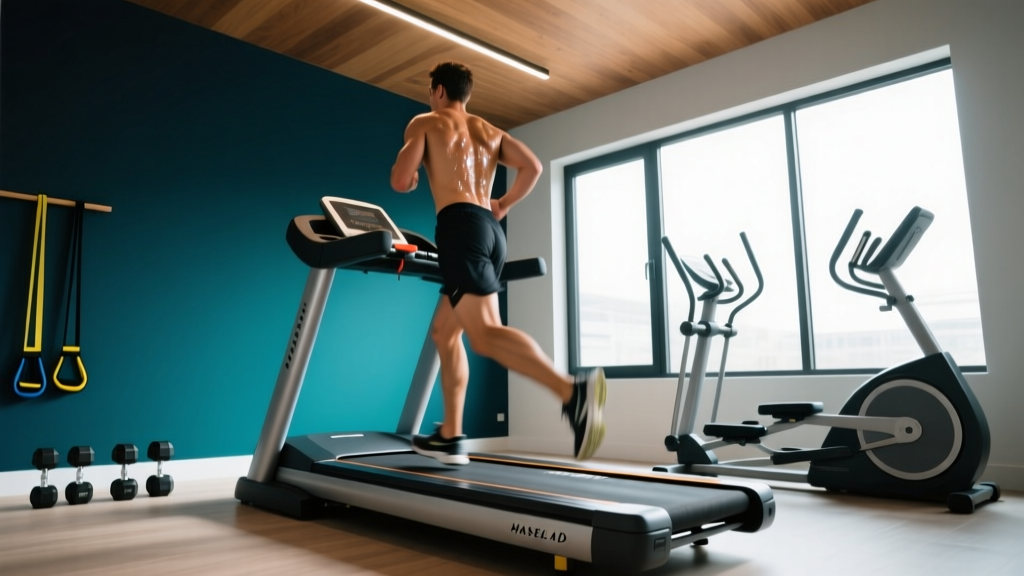
Cardio Machine Noise Comparison: Hitting Your Treadmill Mile Pace
Compare cardio machine noise levels to find the quietest gear. Learn how to maintain a fast treadmill mile pace without waking the house.

The Acoustic Reality of Home Cardio in 2026
Working out at home offers unparalleled convenience, but it introduces a unique architectural challenge: noise transfer. Whether you live in a multi-story apartment, share a home with light sleepers, or simply want to watch TV while training, the decibel output of your fitness equipment matters. According to the CDC's National Institute for Occupational Safety and Health (NIOSH), prolonged exposure to noise above 85 decibels (dB) can cause hearing damage, but even levels around 70 dB can disrupt sleep and concentration in adjacent rooms. When evaluating cardio machines, buyers often focus on screen size or incline capabilities, completely overlooking the acoustic footprint.
This guide provides an in-depth noise level comparison across the major cardio categories. We will pay special attention to the treadmill—the loudest culprit in the home gym—and explore how attempting to maintain a fast treadmill mile pace exponentially increases both impact and motor noise. By understanding the physics of machine acoustics, you can build a home gym that respects your household's peace and quiet.
Acoustic Baseline: Understanding Decibels
The decibel scale is logarithmic, not linear. An increase of 10 dB represents a tenfold increase in sound intensity and is perceived by the human ear as being roughly twice as loud. A quiet library is 40 dB, normal conversation is 60 dB, and a vacuum cleaner is 75 dB. When comparing cardio machines, a 5 dB difference between two models is highly noticeable in a residential setting.
The Treadmill Dilemma: Speed, Impact, and Your Treadmill Mile Pace
Treadmills generate two distinct types of noise: airborne/motor noise (the whir of the belt and the hum of the motor) and structure-borne impact noise (the physical thud of your footfalls transferring through the deck into the floor joists). While motor noise is relatively constant, impact noise scales dramatically with your speed and stride force.
When you are walking at 3.0 mph, the impact force is roughly 1.2 times your body weight. However, when you are training for a race and pushing a 6-minute treadmill mile pace (10.0 mph), the impact force spikes to 2.5 to 3.0 times your body weight. This creates a low-frequency, percussive thumping that easily bypasses standard drywall and floor insulation, turning your ceiling into a subwoofer for the room below.
Motor Strain at High Velocities
Hitting a sub-8-minute treadmill mile pace requires sustained speeds of 7.5 mph or higher. Residential treadmills typically use Direct Current (DC) motors. If a DC motor is underpowered (e.g., 2.5 Continuous Horsepower or lower), pushing it to 8+ mph causes the motor to strain, resulting in a high-pitched mechanical whine and increased cooling fan noise. Commercial-grade treadmills, like the Life Fitness Club Series+, use Alternating Current (AC) motors. AC motors are significantly heavier and more expensive, but they operate with a much lower, quieter hum even at maximum speeds of 12 to 15 mph.
'If your primary goal is improving your treadmill mile pace, you must account for both the structural thud of your footfalls and the acoustic whine of an overtaxed residential DC motor. Upgrading to a 4.0 CHP motor or utilizing specialized acoustic dampening mats is non-negotiable for apartment runners.' — FitGearPulse Acoustic Testing Lab, 2026
Comprehensive Cardio Machine Noise Comparison Matrix
To help you choose the right equipment, we tested the acoustic output of leading 2026 cardio machines at both low and high intensities. Note that 'High Intensity' for treadmills equates to sustaining a rigorous treadmill mile pace (8.0 - 10.0 mph), while for other machines, it represents maximum resistance and cadence.
| Machine Type & Model | Low Intensity (dB) | High Intensity (dB) | Primary Noise Source | Apartment Friendly? |
|---|---|---|---|---|
| Sole F80 Treadmill (3.5 CHP) | 62 dB (Walk) | 78-84 dB (Run) | Deck Impact / Footfalls | No (Without Mats) |
| Peloton Tread+ (Slat Belt) | 65 dB (Walk) | 82-88 dB (Run) | Hard Slat Impact | No |
| Bowflex Max Trainer M9 (Elliptical/Stepper) | 48 dB | 56 dB | Magnetic Resistance Swoosh | Yes |
| Concept2 RowErg (Air Rower) | 55 dB | 72 dB | Air Flywheel Rush | Yes (Airborne only) |
| Schwinn IC4 (Indoor Cycle) | 42 dB | 50 dB | Belt Drive / Pedal Bearings | Yes |
Beyond Treadmills: Silent Alternatives for High-Intensity Cardio
If maintaining a specific treadmill mile pace is not strictly necessary for your training regimen, and your primary goal is simply high-calorie burn and cardiovascular conditioning, alternative machines offer vastly superior acoustic profiles.
Magnetic Resistance Ellipticals and Bikes
Machines like the Bowflex Max Trainer M9 (retailing around $2,299 in 2026) or the Schwinn IC4 ($999) utilize magnetic resistance. Because there is no physical friction pad rubbing against a flywheel, and no footfalls striking a deck, the noise is limited to the mechanical whir of the belt drive and the user's breathing. At maximum effort, these machines rarely exceed 55 dB, making them entirely safe for use in a bedroom while a partner sleeps three feet away.
Air vs. Water Rowing Machines
Rowing provides a massive cardiovascular stimulus without the joint impact of running. However, the resistance type dictates the noise. The gold-standard Concept2 RowErg uses air resistance; at high stroke rates, the fan pushes a significant volume of air, generating a 'swooshing' sound that peaks around 72 dB. While not silent, it is a smooth, white-noise frequency that does not transfer through floor joists. Conversely, water rowers (like the WaterRower Natural) create a splashing sound that many find soothing, though the physical thunk of the handle returning to the catch can vibrate through hard floors if not placed on a mat.
Engineering a Quieter Workout Space: Actionable Mitigation
If you are committed to running and need to hit your target treadmill mile pace without angering your downstairs neighbors, you must address structure-borne vibration. According to guidelines on noise and vibration management from OSHA, controlling noise at the source and along the transmission path is the most effective mitigation strategy. Here is how to engineer your home gym for acoustic isolation.
- Install Vulcanized Rubber Mats: Do not use cheap, 1/8-inch PVC foam mats. You need dense, 3/8-inch thick vulcanized rubber mats (often sold as horse stall mats). The high density absorbs the low-frequency kinetic energy of your footfalls before it reaches the subfloor. Expect to spend $50 to $80 per 4x6 foot mat.
- Decouple the Machine Feet: Place specialized anti-vibration pads (like the ShockPad brand) directly under the treadmill's transport wheels and front feet. This creates a secondary isolation layer that prevents the machine's frame from acting as a tuning fork against the rubber mat.
- Avoid Floor Joist Resonance Zones: The center of a suspended wooden floor spans the greatest distance between support beams, making it highly susceptible to resonant bouncing. Position your treadmill so that the front and rear feet rest as close to the load-bearing walls or directly over the floor joists as possible. Use a stud finder to map your joists before finalizing the layout.
- Rigorous Belt Lubrication: A dry treadmill belt creates immense friction, forcing the motor to work harder and generating a loud, high-pitched squeal. Apply 100% silicone treadmill lubricant exactly every 130 miles or every 3 months. Avoid petroleum-based products, which degrade the rubber deck.
Warning: The 'Carpet' Myth
Placing a heavy treadmill directly on thick residential carpet is a common mistake. While carpet absorbs airborne sound, the soft padding underneath compresses under the dynamic load of a running stride. This causes the treadmill deck to flex unnaturally, leading to premature motor burnout, belt misalignment, and an unstable running surface that can alter your natural treadmill mile pace biomechanics. Always use a hard, dense rubber mat over carpet.
Frequently Asked Questions
Does a heavier treadmill reduce impact noise?
Yes. Heavier treadmills (typically those over 250 lbs, like the NordicTrack Commercial 1750 at 310 lbs) have more mass to absorb the kinetic energy of your footfalls. A lightweight, foldable treadmill (under 150 lbs) will physically bounce and rattle with every stride when you increase your treadmill mile pace, transferring that vibration directly into the floor.
Are manual (non-motorized) treadmills quieter?
Curved, non-motorized treadmills like the Technogym Skillrun or the AssaultRunner Elite eliminate motor noise entirely. However, because they lack a motorized belt to cushion and pull your foot, the impact of your footfalls on the slat belt is often perceived as louder and more aggressive. They are excellent for high-intensity interval training but require significant acoustic dampening mats for apartment use.
How can I test my floor's vibration transfer before buying a treadmill?
Perform the 'Jump Test.' Stand in the center of the room where you plan to place the machine. Jump up and down firmly on both feet for 30 seconds. If you hear rattling from light fixtures, or if a glass of water placed on the floor shows heavy rippling, your floor has high resonant transfer. You will absolutely need 3/8-inch rubber mats and anti-vibration pucks to run safely in that space.
Final Thoughts on Acoustic Fitness
Achieving your fitness goals shouldn't come at the expense of your household's tranquility or your neighbors' sanity. While treadmills remain the king of accessible running, maintaining a rigorous treadmill mile pace requires respect for the physics of sound and vibration. By selecting a machine with a robust AC or high-CHP DC motor, utilizing dense vulcanized rubber isolation, and considering magnetic-resistance alternatives for your high-intensity days, you can build a 2026 home gym that is as quiet as it is effective. For more detailed acoustic testing and structural load limits, refer to our comprehensive Consumer Reports Treadmill Buying Guide archives.
More gear to consider
All reviews
Stair Climber vs Runow Treadmill: Beginner Home Guide
ProForm T35 Treadmill & Stationary Bike Types: Space Layout
Elliptical vs Treadmill: Testing the Life Fitness 95Ti Treadmill

Stair Climber Setup Guide vs XTERRA Fitness TR150 Folding Treadmill
Beyond the Basic Treadmill Definition: Curved vs Motorized Guide
