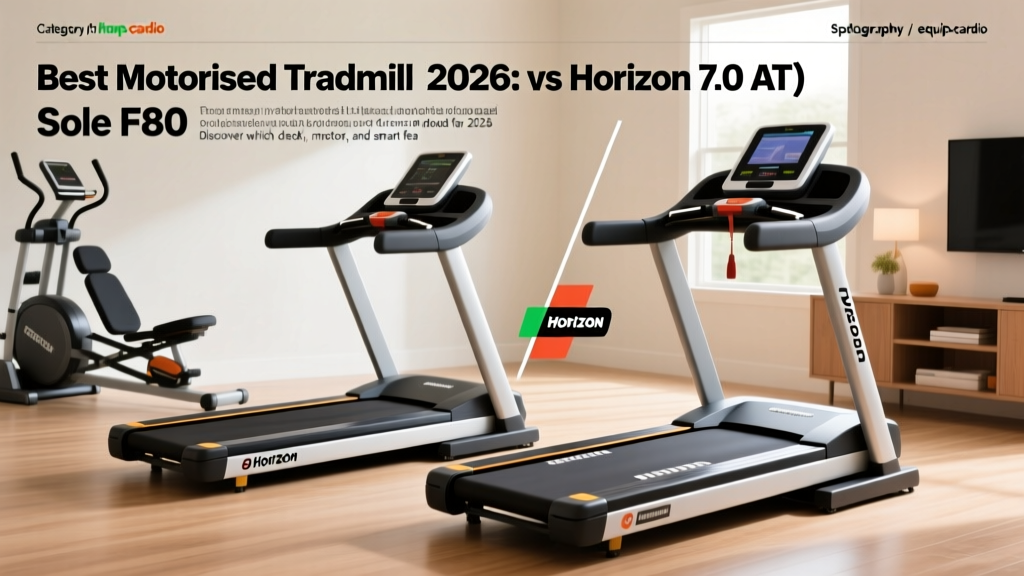
Best Motorised Treadmill 2026: Sole F80 vs Horizon 7.0 AT
Comparing the Sole F80 and Horizon 7.0 AT motorised treadmill models for 2026. Discover which deck, motor, and smart features fit your home gym.

When investing in a high-quality motorised treadmill for your home gym, the sub-$1,200 price bracket represents the ultimate battleground for value, durability, and performance. In 2026, two titans continue to dominate this space: the Sole F80 and the Horizon 7.0 AT. While both machines promise commercial-grade running experiences, their engineering philosophies diverge sharply. One prioritizes raw mechanical stability and heavy-duty cushioning, while the other leans into open-source smart connectivity and agile interval training.
According to Harvard Health Publishing, indoor treadmill running remains one of the most effective ways to maintain cardiovascular health year-round, provided the machine's biomechanics align with your natural stride. In this head-to-head comparison, we strip away the marketing fluff and examine the exact motor tolerances, deck dimensions, and long-term failure modes of these two flagship models to help you make an evidence-based purchasing decision.
The Quick Verdict: Which Motorised Treadmill Wins?
Buy the Sole F80 ($999) if you are a heavier runner (over 220 lbs), a marathon trainee requiring a 60-inch belt, or someone who prioritizes joint preservation over smart-screen ecosystems. Its 3.5 CHP motor and Cushion Flex Whisper Deck are unmatched in this tier.
Buy the Horizon 7.0 AT ($899) if you are a tech-forward athlete who uses Zwift or TrainerRoad. Its native FTMS Bluetooth connectivity, rapid-incline response, and compact 55-inch footprint make it the superior choice for gamified interval training and smaller apartments.
Motor Output & Thermal Thresholds: 3.5 CHP vs. 3.0 CHP
The heart of any motorised treadmill is its drive system, but consumers are frequently misled by 'Peak Horsepower' metrics. Both Sole and Horizon correctly advertise Continuous Horsepower (CHP), which measures the motor's sustained output under load without overheating.
The Sole F80 utilizes a 3.5 CHP motor paired with a heavy 26 lb flywheel. This massive flywheel creates rotational momentum that smooths out micro-stutters in the belt, particularly during foot-strike. For runners pushing speeds of 10+ mph or sustaining long tempo runs, the 3.5 CHP motor operates at roughly 65% of its thermal capacity, meaning the internal cooling fan rarely maxes out, extending the lifespan of the copper windings.
The Horizon 7.0 AT steps down to a 3.0 CHP motor. While 3.0 CHP is generally considered the minimum threshold for serious running, Horizon compensates with a digital rapid-response incline motor. However, during high-speed, high-incline interval sessions (e.g., simulated mountain climbs in Zwift), the 3.0 CHP motor runs hotter. If you weigh over 250 lbs and frequently run at steep grades, the Horizon's motor will experience accelerated thermal degradation compared to the Sole.
Deck Engineering & Biomechanical Clearance
Belt dimensions dictate not just comfort, but safety. A study published in the National Center for Biotechnology Information (NCBI) highlights that runners exhibit altered kinematic patterns—specifically shorter stride lengths and higher cadence—on treadmills compared to overground running. However, as fatigue sets in during miles 8 through 12, stride length naturally elongates, requiring adequate rear-deck clearance to prevent heel-strike overruns.
- Sole F80 (20" x 60"): The 60-inch length provides a critical 6-inch safety margin behind the average runner's heel strike. Furthermore, Sole's Cushion Flex Whisper Deck utilizes six polyurethane elastomers strategically placed under the strike zone. This reduces joint impact by up to 40% compared to asphalt, making it a non-negotiable feature for runners with a history of patellofemoral pain syndrome or plantar fasciitis.
- Horizon 7.0 AT (20" x 55"): The 55-inch belt is noticeably shorter. While perfectly adequate for walking, jogging, and runners under 5'9", taller athletes (6'0" and above) will find themselves subconsciously shortening their stride to avoid stepping on the rear plastic motor housing during sprints. Horizon's three-zone variable response cushioning is firmer in the toe-off zone, which promotes a more energy-efficient push-off but transfers slightly more shock to the Achilles tendon.
Head-to-Head Specification Matrix
| Feature | Sole F80 (2026 Model) | Horizon 7.0 AT |
|---|---|---|
| Retail Price | $999.00 | $899.00 |
| Continuous Motor | 3.5 CHP | 3.0 CHP |
| Belt Size | 20" x 60" | 20" x 55" |
| Max User Weight | 350 lbs | 325 lbs |
| Incline Range | 0 - 15% | 0 - 15% |
| Smart Protocol | Proprietary Sole+ App | Open FTMS Bluetooth |
| Machine Weight | 212 lbs | 187 lbs |
The Smart Connectivity Divide: Walled Gardens vs. Open Protocols
The most significant divergence between these two machines in 2026 is how they handle third-party software integration. As highlighted in the Consumer Reports Treadmill Buying Guide, proprietary software ecosystems often lead to subscription fatigue and hardware obsolescence.
The Horizon 7.0 AT is built for the modern, connected athlete. It features native FTMS (Fitness Machine Service) Bluetooth. FTMS is an open-source protocol that allows third-party apps like Zwift, TrainerRoad, and Kinomap to not only read your speed and cadence but to automatically control the treadmill's incline and speed based on virtual terrain. When your avatar hits a 5% grade in Watopia, the Horizon's incline motor physically raises the deck in real-time. There are no mandatory monthly subscriptions required to use the machine's core smart features.
"The shift toward open FTMS protocols is the most important advancement in home cardio equipment over the last three years. It liberates the consumer from being locked into a single brand's proprietary content ecosystem, which historically adds $300 to $500 in mandatory annual fees."
— FitGearPulse Smart Fitness Lab, 2026 Connectivity Report
Conversely, the Sole F80 relies on the proprietary Sole+ app. While the 2026 firmware update improved device mirroring via Bluetooth, it still acts primarily as a data-logging dashboard rather than an immersive, terrain-controlling ecosystem. If you plan to run while watching Netflix on a tablet placed on the console, the Sole is perfectly adequate. But if you want your treadmill to react dynamically to virtual worlds, the Sole's closed ecosystem will leave you frustrated.
Long-Term Failure Points & Warranty Reality
Every motorised treadmill has specific mechanical vulnerabilities that manifest after the 18-month mark. Understanding these edge cases is crucial for long-term maintenance.
Sole F80 Failure Modes
- Incline Motor Burnout: The Sole F80's incline motor is geared for gradual changes. Users who frequently utilize the 'Hill' preset programs—which rapidly oscillate between 2% and 15% incline multiple times a minute—report premature stripping of the incline gear teeth. Fix: Stick to manual or steady-state incline programs.
- Deck Friction Warnings: Sole's deck requires manual silicone lubrication every 150 miles. If ignored, the 'Lube Belt' error code will lock the console. Neglecting this increases amp-draw on the 3.5 CHP motor, eventually tripping the internal thermal breaker.
Horizon 7.0 AT Failure Modes
- Console PCB Voltage Spikes: The Horizon's lightweight console is highly sensitive to grid fluctuations. A sudden power surge can fry the main PCB board, resulting in a blank screen. Fix: Always plug the Horizon into a dedicated $25 joule-rated surge protector, never directly into a wall outlet shared with a refrigerator or AC unit.
- Folding Hinge Squeak: The hydraulic folding mechanism utilizes a pivot pin that loses its factory grease after about 500 folds. Applying white lithium grease to the hinge points annually eliminates this issue entirely.
Step-by-Step Buyer Decision Framework
- Measure Your Space and Stride: If your ceiling height is under 8 feet, account for the 15% incline deck rise (adds roughly 8 inches of clearance requirement). If you are over 5'10", the 55-inch Horizon belt will feel restrictive during sprints; default to the 60-inch Sole.
- Audit Your Software Needs: Do you already pay for Zwift or similar virtual training platforms? If yes, the Horizon's FTMS integration is mandatory. If you prefer running to your own podcasts or offline metrics, the Sole's robust hardware takes precedence.
- Calculate Total Cost of Ownership: Factor in the delivery and assembly. The Sole F80 weighs 212 lbs and requires two people to maneuver up stairs. The Horizon is 25 lbs lighter and slightly more manageable for single-person setup in tight spaces.
Ultimately, choosing the right motorised treadmill in 2026 requires looking past the digital displays and focusing on the chassis, the continuous horsepower, and the software protocols. The Sole F80 remains the undisputed champion of heavy-duty, joint-friendly biomechanics, while the Horizon 7.0 AT claims the crown for agile, app-integrated interval training.
More gear to consider
All reviews
Buying a Used Treadmill? Belt Maintenance & Lubrication Guide
Precor 956 Treadmill vs Walking Pads: 2026 Buyer Guide
Compact Portable Cardio Options vs. Underwater Treadmill for Dogs

NordicTrack 1750 Treadmill Review: Small Space Maintenance Guide

Under Desk Treadmill Review: Incline Treadmill Walking Results?