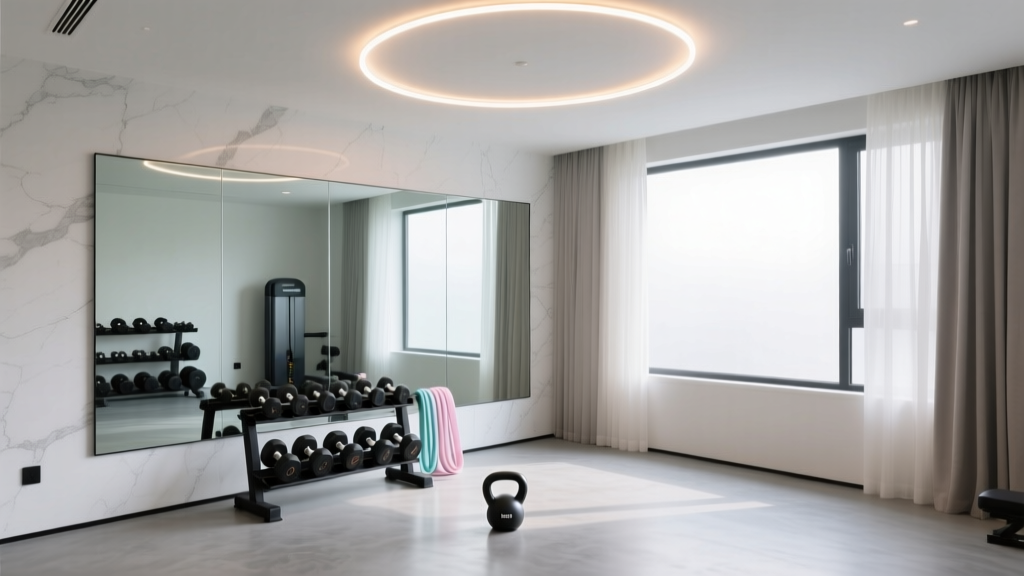
Minimalist Home Gym Design Trends 2026: Mirror & Lighting Showdown
Master minimalist home gym design trends 2026 with our head-to-head mirror and lighting comparison. Get exact placements, product specs, and install costs.

The evolution of the home fitness space has shifted dramatically. As we navigate the minimalist home gym design trends 2026, the focus is no longer on cramming every piece of equipment into a room. Instead, the modern aesthetic relies on negative space, concealed storage, and optical expansion. Two critical elements dictate whether a garage or basement gym feels like a high-end boutique studio or a cluttered storage unit: mirror selection and architectural lighting.
Choosing the right reflective surfaces and illumination is not just about vanity; it is about biomechanical feedback, spatial perception, and video recording clarity. In this head-to-head product comparison, we dismantle the two dominant approaches to minimalist gym optics: frameless low-iron glass versus slim-line architectural framing, and tunable recessed LEDs versus linear suspension pendants. We will provide exact measurements, real-world pricing, and installation frameworks to help you build a flawless space.
The Mirror Showdown: Low-Iron Frameless vs. Slim-Line Matte Framed
Standard clear glass has a distinct green tint caused by iron impurities. In a minimalist gym featuring stark white walls or polished concrete floors, this green hue creates visual dissonance. The 2026 standard demands optical purity. Here is how the top two minimalist mirror systems compare.
Contender A: 1/4-Inch Low-Iron Frameless (Starphire Equivalent)
Frameless low-iron glass offers edge-to-edge reflection without visual interruption. It relies on hidden mounting hardware to maintain the illusion of floating space.
- Material Cost: $22 to $28 per square foot.
- Hardware: Heavy-duty aluminum Z-clip (French cleat) system.
- Aesthetic Profile: Ultra-minimalist; blends seamlessly into white or light grey drywall.
- Edge Case Warning: Frameless edges are vulnerable to chipping from rogue dumbbells. Requires a minimum 6-inch buffer zone from the floor and adjacent walls.
Contender B: 1/5-Inch Matte Black Slim-Frame (1/2-Inch Profile)
For industrial-minimalist spaces (exposed brick, blackened steel racks), a micro-frame provides a defined geometric boundary while protecting the glass edges.
- Material Cost: $34 to $42 per square foot.
- Hardware: Flush-mount perimeter brackets with hidden set screws.
- Aesthetic Profile: Architectural and structured; frames the body like a gallery exhibit.
- Edge Case Warning: The bottom track of cheap framed mirrors traps moisture. In humid garage gyms, this leads to 'black edge rot' (silvering degradation) within 18 months. Ensure the frame has weep holes or a sealed gasket.
Expert Verdict: For pure minimalist expansion in small apartments or dedicated spare rooms, the 1/4-inch Low-Iron Frameless mounted on a Z-clip is the undisputed winner. The Z-clip keeps the bottom edge 1/8-inch off the floor, preventing moisture wicking and allowing for easy baseboard cleaning—a critical detail often missed by amateur installers.
Lighting the Space: Recessed Tunable vs. Linear Architectural Pendants
Lighting a home gym with mirrors requires strict adherence to the law of reflection: the angle of incidence equals the angle of reflection. If your lights are placed directly overhead or too close to the mirror wall, you will blind yourself during overhead presses. According to the Illuminating Engineering Society (IES), proper task lighting requires high Color Rendering Index (CRI) values and strategic spatial offsets to prevent glare and shadowing.
Contender A: 4-Inch High-CRI Recessed Tunable LEDs (e.g., Nora Lighting)
Recessed lighting maintains a clean, unbroken ceiling plane, which is a hallmark of minimalist design.
- Specs: CRI 95+, Tunable White (2700K - 5000K), 800 Lumens per fixture.
- Cost: $140 - $180 per fixture (including smart driver).
- Installation Offset: Must be placed 36 to 48 inches away from the mirror wall to cast light downward at a 45-degree angle, illuminating the lifter without bouncing directly back into their eyes.
- Video Recording: Must feature high-frequency drivers (3000Hz+) to eliminate banding and flicker when recording lifts on modern smartphones at 120fps or 240fps.
Contender B: 2-Inch Linear Suspension Pendants (e.g., WAC Lighting InvisiLED)
Linear pendants act as architectural focal points, drawing the eye horizontally and making narrow basement gyms feel wider.
- Specs: CRI 90+, Fixed 4000K (Neutral White), continuous run up to 20 feet.
- Cost: $220 - $300 per linear foot.
- Installation Offset: Suspended 36 inches above the floor, running parallel to the mirror wall but offset by 4 feet. This creates a 'wash' of light across the lifting platform.
- Video Recording: Excellent diffusion, but hanging cables can clash with the minimalist aesthetic if not perfectly aligned with ceiling joists.
The 2026 Minimalist Grid Framework: Exact Placement Metrics
To achieve the optical depth required for modern minimalist trends, mirrors and lights must follow a strict mathematical grid. Freehanding these measurements results in distorted reflections and harsh facial shadows during form checks. Use the matrix below to plan your layout.
| Zone / Activity | Mirror Bottom Edge Height | Mirror Top Edge Height | Lighting Placement & Angle |
|---|---|---|---|
| Squat Rack / Powerlifting | 18 inches (Clears rack bases) | 84 inches (Captures overhead bar path) | 45-degree downward angle, offset 48" from mirror wall. |
| Dumbbell / Hypertrophy | 24 inches (Clears standard DB racks) | 78 inches | Diffused linear wash, offset 36" from mirror wall. |
| Yoga / Mobility / Floorwork | 8 inches (Near floor level) | 72 inches | Wide-beam recessed, placed directly above the mat zone. |
Step-by-Step Installation Protocol for Frameless Mirrors
- Wall Prep: Ensure drywall is perfectly plumb. A 1/4-inch bow in the wall will cause a frameless mirror to crack under torque. Shim the Z-clip track using a laser level.
- Moisture Barrier: Apply a continuous bead of neutral-cure silicone (not acidic, which eats mirror silvering) to the back of the Z-clip to prevent moisture ingress in garage environments.
- The Lift: Use a vacuum suction cup lifter rated for 150 lbs. Never lift low-iron glass by the edges.
- Sealing: Leave a 1/8-inch expansion gap between adjacent mirror panels. Fill with a color-matched, flexible polyurethane sealant, not rigid caulk.
Real-World Edge Cases and Failure Modes
Even the most expensive minimalist designs fail when edge cases are ignored. Based on years of home gym auditing, here are the most common optical and structural failures:
Warning: The 'Funhouse' Subfloor Effect
If you are installing large-format mirrors (over 6 feet tall) over rubber horse-stall mats, ensure the underlying concrete is self-leveled. Rubber mats compress unevenly under heavy loads. If the mirror is mounted to a stud wall that flexes, or if the floor beneath the mirror shifts, the reflection will warp dynamically while you lift, causing spatial disorientation during heavy squats.
The Camera Flicker Problem: In 2026, recording your lifts for form analysis or social media is standard practice. Standard LED drivers pulse at 120Hz. When you record at 1/240th of a second shutter speed, your video will feature severe horizontal banding. Always specify 'Flicker-Free' or 'High-Frequency' (minimum 3000Hz) LED drivers when purchasing your lighting fixtures. This single specification separates amateur garage gyms from professional-grade studios.
Thermal Shock in Garages: If your minimalist gym is in an uninsulated garage, direct morning sunlight hitting low-iron glass while the ambient air is freezing can cause thermal shock fractures. If your mirror wall faces east or south and receives direct sun, you must apply a shatter-retention safety film (minimum 4-mil thickness) to the back of the glass. This does not affect the reflection but ensures that if the glass shatters, it adheres to the film rather than raining down on your lifting platform.
Final Verdict: Curating the 2026 Aesthetic
Achieving the minimalist home gym design trends 2026 is an exercise in restraint and precision. By selecting 1/4-inch low-iron frameless mirrors mounted on hidden Z-clips, you eliminate visual clutter while maximizing spatial depth. Pairing this with high-CRI, flicker-free recessed lighting offset at a precise 48-inch angle ensures flawless biomechanical feedback and broadcast-quality video recording. Do not compromise on the mounting hardware or the LED driver frequency; in minimalist design, the hidden technical specifications are what ultimately define the quality of the visible space.
More gear to consider
All reviews
Capcom's Home Gym Equipment Bundle Sold Out Quickly in Japan: Remodeling
Force USA HG100 Home Gym Reviews: 2026 Apartment Setup Trends
Pink Home Gym Maintenance Guide for Small Apartments

Brute Force Australia Home Gym: Mirror & Lighting Guide
Hack Squat Alternative Home Gym: Complete Setup Guide
