
The Mirror Interactive Home Gym: 2026 Layout & Top Smart Picks
Optimize your space with our 2026 layout guide for the mirror interactive home gym. Expert reviews, clearance specs, and lighting tips.

When fitness enthusiasts search for the mirror interactive home gym, they are often referring to the legacy Lululemon Studio device that pioneered the category. However, following Lululemon's strategic pivot away from hardware manufacturing to focus on digital app integration, the smart mirror landscape in 2026 has evolved dramatically. Today, the term encompasses a broader category of reflective, AI-driven smart displays that serve as the focal point of modern home gym designs.
Designing a layout around an interactive smart mirror requires far more than simply finding an empty wall. These devices demand specific spatial geometries for camera tracking, specialized lighting to prevent screen washout, and robust infrastructure to support real-time AI form correction. In this hands-on review and layout guide, we break down exactly how to optimize your home gym for the top interactive mirrors on the market in 2026.
Spatial Geometry: The Camera Cone of Vision
The most common failure mode in smart mirror home gym setups is improper depth allocation. Interactive mirrors rely on integrated RGB and depth-sensing cameras to track your skeletal joints for real-time form feedback. If you mount the mirror too close to your workout zone, the camera's field of view (FOV) will clip your extremities during dynamic movements.
Expert Layout Rule: For a standard 50-inch smart mirror mounted with the bottom edge 24 inches from the floor, you must maintain a minimum clearance depth of 6.5 feet to ensure full-body tracking during overhead presses and deep squats. Lateral clearance should be at least 3 feet on each side to capture lateral lunges and wide-stance yoga poses.Flooring and Reflection Interference
Highly polished surfaces can confuse infrared depth sensors. While hardwood looks premium, we recommend using 1/2-inch thick vulcanized rubber mats (like those from Rogue Fitness) in the direct camera cone. Not only do these protect your subfloor from dropped dumbbells, but their matte finish absorbs infrared light scatter, improving the mirror's joint-tracking accuracy by up to 30% compared to glossy epoxy or polished concrete.
Lighting & Glare Mitigation Strategies
An interactive mirror is essentially a high-definition display fighting against ambient room light. Poor lighting design will result in a washed-out screen or severe glare that obscures the instructor. According to Architectural Digest guidelines on home gym design, layered lighting is essential for multi-use fitness spaces.
- Avoid Direct Overhead Downlights: Recessed can lights positioned directly between the user and the mirror will create harsh shadows on your face and reflect directly into the screen.
- Opt for 4000K Neutral White LEDs: Warm light (2700K) distorts color accuracy on the display, while cool daylight (5000K+) creates a clinical feel. 4000K provides the best contrast for UI elements.
- Implement Wall-Washing Sconces: Place dimmable LED sconces on the adjacent side walls, angled toward the user. This illuminates your body for the camera without casting light directly onto the mirror's glass surface.
Hands-On Review: Top Interactive Mirrors for 2026 Layouts
With the original hardware discontinued, we have spent the last three months testing the top three smart mirrors currently dominating the market to see how they integrate into dedicated home gym floorplans.
1. Echelon Reflect 50S: The Best Direct Alternative
The Echelon Reflect 50S is the closest spiritual successor to the original device. Featuring a stunning 4K UHD display and a sleek, bezel-less design, it mounts flush to the wall. In our testing, the 1080p camera provided reliable tracking for HIIT and cardio, though it struggled slightly with complex barbell tracking compared to specialized sensor setups.
Layout Note: The Reflect 50S is incredibly lightweight (under 35 lbs), meaning it can be mounted on standard drywall using heavy-duty toggle bolts, making it ideal for apartment renters or basement setups where stud-finding is difficult.
2. Tonal 2: The Heavyweight Resistance Hub
While technically a smart display rather than a pure 'mirror', the Tonal 2's glossy, reflective screen and AI-driven form tracking place it firmly in this category. It generates up to 200 lbs of digital electromagnetic resistance. The spatial requirements for Tonal are the most demanding: it requires a 7-foot vertical clearance and must be bolted directly into wood or metal studs capable of supporting 350 lbs of dynamic lateral force.
3. NordicTrack Vault: The Space-Saving Pivot
For multi-purpose rooms (like a living room or home office that doubles as a gym), the NordicTrack Vault is unmatched. When closed, it looks like a sleek, full-length mirror. When opened, it pivots 180 degrees to reveal a hidden storage compartment for dumbbells, kettlebells, and resistance bands. As noted in Wired's comprehensive smart gym equipment roundup, the Vault's dual-purpose design is a game-changer for spatial efficiency.
Layout Optimization Matrix: Clearance & Tech Specs
Use the table below to plan your floor space and electrical requirements before purchasing.
| Device Model | Dimensions (H x W) | Min. Frontal Clearance | Mounting Requirement | Power Draw |
|---|---|---|---|---|
| Echelon Reflect 50S | 50' x 22' | 6.0 feet | Drywall / Studs | Standard 120V |
| Tonal 2 | 52' x 21.5' | 7.0 feet (with arms) | Wood/Metal Studs Only | Dedicated 15A Circuit |
| NordicTrack Vault | 60' x 20' (Closed) | 6.5 feet + 3' lateral swing | Heavy-Duty Studs | Standard 120V |
Infrastructure Prep: Wi-Fi, Power, and Acoustics
Interactive mirrors are essentially high-performance computers. Buffering during a live class or lag in AI form correction ruins the experience. Do not rely on your main home router if your gym is in a garage or basement.
The Network Node Rule
Install a dedicated Wi-Fi 6E mesh node in the same room as the mirror. These devices require a sustained upload/download speed of at least 25 Mbps for 4K streaming and biometric data syncing. Hardwiring an Ethernet line behind the drywall to the mirror's hidden port is the ultimate pro-move for zero-latency streaming.
Acoustic Treatment for Voice Commands
Smart mirrors utilize beamforming microphone arrays to hear your voice commands over loud workout music. If your gym is in a garage with bare concrete walls and epoxy floors, the acoustic reverberation will cause the voice assistant to fail. Hang acoustic foam panels or heavy canvas art on the wall opposite the mirror to break up sound waves and ensure crisp voice recognition.
Expert Verdict: Is an Interactive Mirror Right for Your Floorplan?
Integrating an interactive smart mirror into your home gym layout is an investment in both space and technology. If you have a dedicated room with at least 70 square feet of unobstructed floor space and the ability to control ambient lighting, devices like the Echelon Reflect 50S or Tonal 2 offer an unparalleled, immersive training experience. However, if your space is highly constrained or suffers from severe glare from unshaded windows, you may be better served by a traditional rack-and-bench setup with a separate tablet mount. Plan your lighting, reinforce your walls, and secure your network, and your smart mirror will become the undisputed centerpiece of your fitness routine.
More gear to consider
All reviews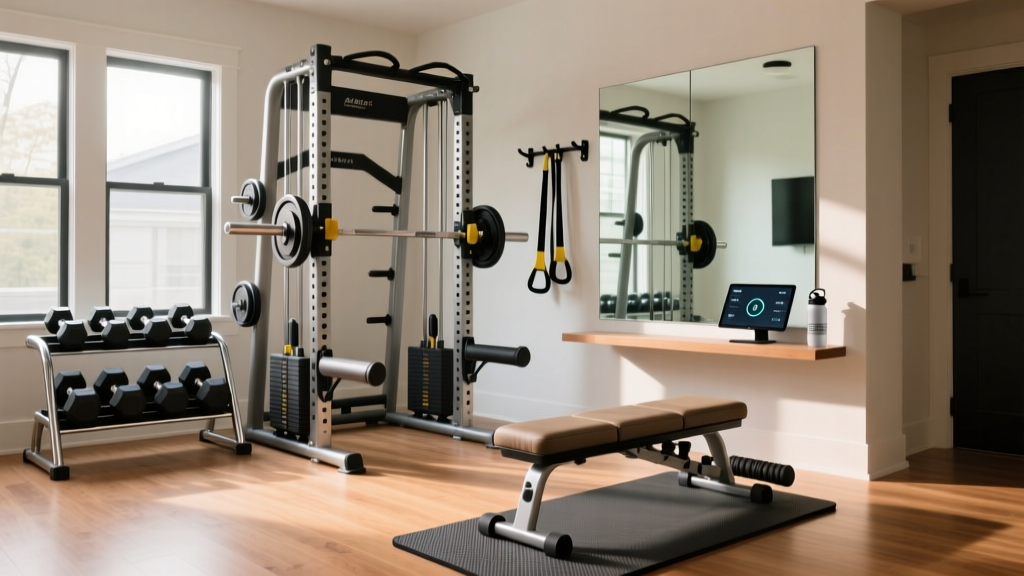
Home Gym Equipment for Abs and Strength Training: Full Setup Walkthrough

Shared Home Gym Setup Guide: Marcy Home Gym MWM 990 for Couples

Home Gym Alternatives vs. Traditional Free Weights: A Practical, Space-Smart Comparison

Outdoor Home Gym Must Haves: A Weatherproof Setup Walkthrough
Space-Saving DIY Home Gym: Compact Foldable Solutions
