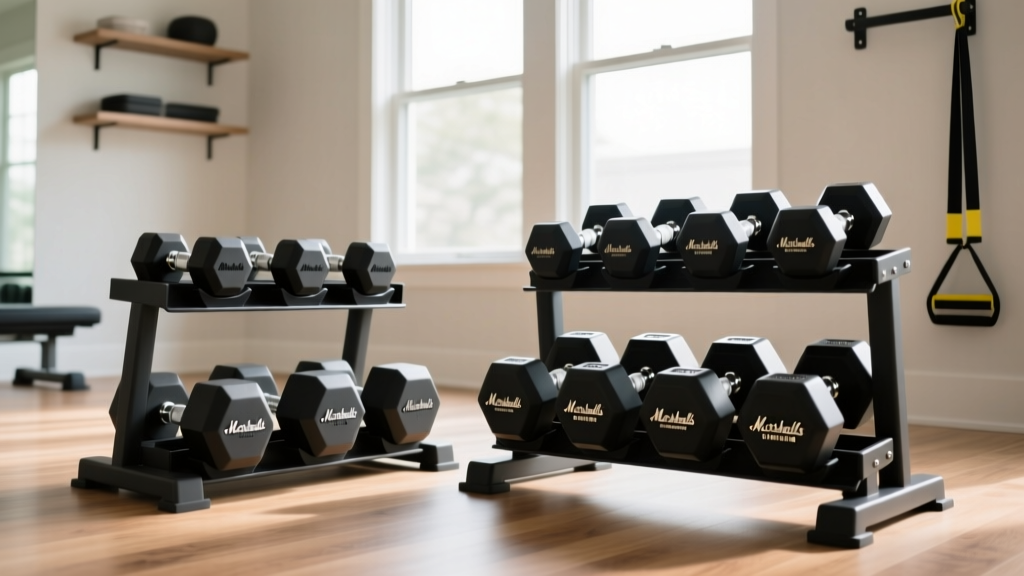
Marshalls Dumbbells vs Urethane: Space & Layout Guide
Discover how Marshalls rubber hex dumbbells compare to premium urethane for home gym space optimization, rack layouts, and footprint efficiency.

The Discount Aisle Dilemma: Budget Rubber vs. Premium Density
Walking into a discount retailer and spotting a full 5-to-50-pound set of rubber hex dumbbells for under $200 is a rite of passage for home gym builders. These Marshalls dumbbells, often sourced from bulk liquidators, offer an undeniable upfront financial advantage. However, as home gym real estate becomes more premium and layout efficiency takes center stage in 2026, the hidden spatial costs of discount gear become glaringly apparent. When you are designing a space-optimized workout environment, every square inch of floor plan and vertical clearance matters. The physical dimensions, material density, and storage requirements of your free weights directly dictate your rack selection, floor spacing, and overall gym flow.
This guide provides a deep-dive spatial analysis comparing standard discount rubber hex dumbbells (like those found at Marshalls or similar discount outlets) against premium virgin urethane dumbbells. We will explore how material density impacts rack footprint, why cheap rubber forces compromises in your layout design, and how to optimize your free weight zone for maximum efficiency.
Dimensional Analysis: How Material Density Dictates Gym Layout
The fundamental difference between a Marshalls rubber hex dumbbell and a premium urethane dumbbell lies in material density. Urethane is a highly engineered, dense polymer that packs more mass into a smaller volume. In contrast, the recycled rubber used in budget hex dumbbells is significantly less dense, requiring larger, bulkier heads to achieve the same weight. This discrepancy creates a cascading effect on your storage layout.
Consider the 30-pound dumbbell, a staple for hypertrophy and general fitness. A standard Marshalls-style rubber hex 30-pound dumbbell typically measures around 13.8 inches in total length, with a head width of approximately 4.6 inches. A comparable 30-pound urethane dumbbell, such as those modeled after Rogue Fitness Urethane Dumbbells, measures closer to 12.2 inches in length with a head width of just 3.7 inches. While a difference of 0.9 inches per head might seem negligible in the hand, it translates to nearly two inches of extra horizontal shelf space required per pair on a storage rack.
| Specification (30lb Pair) | Marshalls-Style Rubber Hex | Premium Virgin Urethane | Layout Impact |
|---|---|---|---|
| Material Density | Low (Recycled Rubber) | High (Virgin Urethane) | Urethane allows tighter vertical tier spacing |
| Total Length | ~13.8 inches | ~12.2 inches | Urethane fits on narrower, wall-mounted shelves |
| Head Width | ~4.6 inches | ~3.7 inches | Rubber hex requires wider rack crossbeams |
| Minimum Rack Depth | 28 inches (to prevent overhang) | 22 inches (flush fit) | Rubber hex eats up 6 extra inches of floor depth |
| Odor & Off-Gassing | High (Requires ventilation space) | Zero to Minimal | Urethane can be stored in tight, enclosed closets |
Rack Configurations and Spatial Constraints
Your choice of dumbbell material must align with your rack configuration. The most common storage solutions are 3-tier horizontal racks and vertical A-frame racks. Budget rubber hex dumbbells actively work against the spatial efficiency of both.
The 3-Tier Horizontal Rack Problem
A standard commercial-grade 3-tier dumbbell rack is typically 22 inches deep and 48 inches wide, designed to hold pairs from 5 to 50 pounds. Because premium urethane dumbbells are compact, they sit flush within the 22-inch depth, leaving the walkway clear. Marshalls rubber hex dumbbells, particularly in the 35lb to 50lb range, feature massively oversized heads. When placed on a standard 22-inch rack, the 50-pound rubber hex heads will overhang the edge by 3 to 4 inches. This overhang creates a severe shin-scraping hazard and forces you to purchase a deeper, 28-inch heavy-duty rack. In a tight 10x10 spare bedroom gym, sacrificing an extra 6 inches of depth across a 4-foot rack eats up 2 square feet of critical floor space, potentially interfering with your bench press or squat rack clearance.
The A-Frame Compromise
To avoid the depth issue of horizontal racks, many budget buyers opt for A-frame vertical racks. While A-frames reduce the wall-footprint to roughly 30x30 inches, they introduce a new spatial problem: the center of gravity and loading clearance. Loading 50-pound Marshalls hex dumbbells onto the upper tiers of an A-frame requires significant lateral swinging space. According to ergonomic guidelines highlighted in comprehensive equipment reviews like the Garage Gym Reviews Best Dumbbells Guide, you need a minimum of 36 inches of clearance on all sides of an A-frame to safely load and unload heavy weights without straining your lower back. This effectively turns a 2.5-square-foot rack into a 25-square-foot restricted zone, destroying the open floor plan required for functional movements like kettlebell swings or lunges.
Environmental Factors: Off-Gassing, Degradation, and Clutter
Space optimization is not solely about physical dimensions; it is also about maintaining a clean, usable, and healthy environment. Discount rubber hex dumbbells are notorious for their intense chemical odor, a byproduct of the vulcanization process and recycled materials used in manufacturing. In a small, poorly ventilated room, this off-gassing can make the space unusable for the first several months, effectively forcing you to store the weights in a garage or shed until the smell dissipates.
Furthermore, cheap rubber degrades over time. Exposure to UV light, temperature fluctuations, and the friction of being dropped on gym flooring causes the rubber to dry out, crack, and flake. This degradation creates a persistent mess of black rubber dust that spreads across your gym floor, requiring constant sweeping and threatening to stain your carpets or mats. Urethane, conversely, is UV-stable, odorless, and highly resistant to abrasion. It maintains its structural integrity and clean appearance for decades, allowing you to store it in tight, enclosed spaces like bedroom closets or under-bed storage bins without worrying about smell or debris.
Step-by-Step Layout Framework for Small Rooms
If you are designing a home gym in a constrained space (e.g., a 10x12 foot room or a single-car garage bay), follow this spatial framework to maximize your layout, keeping the dumbbell footprint in mind:
- Map the 36-Inch Safety Perimeter: Before placing any rack, mark a 36-inch boundary around your primary lifting zone (bench or squat rack). No dumbbell storage should infringe on this perimeter.
- Select Wall-Mounted or Compact 3-Tier Racks: If using urethane dumbbells, you can utilize wall-mounted fold-away racks or ultra-compact 22-inch deep 3-tier racks placed flush against the wall. This reclaims the floor space behind the rack.
- Avoid A-Frames in Narrow Rooms: If your room is less than 12 feet wide, an A-frame rack will bottleneck your traffic flow. Stick to horizontal wall-aligned storage.
- Utilize Vertical Wall Space: For lighter dumbbells (5-25 lbs), consider vertical wall hooks. Urethane dumbbells with precision-machined handles hang securely and safely on heavy-duty steel pegs, completely eliminating the need for floor racks for your high-rep, lighter-weight sets.
- Factor in the Bench Footprint: An adjustable FID bench requires roughly 18x48 inches of floor space, plus 24 inches on each side for dumbbell clearance. Ensure your storage rack does not impede the lateral movement required for heavy dumbbell chest presses.
Expert Layout Tip: When measuring your room for a dumbbell rack, always measure the depth of the rack plus the overhang of your heaviest dumbbell. If you buy Marshalls-style 50lb hex dumbbells and a 22-inch rack, your actual spatial depth requirement is 26 inches. Always plan for the overhang to prevent tripping hazards in tight walkways.
Long-Term Value: Cost Per Square Foot
The financial argument for Marshalls dumbbells usually centers on the cost per pound, which hovers around $1.00 to $1.50 per pound, compared to $3.50 to $4.50 per pound for premium urethane. However, in the context of space optimization, we must evaluate the cost per square foot of your home. If you are paying a mortgage or rent, the square footage dedicated to your gym has a tangible financial value.
By choosing bulkier rubber hex dumbbells, you are forced to buy deeper racks, utilize less efficient A-frames, and sacrifice open floor space that could be used for a rower, a cable machine, or functional turf. Premium urethane dumbbells, while demanding a higher initial capital expenditure, act as a spatial multiplier. Their compact density allows for tighter rack spacing, flush wall-mounting, and a cleaner environment, ultimately preserving the most expensive asset in your home gym: your usable floor space.
Final Verdict
If your primary constraint is a strict upfront budget and you have a massive, well-ventilated garage where spatial efficiency is irrelevant, Marshalls rubber hex dumbbells will get the job done. However, if you are designing a space-optimized home gym in 2026, building out a spare bedroom, or looking to maximize a tight garage bay, the spatial penalties of discount rubber are too high. Premium urethane dumbbells offer superior density, exact dimensional consistency, and zero environmental clutter, making them the undisputed champion for efficient, high-performance home gym layouts.
More gear to consider
All reviews
Power Rack vs Squat Rack vs Stand: PowerBlock Elite EXP Dumbbells

Olympic Barbell Weight: Upgrading the Bent Over Dumbbell Row Female

Power Rack vs Squat Rack: Room for the Dumbbell Lateral Raise Exercise

Bumper vs Iron Plates: Cost Analysis & Deltoid Workout with Dumbbells

Cast Iron vs Competition Kettlebell Care: Upgrading Your Dumbbell Back Workout at Home
