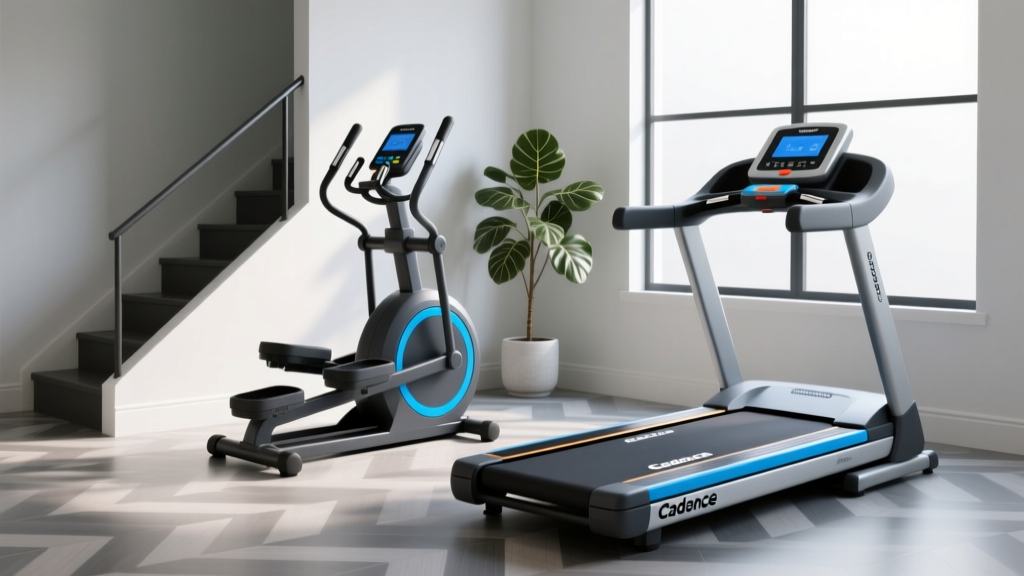
Home Gym Layout: Man Running on Treadmill vs Stationary Bike Types
Optimize your home gym layout by comparing the spatial footprint of a man running on treadmill vs. upright, recumbent, and spin stationary bike types.

The Spatial Reality: Treadmill Clearances vs. Bike Footprints
When designing a home gym in 2026, spatial optimization is no longer just about making equipment fit into a room; it is about calculating biomechanical envelopes, safety buffers, and environmental flow. The most common mistake homeowners make is measuring the static footprint of a machine while ignoring the dynamic space required to use it safely. To understand this, we must compare the spatial demands of a man running on treadmill equipment against the three primary stationary bike types: upright, recumbent, and spin (indoor cycling).
According to facility guidelines published by the American College of Sports Medicine (ACSM), cardio machines require specific safety zones to prevent injury in the event of a fall or dismount. While a treadmill demands significant vertical and posterior clearance, stationary bikes present unique horizontal and lateral challenges depending on their geometry. Let us break down the exact measurements, current 2026 pricing, and layout frameworks for these machines.
The Baseline: Spatial Dynamics of Treadmill Running
To establish a baseline for space optimization, consider the spatial dynamics of a standard 6-foot-tall man running on treadmill equipment like the popular Sole F80 (priced around $1,199). The Sole F80 has a static footprint of 37 inches wide by 82 inches long. However, the active spatial envelope is vastly larger.
- Vertical Clearance (The Ceiling Strike Risk): The Sole F80 features an 8-inch deck height. A 6-foot user (72 inches) standing on the deck reaches 80 inches. During a running gait, vertical bounce adds 3 to 5 inches, and arm swing requires additional overhead space. Therefore, a minimum ceiling height of 96 inches (8 feet) is mandatory. In basement gyms with 7.5-foot ceilings, treadmills are a severe head-strike hazard.
- Posterior Safety Buffer: The ACSM mandates a minimum of 48 inches of clear space directly behind a treadmill. If a user slips, they are ejected backward at the belt's speed (up to 12 mph). Placing a treadmill flush against a wall or a glass window is a critical failure mode in home gym design.
- Total Active Zone: Factoring in the machine and safety buffers, a single treadmill requires an active floor zone of approximately 37" W x 130" L (roughly 33 square feet).
Breakdown of Stationary Bike Types for Compact Spaces
If your room lacks the 8-foot ceilings or the 130-inch linear depth required for a treadmill, stationary bikes offer viable alternatives. However, the three main bike types interact with room geometry in entirely different ways.
1. Upright Bikes: The Vertical Compromise
Upright bikes mimic the geometry of a traditional road bike but with a slightly more relaxed torso angle. They are characterized by a small footprint but a higher vertical profile than spin bikes.
Model Spotlight: Schwinn IC4 (Approx. $899)Static Footprint: 21" W x 48" L
Active Zone Required: 36" W x 60" L (allows for mounting/dismounting and handlebar reach)
Best Layout Application: Narrow alcoves or rooms with low ceilings (minimum 7-foot ceiling clearance is sufficient). Upright bikes do not eject users backward, eliminating the need for a 4-foot posterior safety zone.
2. Recumbent Bikes: The Horizontal Space Hogs
Recumbent bikes feature a bucket seat with a backrest and forward-mounted pedals. They are the gold standard for lumbar support and rehabilitation, but they are notorious for consuming linear wall space.
Take the Horizon Comfort R (priced around $1,499 in 2026). Its footprint is 23 inches wide but a massive 63 inches long. While the vertical profile is incredibly low (often under 45 inches to the top of the seat back), the extended leg position means the user's total length exceeds 80 inches during exercise.
According to ergonomic guidelines from the IDEA Health & Fitness Association, recumbent bikes should be positioned parallel to primary walkways. Placing a recumbent bike perpendicular to a doorway creates an 80-inch trip hazard zone that severely disrupts room flow.
3. Spin (Indoor Cycling) Bikes: The Micro-Footprint Champions
Spin bikes are designed for high-intensity interval training (HIIT) and out-of-the-saddle climbing. They have the most compact footprint of any cardio machine and require zero posterior clearance.
The Keiser M3i (approx. $1,595) is a masterclass in spatial efficiency. Its footprint is just 26" W x 48" L. Because it uses magnetic resistance powered by a built-in generator, it requires no proximity to a wall outlet, allowing you to place it in the dead center of a room or facing a window without worrying about cord management. The total active zone, including lateral sway for out-of-the-saddle climbing, is a mere 40" W x 60" L (16.6 square feet)—exactly half the active zone of a treadmill.
Clearance Matrix: Treadmill vs. Stationary Bikes
Use this comparison matrix to determine which machine aligns with your room's architectural constraints.
| Machine Type | Base Footprint | Total Active Zone | Min. Ceiling Height | Posterior Buffer |
|---|---|---|---|---|
| Treadmill (e.g., Sole F80) | 37" x 82" | 37" x 130" | 8'0" (96") | 48" Mandatory |
| Upright Bike (e.g., Schwinn IC4) | 21" x 48" | 36" x 60" | 7'0" (84") | None Required |
| Recumbent (e.g., Horizon Comfort R) | 23" x 63" | 40" x 84" | 6'0" (72") | None Required |
| Spin Bike (e.g., Keiser M3i) | 26" x 48" | 40" x 60" | 7'0" (84") | None Required |
Layout Design Framework: Choosing Your Primary Anchor
When mapping out your floor plan, use these scenario-based frameworks to select the right cardio anchor based on your specific room dimensions.
Scenario A: The 10x10 Spare Bedroom (Standard Ceilings)
A 100-square-foot room with 8-foot or 9-foot ceilings can comfortably house a treadmill, provided you orient it correctly. Place the treadmill diagonally in a corner or flush against the longest uninterrupted wall, ensuring the 48-inch rear buffer faces into the room or toward an open doorway. If you prefer cycling, this room is large enough to accommodate a recumbent bike parallel to the window, leaving ample space for a separate free-weight rack.
Scenario B: The 8x8 Apartment Nook (Low Ceilings)
If you are converting a basement corner or an attic nook with 7-foot ceilings, cross treadmills off your list immediately. The vertical bounce of a man running on treadmill equipment will result in ceiling strikes. Instead, opt for a Spin Bike like the Keiser M3i or Bowflex C6. Their low top-tube heights and compact 48-inch lengths allow them to slide into tight corners, under shelving units, or directly in front of low windowsills without obstructing natural light or sightlines.
Scenario C: The Long, Narrow Hallway or Galley Space
Narrow spaces (e.g., 6 feet wide by 12 feet long) are notoriously difficult to furnish. Treadmills are too wide (37") and leave only 35 inches for walking past them, violating ADA-compliant walkway standards. Recumbent bikes are the optimal choice here. At just 23 inches wide, a recumbent bike leaves over 4 feet of lateral walking space, while its 63-inch length fits perfectly into the linear geometry of a hallway or galley-style bonus room.
Environmental Factors: Flooring, HVAC, and Sweat Zones
Space optimization extends beyond physical dimensions; it includes environmental impact. The President's Council on Sports, Fitness & Nutrition emphasizes the importance of safe, hygienic environments for home physical activity.
- Impact and Vibration: A 200-pound man running on treadmill equipment generates up to 3x his body weight in impact force per stride. This requires a high-density 3/8-inch vulcanized rubber mat to protect subfloors and dampen acoustic transfer to rooms below. Stationary bikes generate zero vertical impact, requiring only a lightweight PVC or foam mat to catch sweat.
- The Sweat Envelope: Upright and spin bikes project sweat forward and downward in a 3-foot radius. Treadmills project sweat in a wider, more diffuse pattern. Ensure your HVAC vents or portable fans are positioned to blow across the user's path, not directly onto drywall or electronics, to prevent long-term moisture damage and drywall degradation.
- Power Outlet Proximity: Treadmills and motorized recumbent bikes require dedicated 15-amp or 20-amp circuits. Mapping your layout around existing outlets prevents the use of extension cords, which are a major tripping hazard in tight home gyms.
Never route an extension cord across the 48-inch posterior safety buffer of a treadmill. If a user falls and is ejected backward, they can become tangled in the cord, pulling the machine backward or causing severe lacerations. Always route power cables along baseboards and secure them with cable channels.
Final Verdict on Space Optimization
Ultimately, the decision between accommodating a man running on treadmill equipment versus utilizing upright, recumbent, or spin stationary bike types comes down to your room's Z-axis (height) and linear depth. If you have 8-foot ceilings and 11 feet of linear depth, the treadmill remains the king of caloric expenditure. However, if you are battling low ceilings, narrow hallways, or open-concept living spaces where visual clutter is a concern, the micro-footprint of a magnetic spin bike or the ergonomic horizontal glide of a recumbent bike will provide superior spatial harmony without sacrificing cardiovascular health.
More gear to consider
All reviews
ProForm Treadmill Manual: Motor Size, HP & Setup Walkthrough

Goplus 2 in 1 Folding Treadmill Manual & Walking Pad Review

Under Desk Treadmill Value Review: How to Connect Watch to Treadmill

What Does Treadmill Do to Your Body? Noise & Impact Guide

Elliptical vs Treadmill Care: Hiitmill X Treadmill Longevity