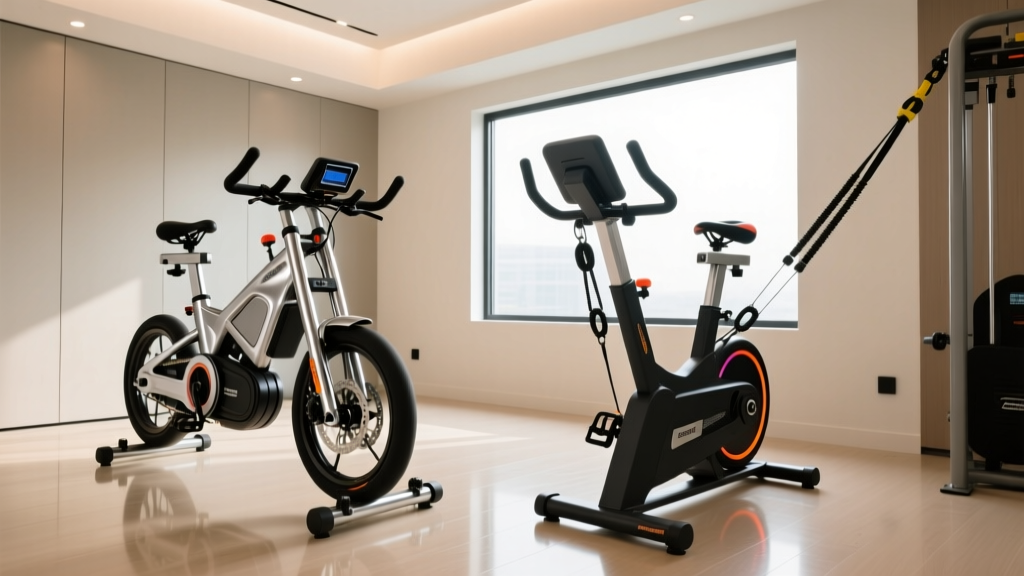
Assault Bike vs Air Bike: Layouts & Treadmill Stand Swaps
Compare the Assault Bike and Air Bike for compact home gyms. Discover layout tips, spatial ROI, and why to swap your treadmill stand for HIIT.

The 2026 Home Gym Spatial Crisis: Choosing Your Cardio Anchor
As urban living spaces shrink and remote work becomes a permanent fixture in 2026, home gym real estate is at a premium. Fitness enthusiasts are constantly forced to weigh the spatial footprint of a machine against its metabolic output. When designing a high-intensity cardio zone, the debate almost always narrows down to the two titans of wind resistance: the Assault Fitness Elite and the Schwinn Airdyne AD7. However, a secondary debate often emerges regarding low-intensity alternatives, specifically the popular combination of a walking pad and a heavy-duty treadmill stand for desk-bound professionals.
This comprehensive layout and comparison guide will dissect the exact dimensions, clearance requirements, and spatial return on investment (ROI) of the Assault Bike versus the Air Bike. Furthermore, we will explore why swapping a cumbersome treadmill stand setup for a dedicated air bike might be the ultimate space-optimization hack for time-crunched athletes seeking maximum cardiovascular adaptation.
The Contenders: Dimensional & Clearance Breakdown
Before you can map out your gym floor, you need exact measurements. Air bikes are notorious for their sprawling handlebars and massive front fans, which dictate strict operational clearances. Below is a precise breakdown of the 2026 market leaders.
| Specification | Assault Fitness Elite | Schwinn Airdyne AD7 | Rogue Echo Bike V2 |
|---|---|---|---|
| Footprint (L x W) | 58.5' x 29.5' (12.0 sq ft) | 51.0' x 28.0' (9.9 sq ft) | 59.0' x 30.0' (12.3 sq ft) |
| Height | 53.5 inches | 52.0 inches | 53.0 inches |
| Total Weight | 176 lbs (Chain Drive) | 115 lbs (Belt Drive) | 125 lbs (Belt Drive) |
| Rear Clearance Needed | 12 inches (Exhaust) | 18 inches (Intake) | 18 inches (Intake) |
| Avg. Retail Price | $1,299 | $1,199 | $1,250 |
Lateral Clearance and Handlebar Sweep
A common layout mistake is pushing an air bike flush against a wall. The multi-grip handlebars on the Schwinn Airdyne AD7 and Rogue Echo V2 sweep outward during high-cadence sprints. You must allocate a minimum lateral clearance zone of 36 inches (center of bike to wall) to prevent knuckle strikes and allow for safe mounting/dismounting. The Assault Fitness Elite features a slightly narrower handlebar profile, making it marginally more forgiving in tight alcoves, but its chain-drive system requires a different spatial consideration for maintenance access, which we will cover later.
The Treadmill Stand Illusion: Spatial ROI & Metabolic Output
When optimizing a spare bedroom or home office for fitness, many professionals default to an under-desk walking paired with an adjustable treadmill stand (a desk converter riser). While this setup promotes non-exercise activity thermogenesis (NEAT), it represents a massive spatial inefficiency for anyone seeking genuine cardiovascular conditioning.
⚠ The Spatial ROI Trap: A standard walking pad (approx. 55' x 20') combined with a treadmill stand and chair clearance demands roughly 18 to 22 square feet of dedicated operational space. Furthermore, this setup strictly limits you to Low-Intensity Steady State (LISS) cardio (1.0 to 4.0 mph).By contrast, the Schwinn Airdyne AD7 requires only 9.9 square feet of physical footprint (plus operational clearance). According to research published by the Mayo Clinic, High-Intensity Interval Training (HIIT) on an air bike can yield the same cardiovascular and metabolic benefits as 45 minutes of LISS walking, but in just 15 minutes. If your goal is VO2 max improvement and lactate threshold training, dedicating 20 square feet to a treadmill stand is a poor spatial investment compared to the dense, high-output footprint of an air bike.
Decision Matrix: Treadmill Stand vs. Air Bike
- Choose the Treadmill Stand Setup If: Your primary goal is postural variation during an 8-hour workday, you are recovering from a lower-body injury, or you strictly require Zone 1/Zone 2 active recovery while typing.
- Choose the Assault/Air Bike If: You need to maximize caloric expenditure per square foot, you engage in CrossFit-style EMOM (Every Minute on the Minute) conditioning, or you lack the ceiling height (often 80+ inches) required to safely use a treadmill stand desk converter without hunching.
Airflow, Acoustics, and Vibration Dampening Layouts
Space optimization is not just about the physical dimensions of the machine; it is about the invisible footprint of air and sound. Air bikes move massive volumes of air to generate resistance. The 26-inch fan on the AD7 can generate wind speeds exceeding 40 mph at the user's face during a max-effort sprint.
The Intake/Exhaust Rule
Never place the front fan of a Schwinn or Rogue air bike directly facing a blank wall less than 3 feet away. The fan will pull in the same turbulent, recycled air, reducing cooling efficiency and causing the motor housing to overheat during prolonged intervals. Furthermore, Harvard Health Publishing notes that thermoregulation is a critical factor in sustaining HIIT performance; if your bike's layout prevents cross-breeze, your core temperature will spike, forcing an early termination of your workout.
Acoustic Layout and Flooring
The Assault Fitness Elite utilizes a heavy-duty steel chain drive. While virtually indestructible, it generates a distinct metallic clatter and harmonic vibration that transfers directly into floor joists. If your home gym is on a second floor or above a finished basement, spatial planning must include acoustic decoupling.
Pro Layout Tip: Do not rely on standard PVC gym tiles. For chain-drive air bikes, invest in a 4x6 foot, 3/4-inch thick vulcanized rubber horse stall mat. Place a layer of closed-cell foam underlayment beneath the mat. This specific 1-inch sandwich will absorb the low-frequency vibration of the Assault Bike's chain, allowing you to position the bike in shared living spaces without causing structural noise complaints.
Conversely, the Schwinn Airdyne AD7 and Rogue Echo V2 use polyurethane belt drives. They are exceptionally quiet, allowing for greater layout flexibility in apartments or multi-use rooms where noise transfer is a primary concern.
Ergonomic Positioning & Multi-Modal Flow
In a multi-modal garage gym, the placement of your air bike dictates the flow of your workout. If you frequently combine air bike sprints with barbell complexes or kettlebell swings, the bike must be positioned in a 'transition zone'.
- The Anchor Point: Place the bike facing the center of the room or your primary mirror. This allows you to monitor your posture and knee tracking during high-cadence sprints without twisting your neck.
- The Dismount Zone: Leave a 4-foot semi-circle clear on the dominant side of the bike (usually the right side, as the drivetrain is on the right). When your heart rate is at 180 BPM and you are experiencing peripheral vision loss, you need a clear, unobstructed path to stumble off the saddle and collapse onto a plyo box or mat.
- Accessory Integration: Avoid mounting large tablet holders or bulky water bottle cages if the bike is positioned near a squat rack. The added width increases the risk of the bike's accessories clipping your barbell sleeves during rack pulls or deadlifts.
Maintenance Footprint: The Hidden Space Cost
A frequently overlooked aspect of spatial planning is the 'maintenance footprint'—the space required to actually service the machine over its lifespan.
The Assault Fitness Elite requires periodic chain lubrication and tension adjustments. To perform this, you need lateral access to the right-side drivetrain cover. If you wedge the Elite into a tight corner with only 6 inches of clearance on the right side, you will be forced to move the 176 lb machine every time you need to perform basic maintenance. Belt-driven models like the Schwinn AD7 require virtually zero drivetrain maintenance, meaning they can be parked tighter to walls or other equipment, offering superior long-term layout stability.
Final Verdict: Designing Your Cardio Zone
When optimizing your home gym layout in 2026, the choice between an Assault Bike, an Air Bike, or a traditional treadmill stand setup comes down to your metabolic goals and spatial constraints. The treadmill stand remains a valuable tool for NEAT and postural health during the workday, but it fails to deliver the high-intensity cardiovascular stimulus required for elite conditioning, all while consuming a disproportionate amount of floor space.
For the ultimate spatial ROI, the Schwinn Airdyne AD7 wins on pure footprint density and acoustic flexibility, making it ideal for tight apartments and shared spaces. However, if you prioritize the rugged, infinite durability of a chain drive and have the floor space to accommodate its maintenance clearance, the Assault Fitness Elite remains the undisputed king of the garage gym. Measure your space, respect the airflow clearances, and choose the anchor that aligns with your physiological demands.
More gear to consider
All reviews
Can an Under Desk Treadmill Hit an 8.0 Treadmill Pace? 2026 Review

Walking Pad vs Treadmill: 2026 Review & How to Clean Treadmill Belt

ProForm 520i treadmill vs 2026 Compact Cardio Market Trends
Maintaining Stationary Bike Types & Sunny Health and Fitness Treadmill SF-T4400
Stair Climber Guide: Bypassing a ProForm Treadmill Incline Problem
