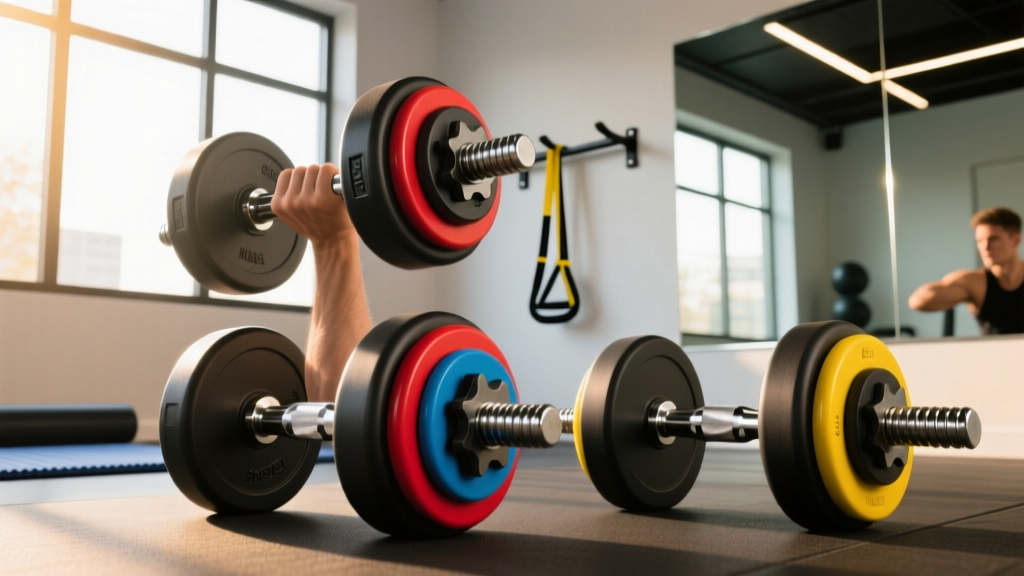
2026 Budget Guide: Loadable Dumbbells for Dumbbell Lunges Exercises
Discover the true cost of scaling dumbbell lunges exercises. We break down 2026 pricing for loadable dumbbell handles, plates, and collars to maximize value.

Unilateral leg training is a non-negotiable pillar of athletic development, hypertrophy, and injury prevention. When programming dumbbell lunges exercises, progressive overload is mandatory for continued adaptation. However, the financial barrier to properly scaling unilateral movements in a home or garage gym is frequently underestimated. While adjustable selectorized dumbbells (like the PowerBlock Pro series) offer convenience, they often max out at 50 or 70 pounds per hand—a threshold that intermediate and advanced lifters will quickly surpass on lunge variations. Fixed hex dumbbells offer infinite scaling but come with a punishing price per pound. Enter the ultimate budget-friendly, high-yield solution: loadable dumbbell handles paired with interchangeable Olympic plates.
The Fixed Dumbbell Pricing Trap for Unilateral Work
To understand the value proposition of loadable dumbbells, we must first audit the cost of traditional fixed-weight alternatives. According to biomechanical analyses of unilateral movements, the stabilizing demands of lunges require significant weight jumps to stimulate the quadriceps and glutes without compromising balance. As noted by the strength training guidelines published by the Mayo Clinic, progressive resistance is critical for muscle and bone density adaptation.
Let us break down the math for a standard lunge progression over a single training block. To properly execute walking lunges, static lunges, and Bulgarian split squats, a lifter might need pairs of 25, 35, 45, 55, and 65-pound dumbbells. In the 2026 market, premium urethane-coated hex dumbbells average $1.60 to $2.20 per pound. Purchasing these five pairs (250 total pounds) will cost between $400 and $550. Furthermore, fixed dumbbells represent 'dead capital'—they cannot be repurposed for barbell work, sled pulls, or heavy farmer's carries.
Loadable Dumbbell Handles: 2026 Market Breakdown & Specs
Loadable dumbbell handles accept standard 2-inch Olympic plates, transforming your existing plate collection into heavy dumbbells. However, not all handles are engineered equally. The three most critical specifications to evaluate are sleeve length, shaft diameter, and knurl aggressiveness. When gripping heavy weights during the eccentric descent of a lunge, handle thickness directly impacts forearm fatigue. A 1.9-inch shaft is vastly superior to a 2.0-inch shaft for grip endurance during high-rep dumbbell lunges exercises.
| Brand & Model (2026) | Sleeve Length | Shaft Diameter | Approx. Price (Pair) | Best For |
|---|---|---|---|---|
| Rogue Loadable Dumbbell Handles | 11.5 inches | 1.9 inches | $145.00 | Max capacity & grip |
| Titan Fitness Loadable Handles | 10.0 inches | 2.0 inches | $89.00 | Strict budget builds |
| Yes4All Olympic Dumbbell Handle | 9.5 inches | 2.0 inches | $65.00 | Lightweight lunges |
| Rep Fitness Loadable Dumbbell | 10.5 inches | 1.9 inches | $125.00 | Ergonomic knurling |
Sleeve Real Estate: The Hidden Limitation
The most common failure point in budget loadable dumbbell setups is miscalculating 'sleeve real estate.' A standard 45-pound cast iron plate is roughly 1.2 inches thick. A 10-inch sleeve can comfortably hold four 45-pound plates per side (8 inches total), leaving room for a collar. However, if you purchase thick crumb-rubber bumper plates or economy urethane plates (which can be up to 2.2 inches thick for a 25lb plate), you will physically run out of sleeve space before reaching your target weight. For heavy dumbbell lunges exercises, buying standard calibrated steel or thin cast-iron plates is a mandatory requirement to maximize your handle's weight capacity.
Plate Economics: Maximizing Value Without Sacrificing Ergonomics
When building a loadable dumbbell setup specifically for lunges, you need precise micro-loading capabilities. Unilateral balance is highly sensitive to weight jumps. Moving from 35 lbs to 45 lbs per hand is a 28% load increase—a massive jump for stabilizing muscles. According to the exercise mechanics database at ExRx, the lunge heavily recruits the gluteus maximus and quadriceps as synergists, requiring smooth, incremental overload to prevent knee valgus and joint strain.
Budget Warning: Avoid buying large denominations of plates (e.g., only 25s and 45s). To properly scale dumbbell lunges, you must invest in fractional plates (0.5 lb, 1.25 lb) and smaller denominations (2.5 lb, 5 lb, 10 lb). Cast iron plates currently average $0.80 to $1.10 per pound on the used market, making them the undisputed value champions for garage gyms.
Collar Security: A Critical Safety Failure Mode
There is a distinct, often overlooked danger when performing walking lunges or reverse lunges with loadable dumbbells: momentum-induced collar slippage. When you step backward into a reverse lunge, the deceleration phase generates kinetic energy that pushes the plates outward against the collar. Standard wire spring collars (the $10 plastic-and-metal clips) are categorically unsafe for dynamic lunging movements. If a spring collar fails at the bottom of a lunge, the plates slide off, violently shifting your center of gravity and virtually guaranteeing a knee or ankle injury.
The 2026 Safety Standard: You must invest in locking clamp collars. The Lock-Jaw Dumbbell Collars ($25/pair) or Rogue Monster Clamps ($32/pair) use a high-tension cam lever that bites into the steel sleeve. They add roughly 0.5 lbs each and take up 1.5 inches of sleeve space, but they eliminate the risk of plate migration during dynamic unilateral movements.
Step-by-Step: Budgeting Your First 100-lb Lunge Setup
Let us construct a highly specific, budget-optimized loadable dumbbell kit designed to take a lifter from beginner walking lunges all the way to advanced 100-lb per hand split squats.
- Handles: Titan Fitness Loadable Handles (Pair) - $89.00
- Collars: Lock-Jaw Dumbbell Clamps (Pair) - $25.00
- Plates (Cast Iron): 4x 45lb, 4x 25lb, 4x 10lb, 4x 5lb, 2x 2.5lb (Total 330 lbs) - Approx. $280.00 (at $0.85/lb)
- Total Investment: $394.00
The ROI Comparison
For $394, you possess the ability to load dumbbells in 2.5-pound increments from 10 lbs up to 100+ lbs per hand. To replicate this exact versatility with fixed urethane hex dumbbells (buying every 5-lb increment from 10 to 100 lbs), you would need 19 pairs (760 total pounds). At a conservative $1.60 per pound, that fixed dumbbell rack would cost $1,216. The loadable setup yields a 67% cost reduction while offering superior micro-loading precision for joint health and unilateral stability.
Frequently Asked Questions (FAQ)
Do loadable dumbbells feel awkward during lunges?
The physical footprint of a loaded dumbbell is larger than a fixed hex dumbbell. When holding 80 lbs per hand, the plates may brush against your thighs during the descent of a walking lunge. To mitigate this, focus on a slight forward torso lean and ensure your stride length is sufficient to clear the plate diameter. Using 10-pound and 25-pound plates (which have smaller diameters) on the innermost part of the sleeve can also help keep the weight compact closer to the handle.
Can I use bumper plates on loadable dumbbell handles?
Yes, but with severe limitations. Standard 45lb bumper plates are 17.7 inches in diameter. If you are performing walking lunges, the massive diameter of the bumpers will strike the floor before your knee reaches the proper depth, completely altering the biomechanics of the exercise and reducing the range of motion. Stick to cast iron or specialized narrow urethane plates for lower-body unilateral work.
More gear to consider
All reviews
Free Weight Setup: Barbell Collar Types & Alternate Dumbbell Press

Beyond a Dumbbells Image: Space-Saving Loadable Gym Layouts

2026 Trend: Loadable Dumbbells for Standing Core Exercises

Bumper vs Iron Plates: 2026 Single Dumbbell Workout Trends

Olympic vs Standard Plates: Serve the Platter Dumbbell Setup Guide