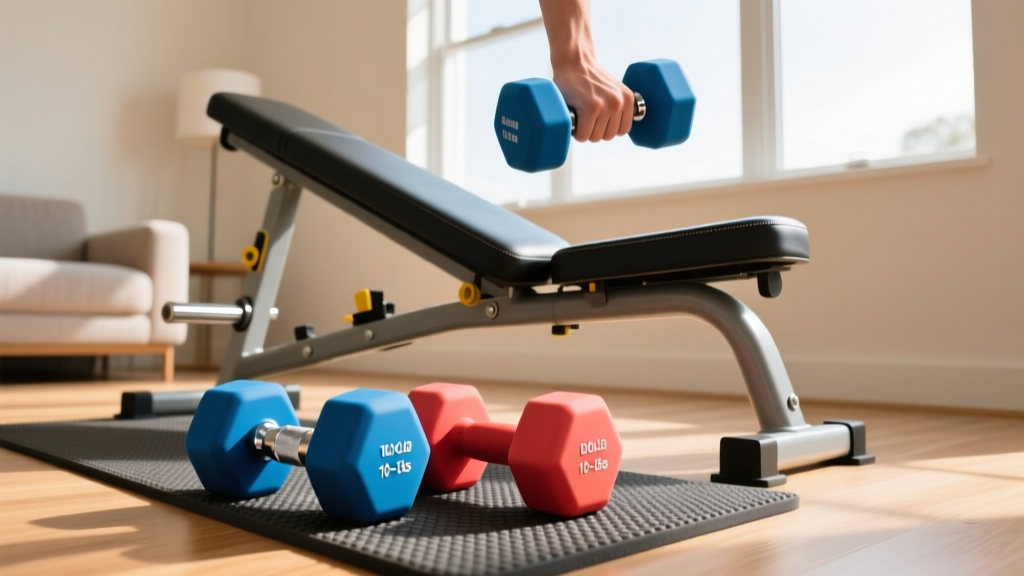
Beginner Guide: Low Incline Dumbbell Press with Neoprene Weights
Master the low incline dumbbell press at home. Our beginner guide covers neoprene dumbbell selection, bench setup, and step-by-step form cues.

The Biomechanical Sweet Spot: Why 15 to 30 Degrees?
When building a home gym, the flat bench press often gets all the glory. However, if your goal is to develop a full, aesthetically balanced chest, the low incline dumbbell press is an indispensable movement. Unlike the standard 45-degree incline press—which heavily recruits the anterior deltoids (front shoulders)—a low incline set between 15 and 30 degrees specifically targets the clavicular head of the pectoralis major (upper chest) while keeping the tension squarely on the pecs.
According to biomechanical analyses referenced in the ACE Fitness Exercise Library, adjusting the bench to a slight 15-to-30-degree angle optimizes the line of pull for the upper chest fibers without compromising shoulder joint integrity. For beginners, mastering this angle with dumbbells rather than a barbell allows for a natural, converging range of motion that accommodates individual limb lengths and reduces wrist strain.
Why Choose Neoprene Coated Dumbbells for Home Use?
Before we dive into the step-by-step execution, we must address the equipment. For home gym beginners, neoprene coated dumbbells offer a distinct set of advantages over bare iron, chrome, or even urethane:
- Superior Grip Security: Neoprene is a synthetic rubber that provides a slightly tactile, non-slip surface. When performing a low incline dumbbell press, your hands will sweat. Neoprene prevents the micro-slippages that can lead to wrist sprains at the bottom of the movement.
- Floor and Equipment Protection: Home gyms are often situated in garages or spare rooms with laminate flooring. The soft neoprene coating absorbs impact, protecting your floors if you need to bail a rep or drop the weights after a heavy set.
- Hexagonal Anti-Roll Design: Almost all neoprene dumbbells feature a hex-shaped head. This is critical for the incline press, as it allows you to safely rest the dumbbells on your thighs or the floor between sets without them rolling away.
While commercial gyms prefer urethane for its extreme durability and lack of odor, high-quality neoprene is the superior budget-friendly choice for home use. As of 2026, urethane dumbbells average $3.50 to $5.00 per pound, whereas premium neoprene sets hover between $1.40 and $2.20 per pound, making it the most cost-effective way to build a comprehensive home weight rack.
2026 Neoprene Dumbbell Buyer’s Matrix
Not all neoprene is created equal. Cheap imports often use a thin dipping process that chips after a few months. Below is a comparison of the top-tier neoprene options for home use this year:
| Brand / Model | Handle Ergonomics | Avg. Price per lb (2026) | Best For |
|---|---|---|---|
| CAP Barbell Neoprene Hex | Standard straight knurl | $1.40 - $1.60 | Budget-conscious beginners |
| Tone Fitness Soft Neoprene | Contoured ergonomic grip | $1.80 - $2.00 | Users with smaller hands/wrists |
| Yes4All Neoprene Coated | Thick chrome knurl | $1.50 - $1.75 | High-volume home circuits |
Step-by-Step: Bench Setup and the 'Thigh-Kick'
The most common point of failure for beginners isn't the press itself; it's getting the heavy dumbbells into position. Attempting to curl heavy weights up to your shoulders while lying on an incline bench is a fast track to a rotator cuff injury. Follow this step-by-step setup protocol:
- Dial in the Angle: Adjust your FID (Flat/Incline/Decline) bench to the first or second notch from the bottom. You are looking for a 15 to 30-degree angle. If your bench doesn't have degree markers, it should look like a slight recline, not a steep seat.
- The Thigh Placement: Sit on the bench and place the heads of your neoprene dumbbells on your distal thighs, just an inch or two above your knees. The hex shape will keep them stable against your legs.
- The Kick-Up: Lean back onto the bench while simultaneously driving your right knee up to 'kick' the right dumbbell into your right hand/shoulder pocket. Immediately follow with the left knee. This uses your powerful leg muscles to position the weights safely.
- Scapular Retraction: Once the weights are stabilized at your shoulders, pinch your shoulder blades together and down (imagine trying to hold a pencil between your shoulder blades). This creates a stable base and protects the shoulder joint.
Execution: The 4-Phase Press
With the National Strength and Conditioning Association (NSCA) emphasizing controlled eccentrics for beginner hypertrophy, your execution of the low incline dumbbell press should follow a strict tempo.
Phase 1: The Descent (Eccentric)
Lower the dumbbells slowly over 2 to 3 seconds. Do not flare your elbows out at a 90-degree angle to your torso. Instead, tuck your elbows at roughly a 45-degree angle. This protects the AC joint and aligns the resistance with the upper chest fibers.
Phase 2: The Stretch
Lower the weights until you feel a deep, comfortable stretch in your upper chest. The dumbbells should end up roughly at nipple-line or slightly below, outside your torso. Do not force a range of motion that causes shoulder pain.
Phase 3: The Press (Concentric)
Drive the weights up explosively but under control. Crucial cue: Do not press the dumbbells straight up toward the ceiling. Press them up and inward along a converging path, mimicking the natural function of the pectoral muscles (horizontal adduction).
Phase 4: The Squeeze
Stop just short of locking out your elbows. Bringing the dumbbells to touch at the top removes tension from the chest and places it on the triceps and joints. Keep a soft bend in the elbow at the top to maintain constant mechanical tension on the clavicular pecs.
"The primary function of the pectoralis major is horizontal adduction. Pressing dumbbells in a slight arc toward the midline, rather than straight up, yields significantly higher EMG activation in the upper chest compared to barbell variations." — Biomechanics of Resistance Exercise
Beginner Programming & Progression Framework
To build muscle and neurological efficiency, beginners should focus on moderate volume and consistent progressive overload. Here is a 4-week starter framework for the low incline dumbbell press:
- Weeks 1-2 (Form Acquisition): 3 sets of 10-12 reps. Rest 90 seconds between sets. Select a neoprene dumbbell weight that leaves you with 3 Reps in Reserve (RIR) at the end of each set. Focus entirely on the 45-degree elbow tuck and the thigh-kick setup.
- Weeks 3-4 (Hypertrophy Focus): 3 sets of 8-10 reps. Rest 120 seconds. Increase the weight by 5 lbs per hand if you can comfortably complete 12 reps with perfect form. Aim for 1-2 RIR.
Neoprene Care: Avoiding the 'Sticky' Degradation
A common edge-case failure with home gym neoprene equipment is 'stickiness' or peeling after a year of use. Neoprene (polychloroprene) is highly durable, but it is vulnerable to two specific environmental factors: UV radiation and harsh chemical cleaners.
The Maintenance Protocol:
- Never use bleach or alcohol-based wipes. These strip the plasticizers from the neoprene, causing it to dry out, crack, and eventually become a sticky mess that ruins your workout clothes.
- Wipe down with a damp microfiber cloth and a mild dish soap solution after heavy sweating sessions. The salts in human sweat can slowly degrade the coating over time if left un-wiped.
- Store away from direct sunlight. If your home gym is in a garage with a window, keep your dumbbell rack out of the direct UV rays, which break down the polymer chains in synthetic rubbers.
By pairing the biomechanical advantages of the low incline dumbbell press with the safety, grip, and floor-friendly nature of neoprene coated dumbbells, you are setting up your home gym for long-term, injury-free success. Master the thigh-kick, respect the 15-to-30-degree angle, and watch your upper chest development transform.
More gear to consider
All reviews
Are 20 Pound Dumbbells Good for Building Muscle? The Loadable Fix

EZ Bar vs Straight Bar: Standing Dumbbell Row 2026 Trends

Best Neoprene Sets for Dumbbell Exercises for Weight Loss

Barbell Collar Comparison: Securing the Heavy Dumbbell Row

Dumbbell Shoulder Workout Guide & 2026 Adjustable Dumbbell Review
