How to Choose Your First Neoprene Weight Dumbbell Set for Home
Learn how to choose and use a neoprene weight dumbbell set for home workouts. This beginner guide covers sizing, care, and starter routines.

Building a home gym is one of the most effective investments you can make for your long-term health, and the cornerstone of any functional fitness space is a reliable weight dumbbell set. For beginners navigating the crowded market of free weights, neoprene-coated dumbbells consistently emerge as the gold standard for home use. They offer an unmatched combination of floor protection, noise reduction, and ergonomic comfort.
However, not all neoprene sets are created equal. From handle ergonomics to hex-head geometry, the subtle design differences between budget and premium sets can drastically impact your workout experience. This step-by-step guide will walk you through exactly how to select, size, and maintain your first neoprene weight dumbbell set, ensuring you get the best return on your investment.
Why Neoprene is the Ultimate Beginner Coating
Neoprene is a synthetic rubber polymer that provides a soft, matte finish. Unlike traditional cast iron or hard rubber, neoprene is entirely odorless and highly resistant to moisture. According to the Centers for Disease Control and Prevention (CDC), adults should engage in muscle-strengthening activities involving all major muscle groups on at least two days a week. Having an inviting, odor-free, and aesthetically pleasing weight set in your living space drastically reduces the friction of starting these daily or weekly routines.
Coating Comparison Matrix
| Material | Odor Level | Floor Safety | Avg. Cost per Pound | Best For |
|---|---|---|---|---|
| Neoprene | None | Excellent | $1.50 - $2.50 | Home beginners, light-to-medium lifting |
| Rubber | High (initially) | Very Good | $1.20 - $2.00 | Garage gyms, heavy lifting |
| Urethane | None | Excellent | $3.00 - $5.00+ | Commercial gyms, premium home setups |
| Cast Iron | None | Poor (rust/scratch) | $0.80 - $1.20 | Traditionalists, outdoor lifting |
Step 1: Sizing Your First Weight Dumbbell Set
The most common mistake beginners make is buying a single pair of dumbbells or purchasing increments that are too far apart. To build a versatile starter set, you need weights that accommodate both your weakest muscle groups (like the lateral deltoids) and your strongest (like the glutes and quadriceps).
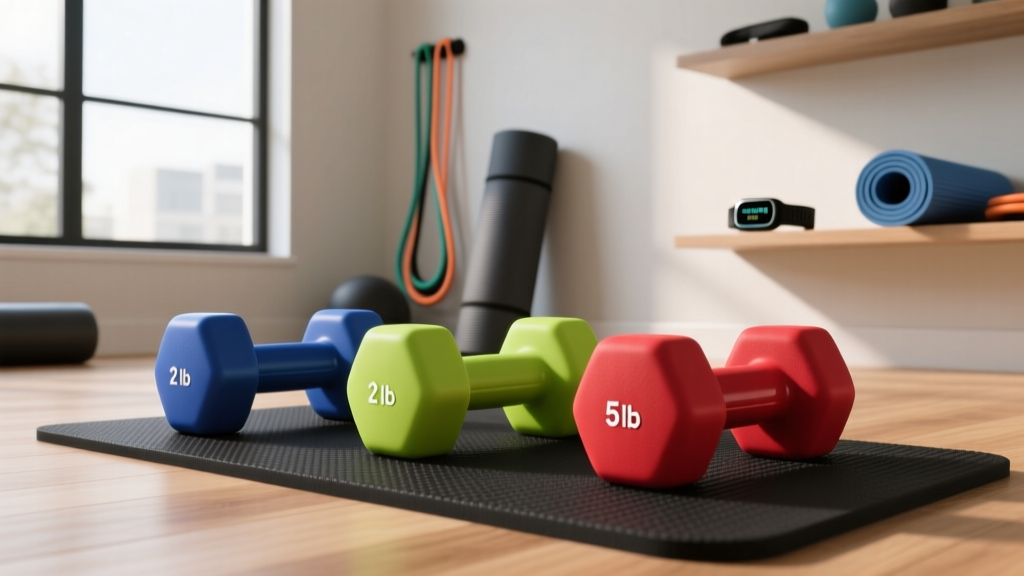
💡 The 3-Pair Starter Rule: For a universal beginner setup, purchase three pairs: a light set (5 to 8 lbs) for isolation and warm-ups, a medium set (10 to 15 lbs) for upper-body pressing and pulling, and a heavy set (20 to 25 lbs) for lower-body movements like goblet squats and lunges. Expect to spend between $90 and $140 for a high-quality 60-to-80-pound total neoprene set.Progressive Overload Planning
The Mayo Clinic emphasizes that progressive overload—gradually increasing the weight, frequency, or number of repetitions in your strength training routine—is essential for continuous muscle adaptation and bone density improvement. If your budget allows, opt for a set that includes 5 lb increments (e.g., 5, 10, 15, 20 lbs) rather than 10 lb jumps, which can be too jarring for shoulder joints when transitioning between exercises.
Step 2: Evaluating Grip and Head Geometry
The physical anatomy of the dumbbell dictates how safely and effectively you can perform movements. When shopping for a neoprene weight dumbbell set, scrutinize these two critical features:
- Hexagonal Heads (Mandatory): Always choose hex-head (six-sided) dumbbells over round ones for home use. Hex heads prevent the weights from rolling away when placed on hardwood floors or carpets, mitigating tripping hazards and protecting your baseboards.
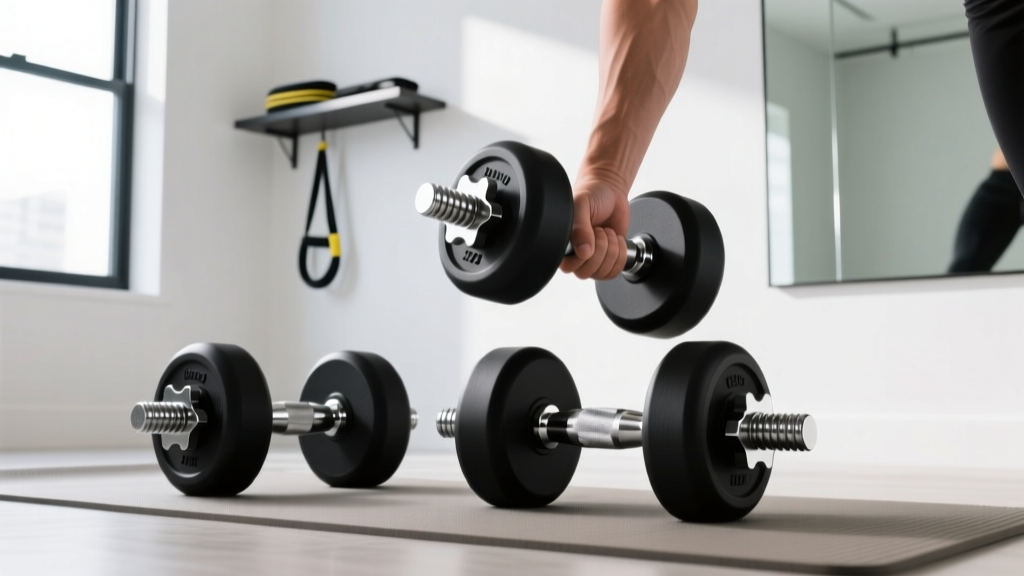
- Contoured Bare-Steel Grips: While some budget sets coat the entire dumbbell in neoprene, this is a design flaw. Neoprene grips become dangerously slippery when exposed to sweat. Look for sets where the heads are coated in neoprene, but the handle is bare, knurled, or chromed steel with a contoured (hourglass) shape. This provides tactile feedback and a secure grip.
Step 3: Your 4-Week Beginner Neoprene Dumbbell Routine
Once your set arrives, it is time to put it to work. Harvard Health Publishing highlights that consistent strength training not only builds muscle mass but also elevates your resting metabolic rate. Below is a foundational full-body routine designed specifically for a 3-pair neoprene set.
Perform this circuit 2 to 3 times per week, resting 60 to 90 seconds between sets. Focus on a slow, controlled eccentric (lowering) phase of 2-3 seconds for every repetition.
- Goblet Squats (Heavy Set - 20/25 lbs): Hold one dumbbell vertically against your chest. Keep your chest proud, brace your core, and squat until your elbows touch your inner thighs. 3 sets of 10-12 reps.
- Dumbbell Floor Press (Medium Set - 10/15 lbs): Lie on your back on a yoga mat, knees bent. Press the dumbbells up, stopping when your triceps lightly touch the floor to protect your shoulder joints. 3 sets of 8-10 reps.
- Bent-Over Rows (Medium/Heavy Set): Hinge at the hips with a flat back. Pull the dumbbells toward your hip pockets, squeezing your shoulder blades together at the top. 3 sets of 10 reps.
- Romanian Deadlifts (Heavy Set): Hold the dumbbells in front of your thighs. Push your hips back until you feel a deep stretch in your hamstrings, then drive your hips forward to stand. 3 sets of 12 reps.
- Lateral Raises (Light Set - 5/8 lbs): Stand tall and raise the dumbbells out to your sides until your arms are parallel to the floor. Pour the pitch of the dumbbell slightly forward at the top. 3 sets of 15 reps.
Step 4: Proper Care and Maintenance (Avoid the 'Peeling' Trap)
Neoprene is highly durable, but it is vulnerable to specific household cleaning chemicals. Many beginners ruin their weight dumbbell sets within the first year by wiping them down with harsh sanitizers after a sweaty workout.
⚠️ Warning: Chemical DegradationNever clean neoprene dumbbells with high-concentration isopropyl alcohol, ammonia, or sodium hypochlorite (bleach). These chemicals break down the synthetic polymer chains in the neoprene, causing the coating to dry out, turn chalky, and eventually peel off in sticky chunks.
The Correct Cleaning Protocol
To sanitize your weights safely, mix a few drops of mild dish soap (like Dawn) into a spray bottle filled with warm water. Lightly mist a microfiber cloth—not the dumbbell directly—and wipe down the steel handles and neoprene heads. Dry them immediately with a separate towel to prevent the bare steel grips from oxidizing or rusting.
Frequently Asked Questions
Can I drop neoprene dumbbells on the floor?
No. While neoprene provides a slight cushion, the interior is still solid cast iron. Dropping them from waist height will crack the neoprene shell, dent your hardwood floors, and potentially warp the metal handle. Always lower them with control or use a thick rubber mat (at least 3/8-inch thick) if you are doing high-intensity interval training (HIIT) that requires dropping the weights.
Will the neoprene color fade or stain my hands?
High-quality neoprene sets use UV-stabilized dyes that will not fade or transfer onto your skin, even when wet with sweat. However, ultra-cheap, unbranded sets found on third-party marketplaces may use inferior surface paints that can stain your palms or workout mats. Always purchase from established fitness brands (e.g., CAP Barbell, Amazon Basics, or Yes4All) that guarantee color-fast manufacturing.
How do I store my weight dumbbell set?
Invest in a tiered A-frame or horizontal rack made of steel with a rubber-lined lip. Storing your dumbbells on a rack not only keeps your home gym organized but also prevents you from having to bend over to pick up heavy weights from the floor, which is a common cause of lower back strain before a workout even begins.
More gear to consider
All reviews
Best Neoprene Dumbbells for Standing Dumbbell Rotations

EZ Bar vs Straight Bar Budget & Flat Bench Dumbbell Chest Press

Cast Iron vs Competition Kettlebells & Dumbbell Exercises for Rounded Shoulders

Best Adjustable Dumbbells for a Heavy Dumbbell Workout: 2026 Matchup

Olympic vs Standard Plates: How Many Calories Do Dumbbell Curls Burn