Loop vs Tube Bands: Budget Value & Lulu Yoga Mat Bag Guide
Compare loop vs tube bands with a 2026 budget breakdown. Discover cost-per-use data, material failure modes, and storage tips for your Lulu yoga mat bag.

The Accessory Budget Dilemma: Premium Storage vs. Core Equipment
When building a versatile home gym or travel fitness kit, consumer spending habits often defy logic. As of early 2026, it is incredibly common for fitness enthusiasts to drop $48 to $68 on a premium lulu yoga mat bag—such as Lululemon’s water-repellent Mat Carrier—only to fill it with $12 thermoplastic tube bands that will snap within three months. This misallocation of the accessory budget compromises both your training efficacy and your long-term financial ROI.
Resistance bands are not a monolith. The debate between loop bands (continuous flat or tubular latex loops) and tube bands (extruded tubing with attached handles and clips) is fundamentally a question of material science, biomechanics, and lifecycle cost. In this comprehensive budget breakdown, we will analyze the true cost-per-use of both styles, examine their distinct failure modes, and explore how your choice of band impacts the longevity and utility of premium storage solutions like your lulu yoga mat bag.
Material Science & Failure Modes: Latex vs. TPE
To understand the value proposition, we must first look at the chemical composition of the elastomers used in modern resistance bands.
The Tube Band Vulnerability
Most budget-friendly tube bands (retailing between $15 and $25 for a 5-piece set) are manufactured from Thermoplastic Elastomer (TPE). While TPE is cheap to mold and latex-free, it suffers from severe stress relaxation. Under constant tension, TPE loses its elastic memory faster than natural latex. Furthermore, the primary failure mode of tube bands is rarely the tubing itself; it is the hardware junction.
- The ABS Clip Shear: Tube bands rely on ABS plastic carabiners or metal clips threaded through nylon webbing. When stretched beyond 150% elongation, the rigid plastic clip creates a stress concentration point, eventually shearing through the softer TPE tubing.
- Handle Dead-Zones: The rigid foam handles limit the functional stretch length, creating biomechanical 'dead zones' at the top of a movement where the band cannot physically extend further without risking hardware failure.
The Loop Band Advantage
Premium loop bands (such as Rogue Fitness Monster Bands or WODFitters Continuous Loops, ranging from $20 to $45) are constructed from layered, vulcanized natural latex. The continuous manufacturing process eliminates hardware junctions entirely. Without plastic clips or rigid handles to create shear points, the tension is distributed evenly across the entire surface area of the band.
Expert Callout: The Ozone Degradation FactorNatural latex loop bands are highly susceptible to UV and ozone degradation. If you store your latex loops in the transparent outer mesh pocket of your lulu yoga mat bag while walking outside in direct sunlight, micro-fissures will develop 40% faster. Always store latex bands in the dark, interior compartment of your bag.
3-Year Cost-Per-Use Breakdown Matrix
Let us apply a rigorous financial lens to the loop vs. tube debate. The following matrix assumes a moderate training frequency of 3 resistance sessions per week (approx. 450 sessions over 3 years).
| Equipment Type | Initial Cost (2026) | Avg. Lifespan | 3-Year Replacement Cost | Cost Per Workout |
|---|---|---|---|---|
| Budget TPE Tube Set (w/ Clips) | $22.00 | 6-8 Months | $88.00 (4 sets) | $0.24 |
| Premium Latex Tube Set (w/ Clips) | $45.00 | 14-18 Months | $90.00 (2 sets) | $0.20 |
| Budget TPE Loop Set (Thin) | $12.00 | 4-6 Months | $72.00 (6 sets) | $0.16 |
| Premium Latex Loop Set (Layered) | $35.00 | 30+ Months | $35.00 (1 set) | $0.07 |
The data reveals a stark reality: premium layered latex loop bands offer a 70% lower cost-per-workout compared to budget tube bands. The initial savings of buying a cheap tube set is entirely negated by the recurring replacement costs driven by hardware failure and TPE degradation.
Storage Dynamics: Protecting Your Lulu Yoga Mat Bag Interior
Beyond the financial metrics, the physical geometry of your resistance bands directly impacts how you transport them. If you have invested in a high-end carrier like a lulu yoga mat bag, you must consider the interior preservation of the bag itself.
The Clip and Handle Hazard
Premium yoga and mat bags utilize specialized interior linings—often antimicrobial, water-repellent polyurethane (PU) or smooth nylon. Tube bands present two major threats to these interiors:
- Abrasion from Hardware: The hard ABS plastic clips and metal D-rings on tube bands act as abrasive agents. Every time you pull your mat out of your lulu yoga mat bag, the loose tube bands shift, and the rigid clips scrape against the interior lining, eventually causing pilling, micro-tears, and degradation of the water-resistant coating.
- Volume Inefficiency: Tube bands with foam handles cannot be compressed. A standard 5-piece tube set with handles consumes roughly 3.5 liters of volume, forcing you to use the bag's secondary shoe or accessory compartment, which throws off the bag's balanced weight distribution when slung over your shoulder.
The Loop Band Storage Advantage
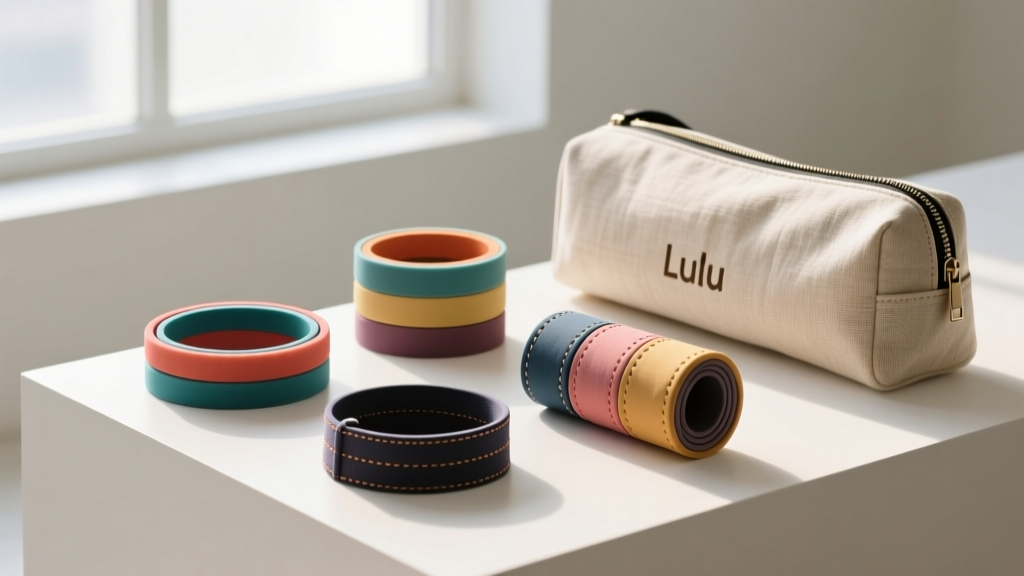
Continuous loop bands are inherently modular and compressible. A 5-piece set of layered latex loop bands can be tightly rolled or braided together into a cylinder no larger than a standard water bottle. This allows you to store them securely in the external mesh pockets or the dedicated strap loops of a lulu yoga mat bag, keeping the main compartment entirely free for your mat, towels, and foam rollers. Furthermore, without hard plastic clips, there is zero risk of interior abrasion.
Biomechanical ROI: Tension Curves and Joint Health
Financial value is irrelevant if the tool does not effectively stimulate muscle hypertrophy or support joint health. According to extensive clinical reviews on elastic resistance training published by the National Institutes of Health (NIH), elastic bands provide comparable muscle activation to traditional isotonic free weights, provided the tension curve is properly managed.
However, the hardware on tube bands disrupts this curve. When performing a banded squat or overhead press, the rigid handles of a tube band force your wrists into a fixed, often unnatural angle. Loop bands, by contrast, can be wrapped directly around the knurling of a dumbbell, looped over your forearms, or anchored beneath your feet, allowing for a fluid, natural range of motion that adapts to your specific biomechanics.
"Muscle-strengthening activities, including the use of elastic resistance bands, are critical for maintaining bone density and metabolic health across all adult age groups."
— National Institute on Aging (NIA), Guidelines on Strength Training
The Verdict: Reallocating Your Accessory Budget
The modern fitness consumer must pivot away from the aesthetic appeal of hardware-laden tube bands and recognize the superior lifecycle value of continuous loop bands. If your budget allows for a $50+ lulu yoga mat bag, it should logically prioritize the $35 investment in a high-quality, layered latex loop band set that will outlast the bag itself.
By choosing loop bands, you eliminate the recurring costs of replacing snapped TPE tubes, protect the premium interior lining of your gym bag from abrasive plastic clips, and unlock a more versatile, joint-friendly biomechanical tool for your training arsenal.
Frequently Asked Questions (FAQ)
Can I use loop bands for the same exercises as tube bands?
Yes, and often with better ergonomics. For exercises like bicep curls or lateral raises where a handle feels natural, you can simply fold a thin latex loop band in half and grip the folded loop, or use specialized silicone grip sleeves (approx. $8) that slide over the loop band to protect your palms without adding rigid, restrictive plastic handles.
How do I clean latex loop bands without damaging them?
Never use chemical cleaners, alcohol, or essential oils on natural latex, as these strip the vulcanized surface and accelerate dry rot. Simply wipe them down with a damp microfiber cloth and mild dish soap after heavy sweat sessions, then air dry them in the shade before placing them back into your lulu yoga mat bag.
Are fabric loop bands better than latex?
Fabric loop bands (usually a cotton-elastane blend) are excellent for lower-body glute activation (like clamshells or lateral band walks) because they do not roll up your legs or pull on body hair. However, they lack the extreme elongation and variable resistance tiers required for upper-body training, making layered latex loops the more versatile, budget-friendly choice for a complete kit.
More gear to consider
All reviews
Medicine Ball Weight Selection & Yoga Mat Care Instructions

Foam Roller Density & Size Guide + DIY Yoga Mat Cleaner Recipe
2026 Pilates Accessories Guide & Best Teal Yoga Mat Picks

Therabody Yoga Mat & Stability Ball vs BOSU Ball 2026 Trends

Loop vs Tube Bands: 2026 Trends & Moonkissed Collective Orchid Mat
