Loop Band vs Tube Band: Top Rack for Yoga Mats & Gear Storage
Compare loop band vs tube band costs, durability, and storage. Discover how a multi-use rack for yoga mats protects your gear and maximizes home gym ROI.

The Hidden Economics of Home Gym Resistance Gear
When outfitting a home gym in 2026, most athletes focus on the upfront price tag of their equipment. However, the true cost of resistance training accessories lies in their longevity, replacement frequency, and the hidden 'storage tax' that degrades gear over time. The debate between loop bands and tube bands is often framed around exercise selection, but from a budget breakdown and value analysis perspective, it is fundamentally a question of material science, failure modes, and organizational infrastructure.
According to the Mayo Clinic, consistent strength training is vital for long-term metabolic and musculoskeletal health. Yet, inconsistent equipment failure disrupts this consistency. In this comprehensive value analysis, we break down the exact 5-year cost of ownership for loop versus tube bands, examine their distinct tension curves, and reveal why investing in a multi-tiered rack for yoga mats is the ultimate budget hack for preserving your resistance gear.
Material Science and Tension Curves: Where Your Budget Actually Goes
To understand the value proposition, we must first look at what you are actually paying for. The market is saturated with cheap thermoplastic elastomer (TPE) bands, but serious athletes invest in 100% natural latex.
The Loop Band Advantage: Linear Tension and Durability
Heavy-duty loop bands (such as the Rogue Fitness Monster Bands or TheraBand CLX) are manufactured using a continuous molding process. This results in a seamless ring of natural latex. Because there are no mechanical joints, the primary failure mode is UV degradation or micro-tearing from sharp fingernails. Furthermore, loop bands offer a true linear tension curve. According to biomechanical data cataloged by ExRx.net, the resistance increases proportionally with the stretch distance, making them highly predictable for accommodating resistance on barbell squats or deadlifts.
The Tube Band Reality: Mechanical Failure Points
Tube bands (like the popular Bodylastics stackable sets or Fit Simplify tubes) consist of a latex core encased in a braided nylon sleeve, terminating in plastic carabiners. The nylon sleeve prevents over-stretching and snapping, which is a great safety feature. However, the failure point simply shifts to the mechanical joints. The friction where the latex tube enters the plastic carabiner clip inevitably causes internal shearing. Under heavy use (3+ days a week), the latex core frays inside the sleeve, leading to sudden, unpredictable snaps at the handle joint.
Loop Band vs. Tube Band: A 5-Year Cost of Ownership Analysis
Let us look at the hard numbers. The following table breaks down the projected costs for a dedicated home gym user training 150 sessions per year over a 5-year period.
| Metric | Heavy-Duty Loop Bands (e.g., Rogue Echo) | Stackable Tube Bands (e.g., Bodylastics) |
|---|---|---|
| Initial Upfront Cost | $115.00 (Set of 4 varying resistances) | $45.00 (Set of 5 with handles/anchors) |
| Average Lifespan | 3 to 5 Years | 12 to 18 Months |
| Replacements Needed (5 Yrs) | 0 to 1 | 3 to 4 Full Sets |
| Accessory Costs (Anchors/Straps) | $20.00 (One-time door anchor purchase) | $0.00 (Included in initial kit) |
| 5-Year Total Cost | $135.00 - $250.00 | $180.00 - $225.00 |
| Cost Per Workout Session | ~$0.18 | ~$0.24 |
The Takeaway: While tube bands win on initial sticker price, loop bands offer a superior long-term ROI for heavy users, provided they are stored correctly to prevent environmental degradation.
The Storage Tax: Protecting Your Latex Investment
Natural latex is highly susceptible to oxidation, UV light, and extreme temperature fluctuations. When left in a pile on the floor, tangled with metal weights, or exposed to direct sunlight from a garage window, the latex oxidizes, turning brittle, sticky, and prone to catastrophic snapping. Proper storage is not just about aesthetics; it is a financial imperative to protect your gear investment.
Why a Rack for Yoga Mats is the Ultimate Multi-Tool
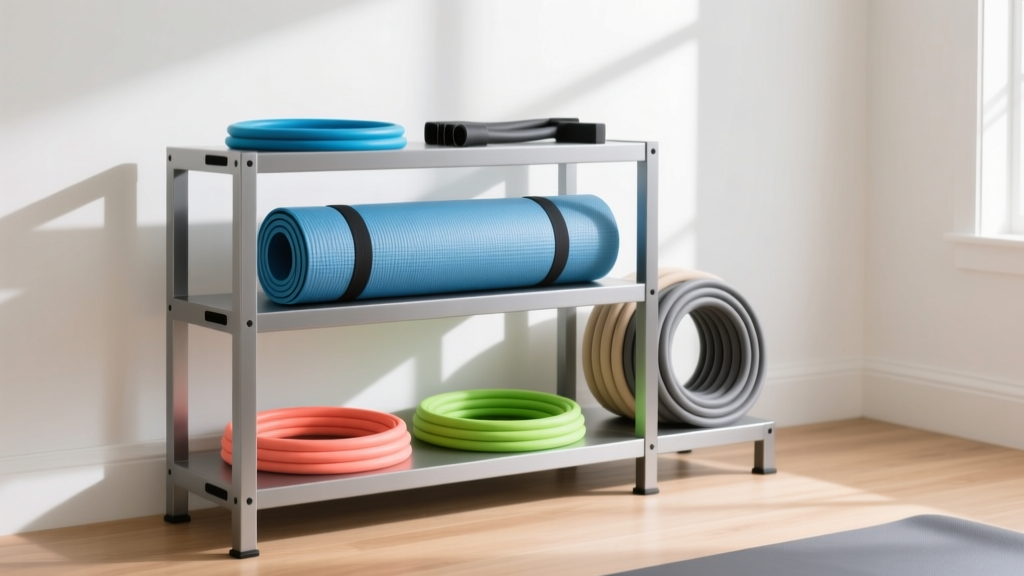
This is where organizational strategy meets budget efficiency. Tube bands with handles and door anchors become a tangled nightmare when thrown in a bin. Loop bands, however, share the exact same storage profile as rolled yoga mats and foam rollers. Instead of buying expensive, specialized resistance band cabinets, the most cost-effective solution in 2026 is repurposing a high-quality rack for yoga mats.
A standard premium yoga mat is 24 inches wide and rolls to a diameter of about 4.5 inches. Heavy-duty loop bands, when rolled, measure roughly 4 inches in diameter. Wall-mounted or freestanding bamboo and steel racks designed for yoga mats feature horizontal dowels or shelves spaced exactly to accommodate these dimensions.
Expert Gear Tip: The Bamboo Advantage
When shopping for a rack for yoga mats to store your resistance bands, opt for bamboo or powder-coated steel over raw wood or cheap plastics. Bamboo is naturally moisture-resistant, which helps regulate the humidity around your natural latex bands. Models like the Yes4All Wall Mount Bamboo Yoga Mat Rack ($28.99) or the BalanceFrom GoYoga 4-Tier Rack ($42.50) provide ample horizontal space to lay loop bands flat without stretching them, while side hooks can be used to hang tube band nylon sleeves and neoprene handles.
Budget Tiers: Building Your Band & Recovery Station
To help you allocate your home gym budget effectively, we have broken down three investment tiers that combine resistance gear with optimal storage solutions.
Tier 1: The Minimalist Starter ($65 Total)
- Gear: Fit Simplify Heavy Duty Loop Band Set ($15) - Note: These are TPE, not natural latex, but acceptable for beginners.
- Storage: Basic over-the-door mesh shoe organizer ($12) - Keeps bands separated and away from UV light.
- Accessories: Generic foam door anchor ($8).
- Recovery: Standard 6mm PVC Yoga Mat ($30).
- Value Verdict: Low upfront cost, but expect to replace the TPE bands within 8 months due to material fatigue.
Tier 2: The Hybrid Athlete ($165 Total)
- Gear: TheraBand CLX Loop Band Set ($45) - Excellent clinical-grade latex with easy-grip loops.
- Storage: Yes4All Wall Mount Bamboo Rack for Yoga Mats ($29).
- Accessories: Rogue Fitness Matador Door Anchor ($25).
- Recovery: Gaiam Essentials Yoga Mat ($35) + 12-inch EVA Foam Roller ($31).
- Value Verdict: The sweet spot for value. The bamboo rack keeps the CLX bands organized and out of sunlight, easily extending their lifespan past the 3-year mark.
Tier 3: The Performance Purist ($280 Total)
- Gear: Rogue Fitness Monster Echo Bands (Set of 3) ($135) - Indestructible natural latex for heavy powerlifting integration.
- Storage: BalanceFrom GoYoga Freestanding Steel Rack ($45) - Holds multiple mats, rollers, and all loop bands.
- Accessories: Heavy-duty nylon anchor strap and carabiner system ($30).
- Recovery: Manduka PRO Yoga Mat ($70).
- Value Verdict: Highest initial cost, but the lowest cost-per-workout over a decade. The steel rack ensures zero tension is placed on the bands while stored.
Maintenance Protocols to Maximize ROI
Even the best rack for yoga mats and bands cannot save gear that is improperly maintained. The Centers for Disease Control and Prevention (CDC) emphasizes the importance of safe, consistent physical activity routines, which requires reliable equipment. To ensure your bands survive their maximum projected lifespan, implement these maintenance protocols:
- The Talcum Powder Trick: Once a month, lightly dust your natural latex loop bands with 100% pure talcum powder or cornstarch. This prevents the latex from adhering to itself and stops the oxidation process that causes the 'sticky' degradation phase.
- Temperature Control: Never store your bands in a garage or shed where temperatures drop below freezing or exceed 85°F (29°C). The indoor, climate-controlled environment of your bedroom or living room (where your yoga mat rack likely resides) is ideal.
- Inspect the Micro-Tears: Before every heavy session, run your thumb along the edge of the loop band. If you feel any jagged edges or micro-tears, retire the band immediately. A small tear under 150 lbs of tension will propagate into a full snap in milliseconds.
Expert Verdict: Which Setup Wins?
When analyzing the budget breakdown and long-term value, heavy-duty natural latex loop bands are the undisputed winners for serious athletes. While stackable tube bands offer convenience for travel and light rehabilitation, their mechanical failure points make them a recurring expense rather than a long-term investment.
However, the true secret to maximizing your home gym ROI lies in how you treat the gear post-workout. By abandoning the tangled plastic bin and investing in a dedicated, multi-tiered rack for yoga mats, you create a centralized, UV-protected recovery and resistance station. This single organizational upgrade not only preserves the structural integrity of your latex bands but also streamlines your daily fitness routine, ensuring that your budget works as hard as you do.
More gear to consider
All reviews
Best Mini Yoga Mat, Block & Strap Travel Guide 2026

Pull-Up Assist Band Sizing & Packing Your Gaiam Yoga Mat Bag

Resistance Band Sets & Lululemon Yoga Mat Colors: Beginner Guide

Battle Rope Length & Thickness Guide: Setup & Manduka Yoga Mat Care

Pilates Accessories Guide: Budget & Average Yoga Mat Thickness
