Loadable Dumbbells for a Budget Dumbbell Workout Routine (2026)
Discover how loadable dumbbells with interchangeable plates offer the best budget breakdown for a scalable home dumbbell workout routine in 2026.

The Economics of a Progressive Dumbbell Workout Routine
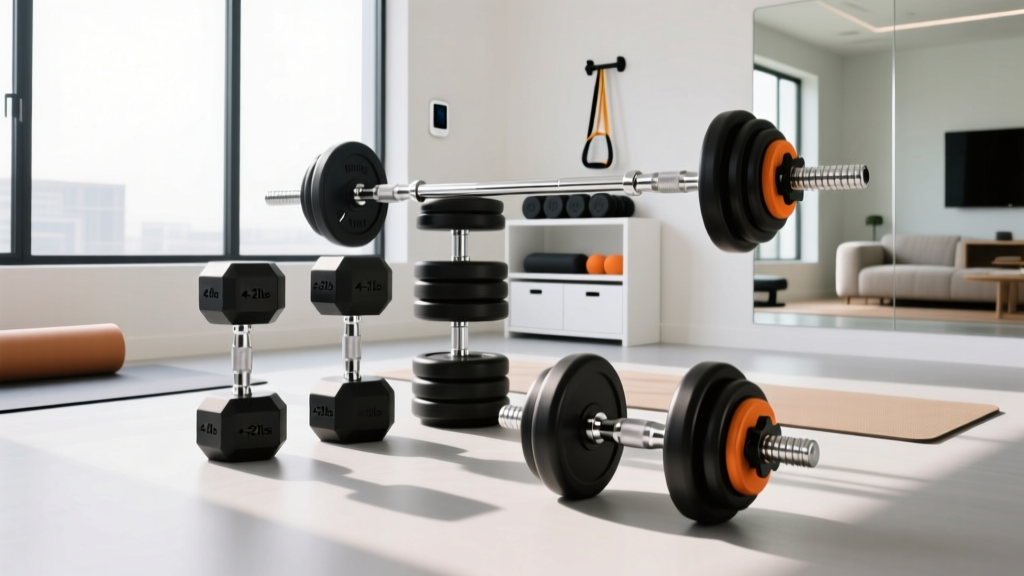
Building a scalable home gym in 2026 requires navigating a harsh financial reality: fixed rubber hex dumbbells cost an average of $2.50 to $3.50 per pound. Outfitting a full rack from 5 to 50 pounds in 5-pound increments will easily set you back $800 to $1,200, not including the storage rack. For lifters focused on hypertrophy and strength progression, this upfront capital barrier is immense. Enter the loadable dumbbell with interchangeable plates—a modular system that fundamentally alters the cost-per-pound ratio of your home setup.
When designing a long-term dumbbell workout routine, progressive overload is non-negotiable. According to the American Council on Exercise (ACE), systematically increasing the stress placed on the musculoskeletal system is the primary driver of muscle growth and strength gains. Loadable dumbbells allow you to purchase weight incrementally as your strength improves, transforming a massive upfront expense into a manageable, pay-as-you-grow fitness investment.
2026 Value Benchmark: The $1.50/lb Threshold
In the current market, a highly optimized loadable dumbbell setup (standard 1-inch cast iron plates paired with budget spin-lock handles) averages $1.40 to $1.65 per pound when bought in bulk. This represents a 55% savings compared to entry-level fixed urethane dumbbells, making it the undisputed king of budget home gym economics.
Upfront vs. Long-Term Costs: Fixed vs. Loadable Matrix
To understand the true value proposition, we must compare the financial footprint of loadable systems against fixed alternatives and adjustable dial dumbbells (like the Bowflex SelectTech or Nuobell). While dial dumbbells offer speed, their cost-per-pound remains notoriously high, and their mechanical complexity introduces long-term failure risks that loadable iron simply does not possess.
| Equipment Type | Upfront Cost (Pair to 50lbs) | Cost Per Pound | Expansion Cost | Lifespan / Durability |
|---|---|---|---|---|
| Fixed Rubber Hex | $500 - $750 | $2.50 - $3.50 | High (Must buy new pairs) | High (Rubber degrades over time) |
| Dial Adjustable (e.g., Nuobell) | $350 - $450 | $4.50 - $5.50 | N/A (Capped at 80lbs) | Moderate (Internal gears can fail) |
| Standard 1' Loadable | $140 - $180 | $1.40 - $1.80 | Low (Buy extra plates) | Indefinite (Solid iron/steel) |
| Olympic 2' Loadable | $220 - $300 | $1.80 - $2.20 | Low (Uses existing barbell plates) | Indefinite |
Top Loadable Dumbbell Handles: Value Analysis
The handle is the anchor of your loadable system. In 2026, the market is saturated with cheap imports, but only a few models offer the structural integrity required for heavy, unilateral movements without bending sleeves or stripping threads.
1. CAP Barbell 14-Inch Solid Steel Spin-Lock (The Ultra-Budget Pick)
Priced at roughly $24.99 per pair, the CAP Barbell 14-inch handle is the gateway to budget lifting. The 14-inch length allows for approximately 5.5 inches of sleeve space per side, capping out around 45 to 60 pounds depending on the plate width you use. The Catch: The star-nut collars require significant time to thread on and off, which can disrupt the density of a fast-paced dumbbell workout routine featuring supersets or drop sets.
2. Titan Fitness Loadable Olympic Dumbbell Handles (The Heavy-Duty Upgrade)
Retailing at $89.99 per pair, these 2-inch Olympic handles are designed for lifters who already own barbell plates. Featuring a 35mm grip diameter and a massive 150-pound weight capacity per hand, they bridge the gap between dumbbells and short barbells. However, the 35mm grip thickness is a critical edge case: lifters with smaller hands will experience premature grip fatigue during high-rep Romanian deadlifts or lunges.
3. Yes4All 16-Inch Premium Grip Spin-Lock (The Mid-Tier Sweet Spot)
At $38.99, the Yes4All 16-inch model offers a contoured, knurled grip and extended sleeves, accommodating up to 80 pounds per hand using standard 1-inch plates. The chrome plating resists rust far better than the painted finishes found on cheaper alternatives, making it the highest-value handle for humid environments or garage gyms.
The Plate Dilemma: Cast Iron, Urethane, and the Diameter Problem
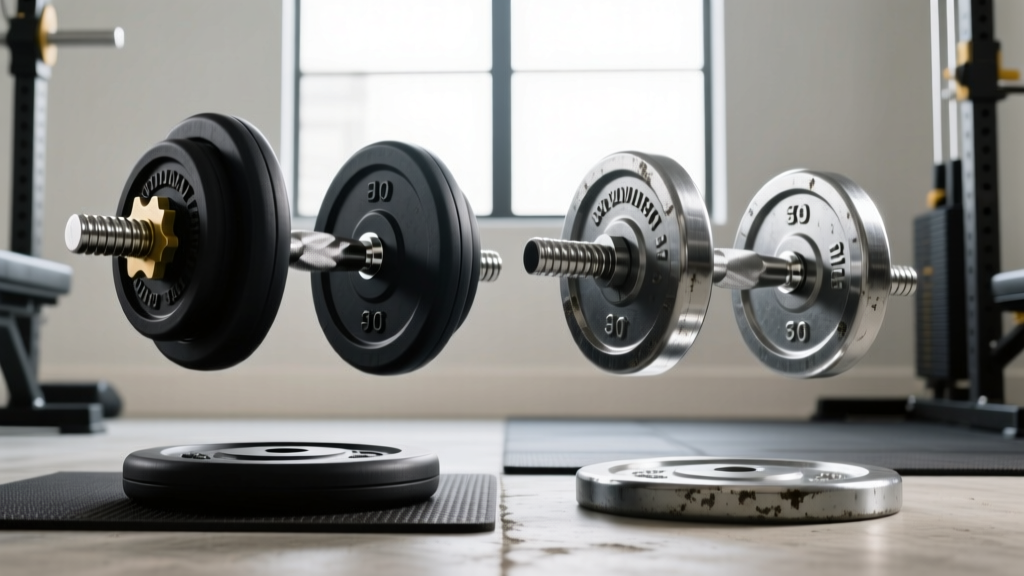
The true value of a loadable system lies in the plates. While cast iron remains the cheapest option (averaging $1.50/lb used or $2.00/lb new), lifters frequently encounter the 'Diameter Problem' when executing floor-based movements.
Expert Insight: The ROM Killer
A standard 1-inch 25-pound cast iron plate has a diameter of roughly 8.5 inches. If you load a 55-pound dumbbell (two 25s and a 5), the plates will physically strike the floor during a dumbbell floor press or renegade row before your pectorals achieve a full range of motion (ROM). To preserve your biomechanics, prioritize buying multiple 10-pound plates (6.5-inch diameter) to stack, or transition to Olympic plates where the weight distribution is denser.
If you are dropping weights from overhead or performing explosive movements, cast iron will destroy your flooring. In these scenarios, investing in crumb rubber or urethane bumper plates is mandatory, though it will push your cost-per-pound closer to $3.00.
Hidden Costs and Mechanical Failure Modes
When running a financial breakdown, most buyers forget to account for the hidden friction points of loadable dumbbells. Addressing these edge cases early will save you money and frustration.
Collar Slippage and Thread Wear
During dynamic movements like dumbbell snatches or walking lunges, rotational torque vibrates standard spin-lock collars loose. A loosened collar shifts the weight distribution mid-rep, creating a severe safety hazard. The Fix: Purchase a set of rubber O-rings ($5 for a pack of 10) and place them on the sleeve before threading the collar. The rubber acts as a friction gasket, completely eliminating rotational slippage without the need to buy expensive lever-lock collars.
The Time Tax of Weight Changes
A comprehensive study on resistance training volume and hypertrophy highlights the importance of sustained mechanical tension and adequate volume. If your dumbbell workout routine requires 5-pound jumps across four different exercises, you will spend nearly 10 minutes of your 45-minute workout just threading collars. To mitigate this 'time tax,' structure your routine by exercise grouping (e.g., all heavy pressing, then all light isolation) rather than traditional straight sets.
Structuring Your First Scalable Dumbbell Workout Routine
To maximize the ROI of your loadable dumbbell investment, implement a micro-loading progression framework. Because you control the plates, you can utilize 1.25-pound fractional plates to ensure continuous adaptation without hitting a hard plateau.
- Weeks 1-3 (Base Volume): Select a weight that allows 3 sets of 10 reps with 2 reps in reserve (RIR). Focus on tempo and mind-muscle connection.
- Weeks 4-6 (Micro-Loading): Add 1.25 lbs to each dumbbell (2.5 lbs total load increase). Maintain the 3x10 rep scheme. This 2.5% load increase is often imperceptible but mathematically forces adaptation.
- Weeks 7-9 (Intensity Peaking): Add 2.5 lbs to each dumbbell and drop the rep target to 3 sets of 6-8 reps. This shifts the stimulus from pure metabolic stress to mechanical tension.
- Week 10 (Deload & Reassess): Reduce volume by 50% to allow central nervous system recovery, then test your new 8-rep max to establish the baseline for your next macrocycle.
Final Verdict: The Ultimate Budget Hack
For the budget-conscious lifter in 2026, loadable dumbbells with interchangeable plates remain the most financially sound equipment investment available. By pairing a $39 set of 16-inch Yes4All handles with $120 worth of carefully selected standard cast iron plates, you can build a 50-pound scalable system for under $160. While you sacrifice the instant-adjust convenience of high-end dial dumbbells, the indefinite lifespan, zero mechanical failure risk, and unbeatable cost-per-pound ratio make loadable dumbbells the undisputed foundation of a progressive, budget-friendly home gym.
More gear to consider
All reviews
Best Dumbbell Racks for Heavy Farmer Carry Dumbbells 2026

ProForm Carbon TL Treadmill Manual: Motor Sizing & Troubleshooting

Barbell Collars Compared: Safety for Close Grip Dumbbell Bench Press
Power Rack vs Squat Rack vs Squat Stand: Dumbbell Twist Press Errors

Dumbbell Rack Guide: Storage & The Dumbbell Floor Press Muscles Worked