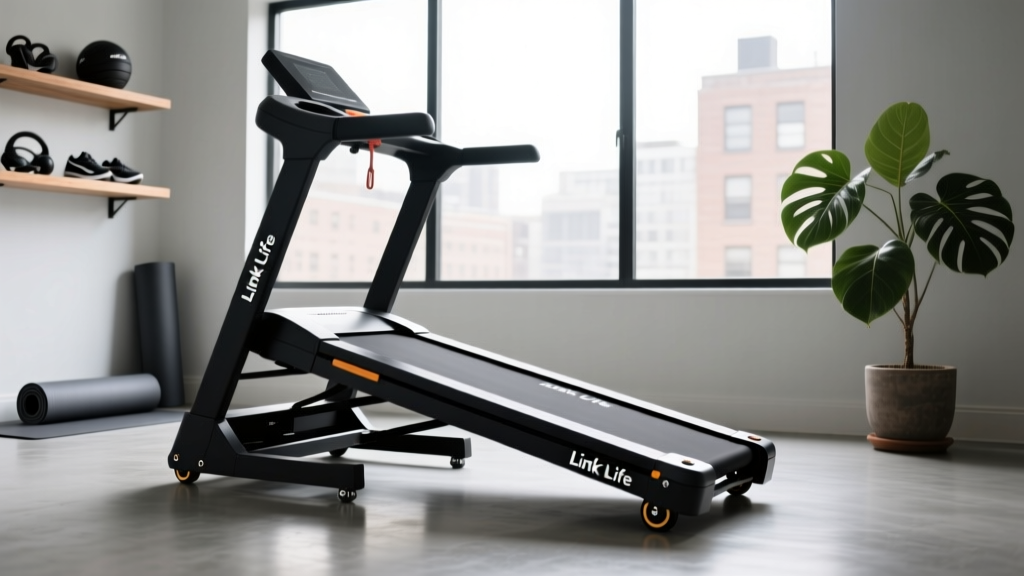
Link Life Treadmill Review: Space-Saving Folding Design Tested
Is the Link Life treadmill the ultimate space-saver? We test its folding mechanism, footprint, and layout integration for small apartments.

The Micro-Living Cardio Dilemma
As urban square footage continues to shrink and remote work solidifies its place in our daily routines through 2026, the demand for hyper-compact fitness equipment has never been higher. Interior designers and fitness experts alike warn against the 'visual weight' of traditional cardio machines—bulky frames that make a 600-square-foot apartment feel claustrophobic, even when not in use. Enter the Link Life treadmill, a folding model that claims to bridge the gap between a functional running deck and an easily stowable piece of furniture. But does its space-saving profile actually hold up to the rigors of daily layout integration?
In this review, we are analyzing the Link Life folding treadmill strictly through the lens of space optimization and layout design. We will break down its exact footprint, hinge mechanics, acoustic profile, and how it fits into real-world small-space floor plans.
Space Optimization Insight: When evaluating folding treadmills, never just measure the 'folded footprint.' You must also calculate the 'swing radius'—the clearance required to safely unfold the deck without striking nearby furniture or walls.Footprint Analysis: Dimensions and Clearance Requirements
The primary selling point of the Link Life treadmill is its ability to disappear into a closet or slide under a bed. Let us look at the exact measurements that dictate where this machine can live in your home.
The Numbers That Matter
- Unfolded Footprint: 54 inches (L) x 23 inches (W) x 46 inches (H)
- Folded Footprint: 54 inches (L) x 23 inches (W) x 6.5 inches (H)
- Unit Weight: 68 lbs
- Running Surface: 16 inches x 43 inches
At just 6.5 inches thick when folded, the Link Life treadmill is genuinely slim enough to slide under standard platform beds (which typically offer 7 to 9 inches of clearance). However, the 54-inch length means it will protrude from under standard twin or full-sized beds, making it better suited for under-desk storage or sliding behind a sofa.
Wall and Baseboard Clearance
A common failure point for apartment dwellers is ignoring baseboards. The Link Life features a recessed rear stabilizer, meaning it can sit flush against a flat wall. However, if your apartment has thick, ornate baseboards (over 3/4 of an inch), the treadmill will tilt slightly forward when folded upright, requiring a wall anchor strap for safety.
The Hinge Mechanism and Daily Setup Friction
A folding treadmill is only 'space-saving' if you actually fold it. If the mechanism is too stiff or heavy, it becomes a permanent fixture. According to Consumer Reports, the ease of the folding mechanism is a top predictor of long-term user satisfaction in compact home gyms.
The Link Life utilizes a manual drop-pin hinge rather than a hydraulic gas-shock system found on premium models like the Horizon 7.0 AT. While this keeps the cost down (retailing around $279), it requires the user to manually support the 45-pound deck weight while removing the safety pin and lowering it.
Ergonomic Warning: If you have lower back issues, the manual lowering of the Link Life deck may cause strain. Always bend at the knees and hinge at the hips when engaging the drop-pin, or opt for a model with an assisted hydraulic lift.
Mobility and the 'Roll-Away' Factor
Once folded, the unit rests on two concealed polyurethane caster wheels. Because the unit weighs 68 lbs, it is light enough for most adults to tilt and roll into a closet. However, the wheels lack a locking brake, meaning if you store it on an uneven hardwood floor, it may slowly drift over time. Placing a small rubber wedge stopper under the wheels is a highly recommended $5 layout hack.
Performance vs. Profile: What Are You Sacrificing?
Space optimization always involves trade-offs. To achieve a 6.5-inch folded profile, the Link Life treadmill houses a compact 2.25 Peak HP motor and a narrower 16-inch belt.
For walking and light jogging (up to 7.5 MPH), the motor remains relatively cool and quiet. However, the 16-inch width restricts lateral movement. If you are a runner with a wide gait, you will feel 'boxed in,' which can alter your natural biomechanics. The Mayo Clinic emphasizes that maintaining proper form is critical to preventing joint injuries during home workouts, making belt width a crucial consideration for taller users or dedicated runners.
Comparison Matrix: Link Life vs. Compact Alternatives
How does the Link Life stack up against other popular space-saving cardio machines on the market in 2026? Below is a layout-focused comparison matrix.
| Model | Folded Thickness | Belt Width | Lift Mechanism | Est. Price |
|---|---|---|---|---|
| Link Life Folding | 6.5 inches | 16 inches | Manual Drop-Pin | $279 |
| Horizon 7.0 AT | 14 inches | 22 inches | Hydraulic Shock | $999 |
| Sunny Health SF-T723015 | 5.0 inches | 15 inches | Fully Flat (No Deck) | $189 |
The Takeaway: The Link Life occupies the 'Goldilocks' zone. It offers a true raised deck with handrails (unlike the fully flat Sunny Health walking pad) while maintaining a much slimmer profile than premium folding models like the Horizon.
Layout Integration: Designing Your Cardio Zone
Integrating the Link Life treadmill into a small apartment requires strategic planning regarding traffic flow, visual weight, and acoustics. Follow this step-by-step framework to map out your space.
Step 1: Map the 'Drop Zone' and Traffic Flow
Identify where the machine will live when in use. You need a minimum of 20 inches of clearance behind the treadmill for safety egress, and 12 inches on either side for arm swing. In a standard 10x10 bedroom, place the treadmill facing a window or an open wall rather than facing into the room, which creates a psychological 'barrier' and disrupts the room's natural traffic flow.
Step 2: Mitigate the Acoustic Footprint
In multi-family dwellings, impact noise is your biggest enemy. The Link Life's compact motor is relatively quiet (around 65 decibels at 4 MPH), but footfalls transfer directly through the floor joists.
Pro-Tip for Apartment Dwellers: Do not rely on thin yoga mats. Invest in a 3/4-inch thick vulcanized rubber horse-stall mat (cut to 3x5 feet) to place under the Link Life. This decouples the machine from the subfloor, reducing low-frequency impact noise transmission to neighbors below by up to 40%.Step 3: Manage Visual Weight with Lighting
Dark, bulky equipment absorbs light and makes small rooms feel cavernous. Because the Link Life features a matte black and dark gray finish, it can act as a visual black hole in a dimly lit corner. Counteract this by placing a floor lamp with a warm-toned bulb (2700K) directly adjacent to the stored treadmill, washing the wall behind it with light and reducing the machine's visual density.
Frequently Asked Questions
Can the Link Life treadmill be stored vertically on its side?
No. The manufacturer explicitly warns against storing the unit vertically on its side rail. The internal lubrication system and the drop-pin hinge are designed only for horizontal under-bed storage or flat folded storage. Storing it vertically may cause the deck to warp over time and voids the warranty.
Is the 16-inch belt too narrow for walking while working?
For standard walking (1.5 to 3.0 MPH) while using a standing desk, the 16-inch belt is perfectly adequate. Most users naturally adopt a narrower stance when walking slowly and focusing on a screen. However, if you plan to use it for high-intensity interval training (HIIT), the narrow belt will feel restrictive.
Does it require assembly upon delivery?
Minimal assembly is required. The main frame arrives pre-assembled. You only need to attach the vertical handrail uprights (4 bolts) and connect the digital monitor wire. Expect the setup to take about 15 minutes with the included Allen wrenches.
Final Verdict: Is It Worth the Square Footage?
The Link Life treadmill is a highly specialized tool designed for a specific demographic: apartment dwellers, home-office workers, and micro-living enthusiasts who prioritize floor space over marathon-training capabilities. Its 6.5-inch folded profile is genuinely impressive, allowing it to vanish under furniture when the workday ends.
While the manual drop-pin hinge and narrow 16-inch belt mean it will not satisfy serious runners, its layout integration potential is superb. If your primary goal is to maintain a daily walking habit without sacrificing your living room's aesthetic or traffic flow, the Link Life folding treadmill remains one of the smartest spatial investments you can make in 2026.
More gear to consider
All reviews
Stair Climber Machine for Home Use vs. Hockey Skating Treadmill: 2026 Guide
Best Compact Treadmills With 12 Incline for Small Spaces (2026)

NordicTrack Treadmill Models: 2026 Small-Space Folding Review

Disadvantages of Treadmill Running: Folding Model Care & Review

Elliptical vs Treadmill vs Treadmill Bike Maintenance
