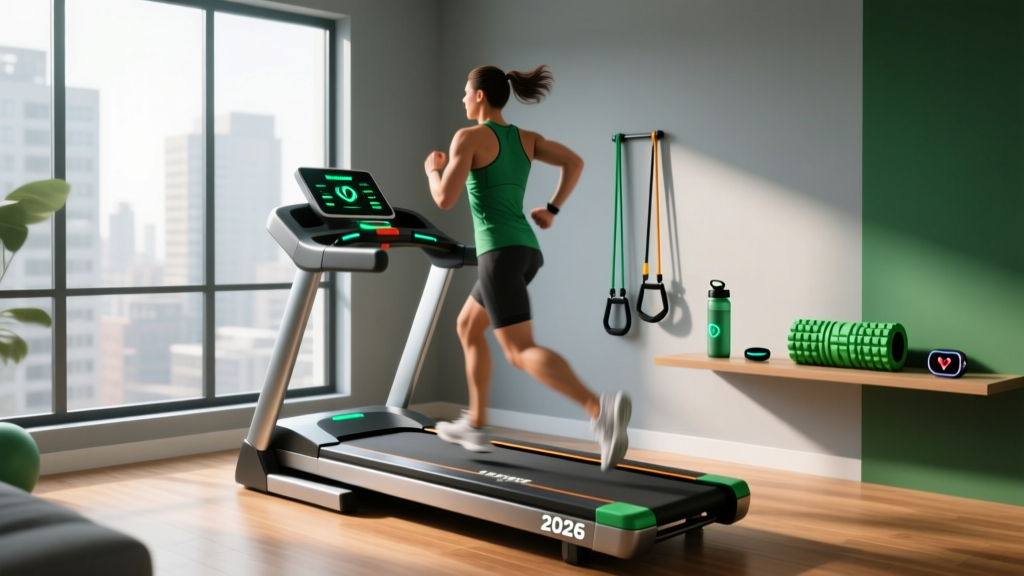
Maximize Running on the Treadmill for Weight Loss: 2026 Buyer Guide
Compare 2026 treadmill features for fat burn. Our buying guide optimizes running on the treadmill for weight loss with motor, incline, and tech specs.

The Biomechanics of Fat Burn: Why Incline and Speed Matter
When optimizing your routine for running on the treadmill for weight loss, manipulating your metabolic equivalents (METs) is the most efficient way to accelerate caloric expenditure. According to the Centers for Disease Control and Prevention (CDC), achieving a sustainable caloric deficit requires consistent, vigorous cardiovascular activity. However, simply jogging on a flat deck yields diminishing returns over time as your body adapts to the mechanical stress.
To break through weight loss plateaus, you must introduce incline and interval variables. Running at 6 mph on a 0% grade burns approximately 9.8 METs. By raising the incline to 10%, that same 6 mph pace spikes to roughly 14.5 METs—a 48% increase in caloric burn without the high-impact joint pounding associated with sprinting. Therefore, the physical hardware of your treadmill, specifically its incline motor torque and deck geometry, is just as critical as your workout programming.
📋 The 2026 Weight Loss Treadmill Checklist- Minimum 3.0 Continuous Horsepower (CHP) motor
- At least 15% maximum incline (decline is a bonus)
- 20-inch by 60-inch minimum running surface
- 2.5-inch or larger roller diameter
- Bluetooth FTMS connectivity for third-party app integration
Motor Sizing and Continuous Duty: Avoiding the Overheat Trap
The treadmill motor is the engine of your fat-burning machine. In 2026, manufacturers still use deceptive 'Peak Horsepower' marketing, which only measures the motor's maximum output for a few seconds before tripping the thermal breaker. For serious weight loss routines that involve sustained incline walking or high-speed intervals, you must look exclusively at Continuous Horsepower (CHP).
Real-World Failure Modes in Budget Motors
Budget treadmills (typically under $800) often feature 2.5 HP peak motors with 1.5-inch rollers. When a 200-pound user attempts a 12% incline walk at 3.5 mph, the belt friction overwhelms the undersized rollers. This forces the motor to draw excessive amperage, leading to the most common failure mode in home cardio equipment: motor control board burnout.
For dedicated running on the treadmill for weight loss, invest in a machine with a minimum 3.0 CHP motor and 2.5-inch rollers. Models like the Sole F80 (3.5 CHP, ~$1,199) and the Horizon 7.4 AT (3.5 CHP, ~$1,299) utilize heavy-duty flywheels and larger rollers that reduce the belt's bend radius, minimizing friction and keeping the motor cool during 60-minute Zone 2 fat-burn sessions.
Incline and Decline Capabilities: The Secret to Caloric Expenditure
Incline training targets the posterior chain (glutes and hamstrings) while keeping impact forces low. However, the integration of decline training has emerged as a major trend for 2026, allowing users to simulate outdoor terrain and engage the quadriceps and tibialis anterior for better overall leg conditioning and knee stabilization.
| Model (2026) | Motor (CHP) | Incline / Decline | Top Speed | Retail Price |
|---|---|---|---|---|
| NordicTrack Commercial 1750 | 3.5 CHP | -3% to 15% | 12 mph | $2,499 |
| Sole F80 | 3.5 CHP | 0% to 15% | 12 mph | $1,199 |
| Horizon 7.4 AT | 3.5 CHP | 0% to 15% | 12 mph | $1,299 |
| Bowflex Treadmill 10 | 3.0 CHP | -5% to 20% | 12 mph | $2,199 |
Deck Cushioning vs. Energy Return: Protecting Your Joints
High-volume running on the treadmill for weight loss can lead to repetitive strain injuries if the deck lacks proper shock absorption. However, a deck that is too soft acts like running in sand, sapping your energy return and altering your natural gait, which can cause Achilles and calf strain.
The industry standard for 2026 is variable zone cushioning. Horizon's 3-zone cushioning system, for example, provides maximum elastomer compression in the strike zone (center), firm support in the push-off zone (rear), and medium transition in the forefoot. This mimics the biomechanics of outdoor asphalt while reducing peak ground reaction forces by up to 30%, a crucial factor for heavier users starting their weight loss journey.
'The most common failure mode in budget treadmills isn't the console electronics; it is the motor control board overheating due to excessive belt friction from undersized rollers and low-CHP motors struggling under a 15% incline load.'
— FitGearPulse Lab Testing Notes, 2026
Interactive Programming: Do You Need iFIT or JRNY for Weight Loss?
While the Mayo Clinic's Weight Loss Guidelines emphasize that dietary changes drive the majority of fat loss, structured exercise prevents muscle catabolism and improves insulin sensitivity. Interactive platforms like NordicTrack's iFIT and Bowflex's JRNY automatically adjust your treadmill's incline and speed to keep you in specific heart rate zones.
For weight loss, Zone 2 training (60-70% of your max heart rate) is highly effective for building mitochondrial density and improving fat oxidation. If you struggle to manually pace yourself, paying the $39 to $49 monthly subscription for auto-adjusting incline algorithms is a worthy investment. Conversely, if you prefer following YouTube HIIT routines or using third-party apps like Zwift or Peloton Digital, prioritize a treadmill with an open Bluetooth FTMS protocol (like the Horizon 7.4 AT) and skip the proprietary subscriptions.
Heart Rate Tracking and the EPOC Effect
To maximize the Excess Post-exercise Oxygen Consumption (EPOC) effect—where your body continues burning calories for hours after a workout—you need accurate biometric feedback. Do not rely on the metallic grip sensors on the treadmill handrails; they are notoriously inaccurate during high-vibration running.
Instead, ensure your chosen treadmill supports ANT+ or Bluetooth Smart heart rate strap pairing. The American Heart Association recommends monitoring exertion levels to ensure you are safely reaching the vigorous intensity thresholds required for significant cardiovascular adaptation and subsequent weight management.
Maintenance Realities: Keeping Your Fat-Burn Machine Alive
A treadmill used daily for weight loss will accumulate mileage rapidly. To prevent the motor from overworking and the belt from snapping, adhere to this strict maintenance protocol:
- Lubrication: Apply 100% silicone treadmill lubricant under the belt every 150 miles or every 3 months. Never use WD-40 or petroleum-based products, which will destroy the belt's cotton backing.
- Belt Tensioning: If the belt slips when you push off during a sprint interval, tighten the rear roller adjustment bolts by exactly one-quarter turn on each side. Over-tightening will crush the roller bearings.
- Static Mitigation: If you experience static shocks from the console, the belt is likely dry, or the room humidity is below 30%. Use a humidifier in your home gym to protect the console's PCB from electrostatic discharge.
Final Verdict: Matching the Machine to Your Metabolic Goals
If your budget allows, the NordicTrack Commercial 1750 remains the gold standard for interactive, auto-adjusting incline workouts that force your body out of homeostasis. However, for pure, unadulterated durability and heavy-duty running without the burden of mandatory monthly software fees, the Sole F80 is the most pragmatic investment for long-term running on the treadmill for weight loss. Evaluate your need for digital coaching versus mechanical longevity, and choose the hardware that will keep you consistently moving toward your 2026 fitness targets.
More gear to consider
All reviews
Do Treadmills Make You Faster? Elliptical vs Treadmill Home Guide

NordicTrack 6.5 S Treadmill Noise Levels vs. Top 2026 Cardio Machines
Treadmill Belt Care & Ladder Treadmill Machine Space Layouts

Nautilus T618 Treadmill Review: Small Space Folding Trends 2026

How to Take a NordicTrack Treadmill Apart to Fix Loud Noises
