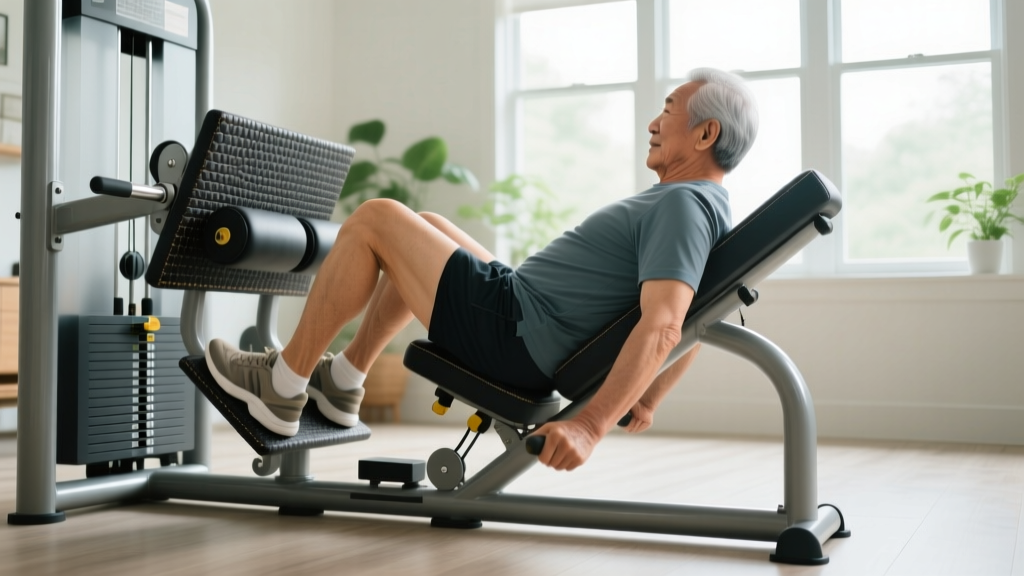
Hip Thrust Pads and the Leg Press Machine for Seniors: Budget Guide
Analyze the value of hip thrust machines and pads. We break down budgets for older adults seeking a safe leg press machine for seniors alternative.

The Posterior Chain Gap in Senior Leg Training
When building a home gym or outfitting a senior wellness center, the search often begins with a leg press machine for seniors. It is a logical starting point: leg presses provide a stable, seated environment to build quadriceps strength without the spinal compression associated with heavy barbell back squats. However, standard 45-degree or horizontal sled leg presses predominantly target the anterior chain (quads) and offer limited range of motion for the gluteus maximus and hamstrings.
For older adults, neglecting the posterior chain is a critical error. According to the Centers for Disease Control and Prevention (CDC), maintaining lower-body power and hip extension strength is directly correlated with fall prevention and gait stability in adults over 65. This is where the hip thrust emerges as the ultimate complementary movement—or even a primary alternative—to the traditional leg press. By driving the hips upward against resistance, seniors can safely load the glutes and hamstrings while keeping the spine entirely neutral and supported by a bench or machine pad.
But how do you budget for this? The market is flooded with options ranging from $15 foam sleeves to $4,000 commercial plate-loaded glute drives. In this 2026 value analysis, we break down the true cost, material longevity, and biomechanical value of hip thrust pads and dedicated machines for the aging demographic.
Deconstructing the Barbell Pad Market: EVA vs. NBR Foam
If you are adapting a standard flat bench to perform hip thrusts, a barbell pad is mandatory. Placing a bare steel barbell across the pelvis (specifically the anterior superior iliac spine, or ASIS) will cause severe bruising and nerve compression, especially for seniors with thinner subcutaneous tissue layers. However, not all pads are created equal, and buying the wrong one is a common budget trap.
The Budget Trap: NBR Foam Pads ($12 - $20)
Nitrile Butadiene Rubber (NBR) is the squishy, low-density foam found in most budget pads (e.g., Fit Simplify or generic Amazon brands). While they feel soft to the touch, NBR foam typically has a density of around 20kg/m³. Under a modest load of 135 lbs, a 2-inch thick NBR pad will compress down to less than 0.4 inches. This 'bottoming out' effect transfers the barbell pressure directly to the pelvic bone, defeating the purpose of the pad entirely.
The Value Standard: High-Density EVA Foam ($25 - $50)
Ethylene-Vinyl Acetate (EVA) foam is the industry standard for heavy lifting. Brands like Dark Iron Fitness and Rogue Fitness utilize EVA foam with densities ranging from 50kg/m³ to 70kg/m³. A 2-inch thick EVA pad will only compress to about 1.2 inches under 225 lbs of pressure, maintaining a crucial buffer between the steel bar and the user's pelvis. For seniors, investing $35 in a high-density EVA pad is a non-negotiable requirement for joint safety.
Expert Warning: When purchasing an EVA pad, check the inner diameter. Standard Olympic barbells have a 50mm sleeve, but the shaft is often 28mm-29mm. A pad with a 1.5-inch inner core will grip the bar tightly, preventing the pad from spinning and tearing the skin on the user's hips during the thrusting motion.Dedicated Hip Thrust Machines: Tiered Budget Breakdown
While a bench and pad setup works, getting into position with a heavy barbell on the floor requires significant mobility and core strength—traits that often decline with age. Dedicated hip thrust machines eliminate the setup friction, allowing seniors to safely load and unload weight from a seated position. Here is how the 2026 market breaks down by budget tier.
Tier 1: Leverage and Pivot Machines ($300 - $650)
Entry-level machines like the Fitness Reality Glute Drive or the Titan Fitness T-Series Glute Drive utilize a fixed pivot point and a padded carriage. Pros: Highly accessible; users simply sit down, pull a lever to release the safety, and thrust. Footprints are relatively small (approx. 55 x 25 inches). Cons: The fixed pivot arc does not perfectly match human biomechanics, which can cause slight lower back hyperextension at the top of the movement if the user is not careful. Weight capacities usually max out around 400-500 lbs, which is more than enough for senior training but limits heavy progressive overload for advanced lifters.
Tier 2: Linear Bearing and Cable-Driven Machines ($1,200 - $2,500)
Mid-tier options, such as the Arsenal Strength Hip Thrust or various selectorized cable hip thrust attachments found in commercial gyms, use linear bearings or dual-cable systems. These provide a perfectly vertical resistance profile. Value Proposition: The vertical resistance eliminates the shear force on the lower back. For senior rehabilitation clinics or high-end home gyms, this tier offers the best balance of safety, smooth resistance, and durability.
Tier 3: Commercial Plate-Loaded Glute Drives ($3,500+)
The Rogue Fitness Monster Glute Drive remains the gold standard. Built from 3x3-inch 11-gauge steel and featuring a massive contoured pad, it mimics the exact feel of a barbell but with the safety of a seated start. While overkill for a budget-conscious home user, it is the ultimate investment for senior living facilities where equipment must withstand decades of daily use without mechanical failure.
Cost-Per-Use & Value Matrix
To truly understand the value of these setups, we must look beyond the initial purchase price and evaluate the cost-per-use over a standard 5-year lifecycle, assuming a training frequency of twice per week (520 total sessions).
| Setup Type | Est. 2026 Cost | Setup Friction | Spinal Shear Risk | Cost Per Session (5 Yrs) |
|---|---|---|---|---|
| Bench + NBR Pad | $100 | High (Floor setup) | Moderate | $0.19 |
| Bench + EVA Pad | $140 | High (Floor setup) | Low | $0.27 |
| Pivot Machine (Titan/Fitness Reality) | $450 | Low (Seated start) | Low | $0.86 |
| Linear Bearing Machine (Arsenal) | $1,600 | Very Low | None | $3.07 |
Real-World Failure Modes and Maintenance
When evaluating budget equipment, understanding how it fails is just as important as how it performs on day one. The National Institute on Aging emphasizes that consistent, uninterrupted exercise routines are vital for combating sarcopenia. Equipment downtime disrupts this consistency.
Pad Seam Splitting
The most common failure point on budget barbell pads is the longitudinal seam. Cheaper pads use single-stitch threading on low-grade PU leather. When the foam compresses and expands repeatedly, the tension snaps the thread. By month six, the foam is exposed to sweat and oils, degrading the material rapidly. Value Tip: Always look for pads with double-stitched, reinforced vinyl or heavy-duty Cordura nylon covers.
Machine Pivot Pin Wear
On sub-$500 pivot hip thrust machines, the main axis of rotation relies on a steel pin moving through a steel or bronze bushing. Without regular lubrication, metal-on-metal friction creates micro-abrasions. Over a year, this leads to a 'grinding' sensation and lateral wobble in the carriage. For senior users who may not be inclined to perform monthly equipment maintenance, spending an extra $150 on a machine with sealed ball bearings or grease-fitted bushings is a wise long-term investment.
Final Verdict: Complementing the Leg Press
A high-quality leg press machine for seniors is an excellent foundation for lower-body hypertrophy and quad isolation. However, it is incomplete without dedicated posterior chain work. If your budget is strictly under $150, abandon the cheap NBR pads and invest in a high-density EVA foam sleeve paired with a sturdy, 16-inch high flat bench. This allows for safe, heavy hip thrusts without pelvic trauma.
If your budget allows for $400 to $600, a dedicated pivot-style hip thrust machine is the superior choice for older adults. The elimination of floor-based setup friction and the ability to safely bail out of a repetition without a spotter make it one of the highest-value pieces of equipment you can add to a senior-focused training space. Prioritize biomechanical safety and material density over flashy features, and your equipment will support healthy, powerful movement for years to come.
More gear to consider
All reviews
Standing vs Seated Calf Raises & Leg Press Machine Foot Placement

Titan Fitness Leg Press Hack Squat Machine vs 45° & Horizontal Guide

Substitute for Leg Press Machine: Standing vs Seated Calf Raise Errors

Hip Thrust Machines vs. Different Leg Press Machines: Budget Guide

Leg Extension & Curl Guide: Adding an Inclined Leg Press Machine
