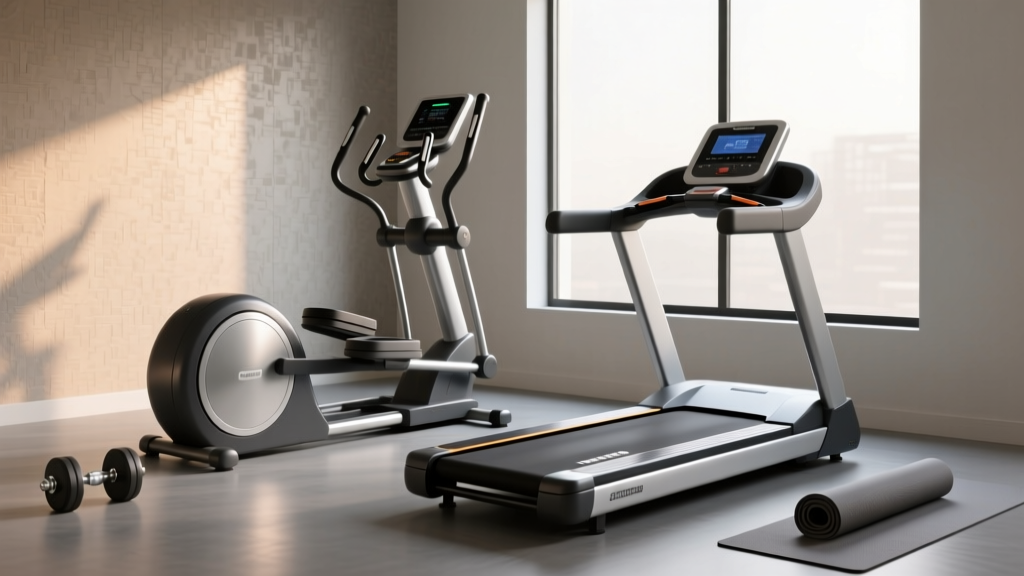
Elliptical vs Treadmill: Space Layouts & Solo F80 Treadmill Fit
Compare elliptical vs treadmill layouts for home gyms. Discover clearance zones, ceiling height math, and how the Solo F80 treadmill fits small spaces.

The Spatial Dilemma: Footprint vs. Functional Clearance
When designing a home gym in 2026, the debate between an elliptical and a treadmill extends far beyond calorie burn and joint impact. It is fundamentally a question of spatial geometry, structural load, and safety clearances. Many homeowners begin their equipment search by looking for the highly rated Solo F80 treadmill—a common phonetic misspelling of the industry-standard Sole F80. While this heavy-duty folding treadmill is a phenomenal piece of cardio engineering, dropping it into a spare bedroom or basement without calculating the true spatial requirements is a frequent and costly design error.
The core difference between treadmill and elliptical layout design lies in the distinction between the machine footprint and the functional safety zone. A machine might fold down to a seemingly compact 3-square-foot rectangle, but the operational envelope required to use it safely dictates your room's entire floor plan. According to the American Heart Association, consistency is the key to cardiovascular health; if your equipment layout makes the room feel claustrophobic or unsafe, adherence to your fitness routine will plummet.
Vertical Clearance: The Hidden Space Killer
Horizontal space is only half the battle. Vertical clearance is where most home gym layouts fail, particularly with treadmills. When you step onto a treadmill, you are elevated by the deck height. The Sole F80 (often searched as the Solo F80) features a robust frame with a deck step-up height of approximately 8 inches. If you are 6 feet tall (72 inches), your head is now at 80 inches. Add the mandatory 5-inch overhead clearance for arm movement and natural running bounce, and you suddenly require an 85-inch (7-foot 1-inch) minimum ceiling height just to walk on a flat incline.
⚠️ The Incline Trap
When a treadmill like the Sole F80 is set to a 15% incline, the front of the deck rises significantly. If you are placing the machine in a room with sloped ceilings, exposed beams, or low-hanging HVAC ducts, you must measure the vertical clearance at the front apex of the machine where your head will actually be during an incline sprint, not just at the rear console.
Ellipticals, conversely, keep your center of gravity much closer to the floor. A front-drive elliptical like the Sole E95 has a pedal clearance of just 10 to 12 inches at its lowest point, meaning a standard 8-foot ceiling is more than sufficient for users up to 6'4" tall, even with the machine's maximum stride elevation.
The Fall Zone: What the CPSC Mandates
The most critical spatial differentiator between ellipticals and treadmills is the rear clearance zone. The U.S. Consumer Product Safety Commission (CPSC) strictly advises that treadmills require a massive rear safety zone to prevent catastrophic injuries in the event of a fall. If a user trips on a moving belt, they are propelled backward. The CPSC recommends a minimum of 78 inches (6.5 feet) of clear, unobstructed space directly behind the treadmill.
Ellipticals do not require this extreme rear clearance. Because your feet are fixed to pedals and there is no motorized belt propelling you backward, a standard 24-inch clearance for mounting, dismounting, and pedal overhang is entirely sufficient. This single factor often makes the elliptical the only viable choice for narrow galley-style rooms or basement corridors.
Elliptical vs. Treadmill: The Dimensional Showdown
To visualize the spatial impact, let us compare the real-world layout requirements of three popular home cardio categories, using the Sole F80 as our benchmark folding treadmill.
| Machine Type | Reference Model | Unfolded Footprint | Total Safety Zone Required | Min. Ceiling Height (for 6' User) |
|---|---|---|---|---|
| Heavy-Duty Folding Treadmill | Sole F80 (Solo F80) | 82.5" L x 34.5" W (19.8 sq ft) | 160.5" L x 34.5" W (38.4 sq ft) | 7' 2" (Flat) / 7' 8" (Incline) |
| Front-Drive Elliptical | Sole E95 | 82" L x 31" W (17.6 sq ft) | 106" L x 31" W (22.9 sq ft) | 6' 10" |
| Compact Vertical Elliptical | Bowflex Max M9 | 49" L x 30.5" W (10.3 sq ft) | 73" L x 30.5" W (15.4 sq ft) | 7' 6" |
Note: While the Sole F80 folds to roughly 43" x 34.5" for storage, you cannot utilize that folded footprint for actual exercise. Layout design must prioritize the operational safety zone over the storage footprint.
Electrical, Acoustic, and Subfloor Layouts
Space optimization is not just about empty air; it is about the infrastructure hidden in the walls and floors. Treadmills and ellipticals demand entirely different environmental layouts.
1. Electrical Circuit Mapping
A heavy-duty treadmill like the Sole F80 utilizes a 3.5 CHP (Continuous Horsepower) motor. When running at high speeds or pushing a 300-lb user up a 15% incline, the motor experiences massive amperage spikes. Treadmills require a dedicated 15-amp or 20-amp circuit. Placing a treadmill on a shared circuit with a window AC unit or a space heater will inevitably trip the breaker mid-workout. Ellipticals, which use much smaller resistance motors and rely heavily on user momentum, draw significantly less current and can safely share standard household circuits.
2. Acoustic Decoupling and Floor Joists
If your home gym is on a second floor or above a finished basement, impact noise is a primary layout constraint. A runner's footstrike generates up to 3 times their body weight in downward force, transmitting low-frequency acoustic vibrations directly through the subfloor. Treadmill layouts in upper-floor rooms mandate the use of 3/8-inch to 1/2-inch high-density EVA foam mats to decouple the machine from the floor joists. Ellipticals are zero-impact machines; the pedals never leave the track, resulting in near-silent operation that requires minimal acoustic dampening.
Biomechanics vs. Spatial Reality
Sometimes, your room's geometry forces a compromise on your preferred training modality. The Mayo Clinic notes that ellipticals offer distinct advantages for joint preservation, providing a low-impact cardiovascular workout that spares the knees and hips from the repetitive pounding of running. However, treadmills offer superior bone-density loading due to that exact impact.
- Choose the Treadmill Layout If: You have a dedicated room with standard or vaulted ceilings (8+ feet), a rectangular footprint that allows for the 78-inch rear fall zone, and you prioritize bone-density loading and sprint mechanics.
- Choose the Elliptical Layout If: You are designing a gym in a basement with low-hanging ductwork, a narrow spare room, or a second-floor bedroom where acoustic vibration and joint impact are primary concerns.
Strategic Layout Configurations for Compact Rooms
If you are committed to a treadmill but are working with a tight spatial envelope, utilize these professional layout strategies to maximize the room's functionality:
- The "Dead Corner" Anchor: Never place a treadmill in the center of a room or floating off a wall. Anchor it in a corner facing the door or a window. This naturally creates the 78-inch rear fall zone behind the machine without eating into the room's primary walkways.
- Bi-Fold Mirror Integration: Mount a large shatterproof mirror on the wall directly in front of the treadmill. This not only allows for form correction but creates an optical illusion that doubles the perceived depth of the room, mitigating the claustrophobia of staring at a blank wall during a 45-minute run.
- Vertical Storage Exploitation: Because the rear clearance zone of a treadmill must remain entirely empty of physical objects, use the walls adjacent to the treadmill for shallow, vertical storage (e.g., 6-inch deep shelves for resistance bands, foam rollers, and heart rate monitors) rather than bulky furniture.
Final Verdict: Designing for the Machine You Will Actually Use
The search for the perfect "Solo F80 treadmill" or a comparable elliptical must end with a tape measure in hand. The Sole F80 is an exceptional, durable machine that easily competes with commercial gym equipment, often retailing between $1,199 and $1,499 in 2026. However, its 38.4-square-foot operational safety zone is non-negotiable. If your room cannot accommodate the CPSC-mandated fall zone without forcing you to shuffle sideways past the console, the spatial friction will eventually kill your workout consistency. In those constrained environments, a high-quality front-drive elliptical provides a biomechanically sound, spatially efficient alternative that respects both your joints and your floor plan.
More gear to consider
All reviews
NordicTrack Treadmill T6.5s: Feature Comparison & Buying Mistakes
Link Life Treadmill Review: Space-Saving Folding Design Tested
Mastering the Treadmill Zone: Belt Lubrication and Care Guide
Is WellFit a Good Treadmill Brand? Motor HP Guide
How Much to Walk on Treadmill to Lose Weight: Portable Pad Care