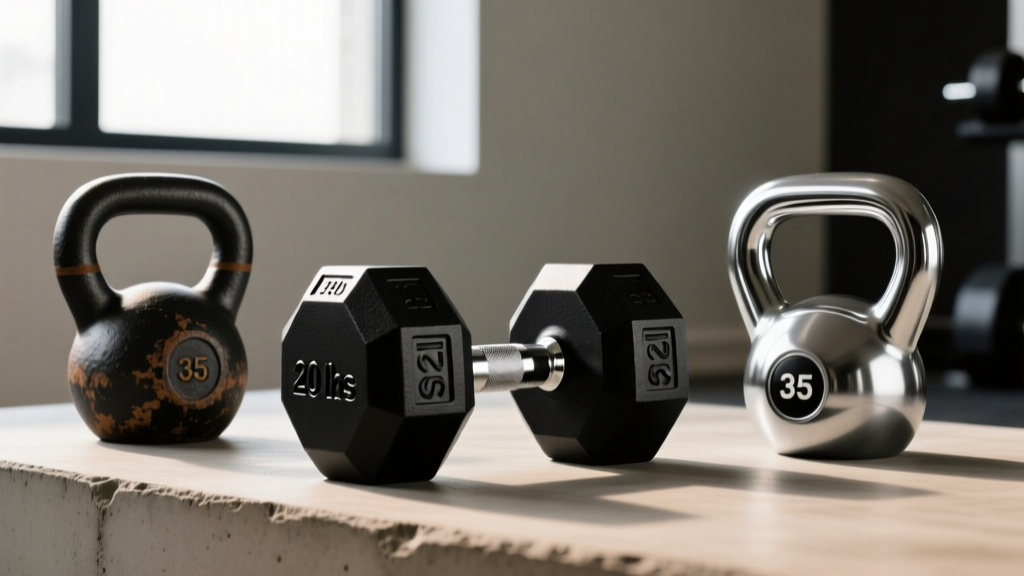
Cast Iron vs Competition Kettlebells & Black Dumbbell Set Value
Compare cast iron vs competition kettlebells and a standard black dumbbell set. Discover the true cost-per-pound and best value for your 2026 home gym.

The 2026 Free Weight Economy: Where Does Your Budget Go?
Building a functional home gym in 2026 requires a ruthless approach to budget allocation. With freight costs and raw material prices fluctuating, lifters are forced to weigh the utility of specialized equipment against versatile staples. The most common crossroads for intermediate lifters is deciding between investing in kettlebells—specifically navigating the cast iron vs. competition kettlebell debate—or defaulting to the traditional, rubber-coated black dumbbell set.
This guide strips away the marketing fluff and provides a hard-data budget breakdown. We will analyze the metallurgy, cost-per-pound ratios, biomechanical utility, and long-term failure modes of cast iron kettlebells, competition steel kettlebells, and standard hex dumbbells to help you maximize your training ROI.
Cast Iron vs. Competition Kettlebells: A Metallurgical and Financial Breakdown
Not all kettlebells are created equal. The physical dimensions, handle thickness, and center of mass drastically alter the training stimulus and the price tag. According to BarBend's comprehensive kettlebell testing, the divergence between cast iron and competition models is the single biggest factor in equipment pricing and longevity.
The Cast Iron Standard: Grinds and Raw Power
Cast iron kettlebells are the traditional choice. They are typically sand-cast, ground down, and finished with an e-coat or powder coating.
- Dimensions: Variable. A 12kg bell is physically smaller than a 24kg bell. The handle diameter also scales, often ranging from 28mm on lighter weights to 35mm on heavier beasts.
- Biomechanics: The compact, variable shape makes them ideal for 'grind' movements like goblet squats, strict presses, and floor presses, where the bell rests comfortably against the forearm or chest.
- Pricing (2026 Average): $2.00 to $2.60 per pound. A standard 16kg (35lb) cast iron bell costs roughly $75 to $90.
The Competition Specification: Ballistics and Uniformity
Competition kettlebells are engineered for the sport of kettlebell lifting (Girevoy Sport). They are constructed from solid steel or a steel shell filled with an air/lead matrix to achieve uniform sizing.
- Dimensions: Strictly uniform. Every competition bell, from 8kg to 32kg, measures exactly 210mm in height, 210mm in width, and 210mm in depth. The handle diameter is universally locked at 33mm.
- Biomechanics: The uniform size means your rack position, snatch mechanics, and jerk timing remain identical regardless of the weight. The 33mm handle and wider horns are optimized for high-repetition ballistic movements.
- Pricing (2026 Average): $4.00 to $5.50 per pound. A 16kg competition bell will set you back $140 to $160.
The Black Dumbbell Set Alternative: Utility vs. Specialization
When lifters balk at the $160 price tag of a single 16kg competition kettlebell, they often pivot to purchasing a standard 5-to-50-pound rubber-coated black dumbbell set. A complete 10-pair hex set (550 total pounds) typically costs between $850 and $1,100 in 2026, averaging out to an attractive $1.50 to $2.00 per pound.
But does a black dumbbell set offer the same functional value as kettlebells? The answer lies in the center of mass. Dumbbells feature a symmetrical load distributed evenly on either side of the handle. Kettlebells feature an offset center of mass. Research published in the National Institutes of Health (NIH) highlights that the offset load of a kettlebell demands significantly higher activation from the stabilizer muscles in the shoulder girdle and core during dynamic movements.
Where the Black Dumbbell Set Wins
- Hypertrophy and Isolation: For lateral raises, bicep curls, and chest flyes, the symmetrical balance of a rubber hex dumbbell is vastly superior.
- Micro-loading: A standard set allows for 5-pound jumps, whereas kettlebells typically jump in 4kg (8.8lb) or 8kg (17.6lb) increments.
- Floor Stability: The hex-shaped heads of a quality black dumbbell set prevent rolling, making them safer for renegade rows and floor-based transitions.
Where the Black Dumbbell Set Fails
You cannot safely or effectively perform a kettlebell swing, a Turkish get-up, or a bottoms-up press with a standard hex dumbbell. The handle length is too short to accommodate two hands for heavy swings, and the symmetrical weight distribution completely removes the anti-rotational core stimulus required for advanced kettlebell flows.
Cost-Per-Pound & Utility Matrix
To visualize the budget breakdown, let us compare the cost and utility of acquiring roughly 35 pounds of working weight across the three equipment categories.
| Equipment Type | Target Weight | Est. 2026 Cost | Cost Per LB | Primary Training Modality |
|---|---|---|---|---|
| Cast Iron Kettlebell | 16kg (35 lbs) | $80.00 | $2.28 | Grinds, Heavy Swings, General Fitness |
| Competition Kettlebell | 16kg (35 lbs) | $150.00 | $4.28 | Ballistics, Snatches, Kettlebell Sport |
| Rubber Hex Black Dumbbell Set | Pair of 35s (70 lbs total) | $125.00 | $1.78 | Bodybuilding, Isolation, Symmetrical Pressing |
Note: While the dumbbell set offers the lowest cost-per-pound and double the total weight, it cannot replicate the offset-load biomechanics of the kettlebell. They are complementary tools, not direct substitutes.
Long-Term Failure Modes and Maintenance Costs
When analyzing value, you must factor in how the equipment degrades over a 5-to-10-year timeline. Budget gear often costs more in the long run due to replacement needs.
Cast Iron Degradation
The primary failure mode for cast iron is rust, particularly in unclimate-controlled garages. If the powder coat chips from dropping the bell on concrete, moisture will infiltrate the porous iron. Preventative Cost: Periodic sanding and reapplication of a rust-inhibiting enamel paint ($15 per can, required every 2-3 years).
Competition Steel Wear
Competition bells are incredibly durable, but the polished steel handles can develop micro-burrs or 'tear zones' if dropped onto rough concrete repeatedly. Furthermore, the painted color bands on the horns can chip. Preventative Cost: Using a drop mat ($60-$100 one-time purchase) and occasional fine-grit sandpaper to smooth the handle.
Rubber Hex Dumbbell Set Off-Gassing and UV Damage
The ubiquitous black dumbbell set is usually coated in recycled rubber or cheap virgin rubber. In hot garages, these can off-gas volatile organic compounds (VOCs), creating a toxic odor that permeates your home. Additionally, UV exposure from a nearby window will cause the rubber to dry-rot, crack, and flake onto your flooring. Preventative Cost: Upgrading to Urethane-coated dumbbells, which costs roughly 40% more upfront but eliminates off-gassing and UV degradation entirely.
The Final Verdict: Matching Gear to Your Training Style
Your budget should follow your training intent. Do not buy competition kettlebells if your primary goal is slow-twitch muscle hypertrophy; buy the black dumbbell set. Do not buy a black dumbbell set if you want to master the kettlebell snatch; buy the competition steel.
The 2026 Buyer's Decision Framework
- The Generalist / CrossFit Athlete: Buy Cast Iron Kettlebells. The variable handle thickness builds robust grip strength, and the lower price point allows you to buy a wider range of weights (e.g., 16kg, 24kg, 32kg) for heavy swings and goblet squats.
- The Endurance / Sport Specialist: Buy Competition Kettlebells. The uniform 33mm handle and identical dimensions are mandatory for high-rep, multi-set endurance protocols where muscle memory and joint alignment are paramount.
- The Bodybuilder / Aesthetic Lifter: Buy the Black Dumbbell Set (preferably Urethane). The symmetrical load, micro-loading capabilities, and suitability for isolation movements offer the highest ROI for pure muscle building.
Ultimately, the smartest home gym budgets in 2026 do not treat these tools as mutually exclusive. A highly optimized, budget-conscious setup involves purchasing a core pair of competition kettlebells (16kg and 24kg) for ballistic and core work, while slowly building out a black dumbbell set from 15 to 50 pounds for pressing, pulling, and isolation work. By understanding the exact cost-per-pound and metallurgical realities of your gear, you ensure that every dollar spent directly translates to performance gains.
More gear to consider
All reviews
Budget Dumbbell Racks: Value Analysis & Protecting the Dumbbell Pullovers Muscles Worked

Best Dumbbell Racks for Seated Dumbbell Rear Raises 2026
Compact Dumbbell Racks: Layouts for Pull Downs With Dumbbells

Barbell Buying Guide: Weight, Knurling & How to Hit Lats With Dumbbells

Optimizing Space for Trap Workouts with Dumbbells: Urethane vs Hex
