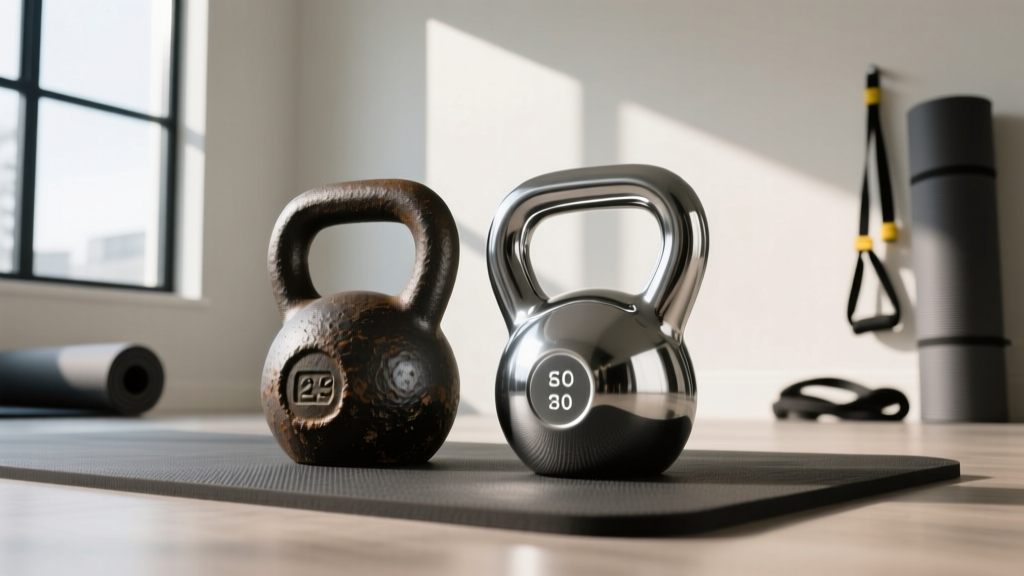
Cast Iron vs Competition Kettlebells Beyond Standard Dumbbell Curls
Analyze the 2026 ROI of cast iron vs competition kettlebells, comparing cost-per-pound and biomechanics beyond standard dumbbell curls.

The Baseline: Moving Past the Dumbbell Rack
For most home gym owners, the journey into free weights begins with a pair of adjustable or hex dumbbells. They are the undisputed kings of isolation work; after all, you cannot beat the fixed center of mass required for strict, hypertrophy-focused standard dumbbell curls or lateral raises. However, as training evolves from pure isolation to full-body ballistic and posterior-chain movements, the limitations of the dumbbell become glaringly obvious. You cannot safely perform a high-rep kettlebell snatch or a tactical clean with a dumbbell. This realization forces a critical purchasing decision: do you invest in traditional cast iron kettlebells or premium competition steel?
In this 2026 budget breakdown and value analysis, we dissect the cost-per-pound, metallurgical differences, and biomechanical ROI of both kettlebell types, helping you decide where to allocate your equipment budget once you outgrow basic dumbbell work.
Cast Iron Kettlebells: The Budget-Friendly Workhorse
Cast iron kettlebells are poured into molds, resulting in a single, solid piece of iron. Because the mold size changes with weight, a 12kg cast iron bell will be physically smaller and have a thinner handle than a 32kg bell from the same manufacturer.
2026 Pricing and Coating Economics
As of early 2026, the market rate for quality cast iron kettlebells ranges from $1.10 to $1.80 per pound. Brands like Yes4All and CAP Barbell dominate the lower end ($1.10–$1.30/lb), often utilizing basic powder coatings that can chip over time and feel abrasive during high-friction rack positions. Premium cast iron options, such as the Rogue E-Coat Kettlebells, sit at the $1.60–$1.80/lb mark. The e-coat (electrophoretic deposition) process provides a superior, rust-resistant finish that preserves the tactile feel of the iron without the chalk-slip issues of thick powder coats.
Pros of Cast Iron:- Significantly lower cost-per-pound.
- Compact footprint for heavier weights (e.g., a 48kg iron bell is much smaller than a 48kg competition steel bell).
- Ideal for slow, heavy grinds like goblet squats and strict presses.
- Handle diameters vary wildly (often scaling up to 38mm+ on heavy bells), which can crush the wrists during cleans.
- Inconsistent window sizes make inserting the hand for snatches a guessing game across different weights.
Competition Steel Kettlebells: The Premium Biomechanical Tool
Competition kettlebells are manufactured from hollow steel. The defining characteristic of a competition bell—governed by international kettlebell sport standards—is that every single bell shares the exact same physical dimensions, regardless of weight. A 8kg bell and a 32kg bell will both have a 280mm height, a 210mm width, and a strict 33mm handle diameter. The weight difference is achieved by altering the thickness of the steel walls or adding internal steel shot/ballast.
The 33mm Handle Standard and Wrist Preservation
According to the methodologies outlined by the StrongFirst certification body, consistent handle geometry is non-negotiable for high-rep ballistic training. The universal 33mm handle diameter allows the bell to rest securely on the forearm in the "rack" position without bruising the wrist or requiring the lifter to adjust their grip mechanics when moving up in weight.
"When transitioning from standard dumbbell curls to dynamic kettlebell snatches, the wrist takes a massive beating. The 33mm competition handle and uniform window size allow the bell to flip over the wrist smoothly, dissipating force evenly. A thick, 38mm cast iron handle will simply bruise the radial bone during heavy cleans."
The financial barrier is the primary drawback. In 2026, competition steel kettlebells command between $3.20 and $4.50 per pound. A single 24kg (52.8 lb) Kettlebell Kings Competition Steel bell will cost roughly $195, whereas a cast iron equivalent might cost $75.
2026 Cost-Per-Pound Value Matrix
To contextualize the investment, let us compare the current market averages for cast iron kettlebells, competition steel, and standard adjustable dumbbells (the baseline for exercises like standard dumbbell curls).
| Equipment Type | Avg. Cost Per Pound (2026) | Handle Consistency | Best Use Case | ROI Rating |
|---|---|---|---|---|
| Adjustable Dumbbells (e.g., Nuobell) | $3.50 - $4.00 / lb | Fixed (but bulky) | Isolation (Standard Dumbbell Curls, Raises) | High for Hypertrophy |
| Budget Cast Iron (Powder Coat) | $1.10 - $1.30 / lb | Varies by Weight | Heavy Grinds, Swings, Budget Gyms | Highest (Pure Budget) |
| Premium Cast Iron (E-Coat) | $1.60 - $1.80 / lb | Varies by Weight | General Fitness, Goblet Squats, Carries | High (Durability) |
| Competition Steel (Hollow Core) | $3.20 - $4.50 / lb | Strict 33mm Universal | Snatches, Cleans, Jerks, KB Sport | High (For Ballistics) |
Biomechanics: Offset Mass vs. Fixed Mass
Why buy kettlebells at all if you already own dumbbells? The ExRx biomechanics database and various kinesiology studies highlight that the offset center of mass in a kettlebell fundamentally changes muscle recruitment. During a dumbbell press, the load sits directly over the wrist joint. During a kettlebell press, the mass sits behind and above the wrist, requiring intense stabilization from the rotator cuff and anterior core to prevent the bell from pulling the arm into extension.
Furthermore, while National Strength and Conditioning Association (NSCA) literature supports the use of dumbbells for bilateral imbalances, the kettlebell's unique horn shape allows for two-handed, offset loading (like the goblet squat) that dumbbells simply cannot replicate safely or comfortably. You are paying for a completely different movement paradigm, not just a different shape of iron.
The Budget Breakdown: 3 Buying Scenarios
How should you allocate your 2026 equipment budget? Choose the scenario that best matches your training goals.
Scenario A: The Hypertrophy & General Fitness Lifter
The Strategy: Keep your adjustable dumbbells for isolation work (standard dumbbell curls, tricep extensions) and buy Premium E-Coat Cast Iron Kettlebells for swings and goblet squats.
Budget Allocation: $150 for a pair of 20kg cast iron bells.
Why: You do not need a uniform 33mm handle if you are rarely performing high-rep snatches or cleans. The e-coat provides the durability you need without the competition steel tax.
Scenario B: The Hardstyle & Ballistic Athlete
The Strategy: Invest heavily in Competition Steel Kettlebells for the 16kg, 20kg, and 24kg range.
Budget Allocation: $450+ for three competition bells.
Why: If your programming involves "Armor Building" complexes, heavy cleans, or snatch tests, the uniform window size and 33mm handle will save your wrists from severe bruising. The consistency allows you to focus on power output rather than adjusting your grip for a thicker handle.
Scenario C: The Hybrid Home Gym (The Optimal Value Play)
The Strategy: Buy one "anchor" Competition Steel Bell (usually 20kg or 24kg) for technical ballistic practice, and fill out the rest of your weight range with Cast Iron.
Budget Allocation: $130 (1x 20kg Steel) + $90 (2x 16kg Cast Iron).
Why: You get the biomechanical perfection of steel for your most technically demanding lifts, while saving money on the lighter and heavier grinds where handle thickness matters less.
Final Verdict on ROI
Upgrading your home gym beyond the basics requires a clear understanding of your movement diet. If 90% of your arm and shoulder training consists of strict isolation movements like standard dumbbell curls and presses, your money is best spent expanding your dumbbell rack. However, the moment you commit to posterior-chain ballistics, the kettlebell becomes mandatory. Cast iron offers undeniable financial value for generalists and heavy grinders, but competition steel remains an irreplaceable, joint-saving investment for anyone serious about the snatch, clean, and jerk. Spend on the steel where your wrists demand it, and save on the iron where they don't.
More gear to consider
All reviews
Dumbbell Rack Trends 2026: Storage for Dumbbell Lying Leg Curls

Troubleshooting Different Types of Dumbbell Curls with Neoprene Weights

Beyond Bowflex SelectTech 552 Dumbbells: Barbell Knurling Guide
Dumbbell Upper Body Workout Female Lifters Outgrow: Barbell Guide

Rubber Hex vs Urethane: Maintaining Your 40 lb Dumbbell Pair
