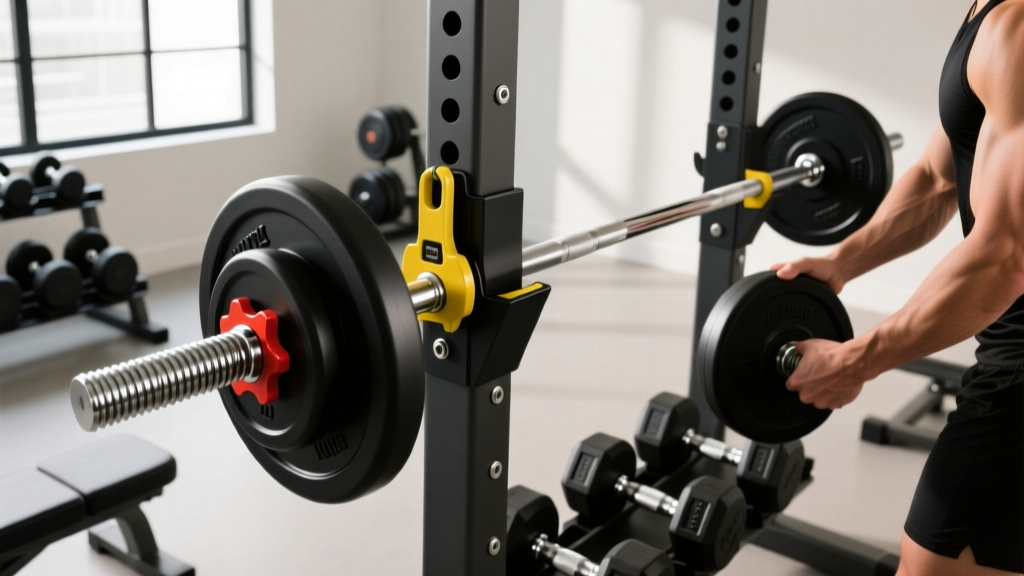
Collar & Clamp Types Comparison: Mistakes & Dumbbells for Rear Delts
Compare barbell collar and clamp types, troubleshoot common safety mistakes, and learn how to secure adjustable dumbbells for rear delts safely.

The Anatomy of Free Weight Security: Beyond the Spring Clip
Walk into any commercial gym in 2026, and you will still see lifters performing heavy barbell squats with nothing but a pair of cheap chrome spring clips securing 300+ pounds of iron. This is a catastrophic safety oversight. Whether you are dropping a barbell during a failed clean or stabilizing adjustable dumbbells for rear delts during a complex isolation arc, the collar or clamp is the only mechanical barrier between a successful lift and a severe injury.
In this troubleshooting guide, we break down the exact mechanical differences between barbell collar and clamp types, identify the most common user errors, and apply these safety principles to the often-overlooked hazards of using adjustable and plate-loaded dumbbells for rear delts.
Barbell Collar vs. Clamp Types: A Technical Comparison
Not all securing mechanisms are created equal. The holding force—measured by the lateral pressure applied to the sleeve—varies wildly based on the mechanism. Below is a technical comparison of the most common types found in modern home and commercial gyms.
| Type | Mechanism | Approx. Holding Force | Price Range (Pair) | Best Use Case | Common Failure Mode |
|---|---|---|---|---|---|
| Spring Clips | Coiled steel tension | 15 - 25 lbs | $10 - $15 | Light isolation, machine pins | Metal fatigue; slipping on chalky sleeves |
| Lever Clamps (e.g., Eleiko) | Mechanical cam leverage | 150+ lbs | $50 - $65 | Olympic lifting, heavy squats | TPU O-ring degradation over time |
| Lock-Jaw Clamps | Glass-filled nylon cam | 80 - 100 lbs | $30 - $40 | Powerlifting, general strength | Hinge pin snapping under extreme torque |
| Spinlock Collars | Threaded nut on sleeve | Variable (User torque) | $15 - $25 | Plate-loaded dumbbell handles | Vibration loosening the nut mid-set |
3 Critical Barbell Collar Mistakes (And How to Troubleshoot Them)
Even with high-end equipment like the Rogue HG 2.0 Collars, user error can render the safety mechanism useless. Here is how to troubleshoot the most frequent mistakes.
Mistake 1: The "Sleeve Gap" Hazard
The Error: Leaving a half-inch gap between the outermost bumper plate and the collar.
The Physics: During a dynamic lift like a push-press, the barbell whips and oscillates. If there is a gap, the plates build kinetic momentum before slamming into the collar. This repetitive impact can crack the nylon body of a clamp or permanently deform a spring clip.
The Fix: Always push the collar flush against the plate. If your barbell sleeve is too short to accommodate your plates plus a flush clamp, you need to upgrade to a bar with a longer loadable sleeve length (at least 16.3 inches for heavy Olympic lifting).
Mistake 2: Ignoring Sleeve Tolerances and Chalk Buildup
The Error: Clamps sliding off during the eccentric phase of a lift.
The Physics: Standard Olympic sleeves are nominally 50mm (1.968 inches). However, cheaper barbells can measure up to 49mm, while chalk dust and oxidized zinc can add 0.5mm to the surface. This alters the friction coefficient.
The Fix: Wipe your barbell sleeves with isopropyl alcohol weekly. If your lever clamp feels loose on a specific bar, check if the inner TPU O-ring is worn. Replacement 50mm ID O-rings cost less than $5 and restore factory-level tension.
Mistake 3: Using Spring Clips for Asymmetrical Loads
The Error: Using spring clips for unilateral landmine presses or rotational core work.
The Physics: Asymmetrical loading creates rotational torque on the sleeve. Spring clips only provide linear lateral pressure and offer zero rotational grip. The collar will spin and slide off.
The Fix: Exclusively use cam-lock or lever clamps (like the Eleiko Olympic Training Clamps) for any movement involving rotational force vectors.
Isolation Hazards: Securing Dumbbells for Rear Delts
While barbell safety gets the most attention, the mechanics of isolation exercises present unique, under-discussed hazards. Specifically, selecting and securing dumbbells for rear delts requires a deep understanding of gravity vectors and collar integrity.
The Biomechanical Danger of the Rear Delt Fly
When performing a bent-over rear delt fly or a chest-supported reverse raise, the dumbbell undergoes a radical shift in orientation. At the bottom of the movement, the dumbbell sleeve points directly at the floor. At the top of the arc, it points horizontally.
If you are using 14-inch plate-loaded dumbbell handles with standard spinlock collars, this shifting vector is a major liability. The vibration of the plates clinking together, combined with the downward pull of gravity at the bottom of the arc, can cause a poorly torqued spinlock nut to back off the threads. A 10-pound iron plate dropping from a horizontal position during a rear delt contraction can easily result in a fractured foot or severe laceration.
Troubleshooting Adjustable Dumbbells for Rear Delt Work
Most modern home gyms rely on adjustable dumbbells (like Bowflex SelectTech, Nuobell, or PowerBlock) for rear delt isolation due to the need for rapid weight drops (e.g., going from 25 lbs to 15 lbs for a mechanical drop-set). However, these mechanisms have specific failure modes:
- Dial Mechanisms (e.g., Bowflex 552): The internal guide rods rely on a plastic retaining clip. If the dial is not perfectly aligned when lifting the dumbbell out of the cradle, a single increment plate (usually 2.5 or 5 lbs) may be left behind. Troubleshooting: Always perform a "cradle check"—visually verify that both ends of the dumbbell display the same number and that no gaps exist in the plate stack before initiating a rear delt raise.
- Handle-Based Adjustables (e.g., Nuobell): These use a pin-locking mechanism through the handle. During a rear delt fly, the wrist naturally pronates and supinates. If the handle is gripped too loosely, the rotational force can theoretically stress the locking pin. Troubleshooting: Maintain a neutral, firm grip and avoid excessive wrist rotation during the eccentric phase of the fly.
- Block Designs (e.g., PowerBlock): The safest option for rear delt work. The enclosed cage design and internal pin make it physically impossible for plates to slide off the sleeve, regardless of the gravity vector.
Step-by-Step Clamp Maintenance Protocol
To ensure your equipment remains safe, implement this 3-step maintenance protocol recommended by strength and conditioning professionals for inspecting and maintaining fitness equipment.
- Visual O-Ring Inspection (Monthly): Remove the collar and inspect the inner TPU or rubber O-ring. Look for flat spots, micro-tears, or brittleness. If the O-ring no longer rebounds when pressed with a thumbnail, replace it immediately.
- Sleeve Degreasing (Weekly): Sweat, chalk, and machine oil create a slick paste on barbell and dumbbell sleeves. Use a nylon-bristle brush and a 70% isopropyl alcohol solution to scrub the sleeves. Dry completely before re-racking.
- Tension Bolt Calibration (Bi-Annually): Many lever clamps feature a small hex bolt that adjusts the cam tension. If the lever closes too easily (offering insufficient holding force) or requires excessive force to close (risking handle snap), use a 4mm Allen key to adjust the tension bolt by quarter-turns until the lever requires firm palm pressure to snap shut.
Final Thoughts on Free Weight Security
Whether you are loading 500 pounds for a deadlift or dialing in 15-pound adjustable dumbbells for rear delts, the collar is your primary safety device. Stop relying on $10 spring clips for heavy compound movements, and start treating your adjustable dumbbell locking mechanisms with the same respect you give your barbell clamps. Invest in high-quality lever or cam-lock clamps, maintain your O-rings, and always verify your sleeve security before stepping under the bar or bending over for your next set.
More gear to consider
All reviews
Standard vs Olympic Plates for Beginner Dumbbell Workouts
Beyond Dumbbells for Flabby Arms: Olympic Barbell Weight & Knurling Guide

Bumper vs Iron Plate Care: Longevity & Underhand Dumbbell Rows

Bumper vs Iron Plates: Elevating Dumbbell Split Squats & Gym Builds

Barbell Collar Types: Upgrading From Alternating Dumbbell Curls
