EZ Curl vs Straight Bar Care & Dumbbell Upright Storage
Compare EZ curl bar vs straight bar longevity. Learn maintenance routines, coating care, and why storing them on a dumbbell upright damages sleeves.

The Anatomy of Longevity: EZ Curl vs. Straight Bar
When outfitting a home or commercial gym, lifters obsess over the biomechanical differences between an EZ curl bar and a standard Olympic straight bar. However, from a maintenance and longevity perspective, these two pieces of equipment age very differently. The structural geometry, knurling patterns, and sleeve tolerances dictate how each bar responds to sweat, chalk, and improper storage. Whether you are using a premium $295 Rogue Curl Bar or a budget-friendly $129 Titan Fitness Olympic EZ Curl, understanding the specific wear patterns of specialty bars versus straight bars is critical for protecting your investment.
While a straight bar features a uniform 28mm to 29mm shaft and continuous linear knurling, an EZ curl bar incorporates multiple angled bends (typically 4 to 6) designed to reduce wrist supination stress. These bends create structural 'valleys' that fundamentally change how debris accumulates and how the bar must be cleaned, oiled, and stored. In this guide, we break down the exact maintenance protocols for both bar types and expose a common storage mistake involving the dumbbell upright rack that is silently destroying your equipment's sleeves.
The Storage Dilemma: Why Your Dumbbell Upright is Ruining Your Bars
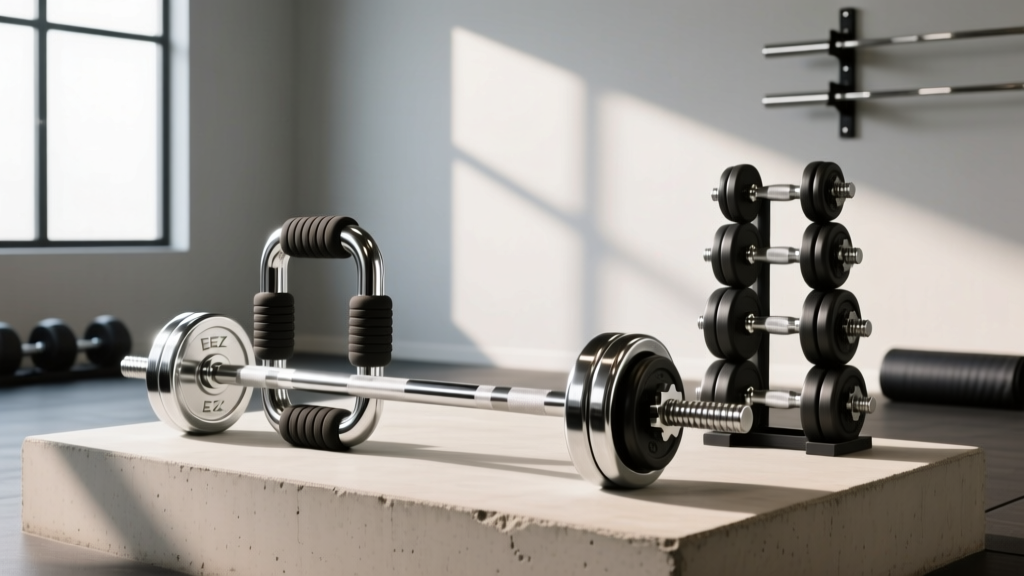
One of the most pervasive errors in garage gym management is using a dumbbell upright storage tree to house specialty bars. A standard dumbbell upright features tiered horizontal shelves or angled prongs designed specifically for the hexagonal or round profiles of dumbbells. Because vertical barbell racks take up dedicated floor space, many lifters attempt to lay their straight bars or EZ curl bars horizontally across the top tier of their dumbbell upright, or lean them against the side supports.
⚠️ WARNING: Point-Load Friction & Bushing FailureResting a loaded or even unloaded barbell horizontally across the metal shelving of a dumbbell upright creates severe point-load friction. For straight bars, the steel-on-steel contact scratches the sleeve's hard chrome or zinc finish, accelerating rust. For EZ curl bars, the uneven geometry prevents balanced resting; the bar will inevitably roll, leading to catastrophic drops that can chip the coating, bend the shaft, and displace the internal snap rings holding the sleeve assembly together.
Furthermore, leaning an EZ curl bar vertically against the side of a dumbbell upright puts lateral pressure on the lower sleeve. Over time, this uneven gravitational pull can warp the bronze bushings inside the sleeve, leading to a 'grinding' sensation during curls and a complete loss of smooth sleeve spin. According to equipment care guidelines published by Rogue Fitness, barbells should always be stored vertically in a dedicated bar rack or horizontally on specialized barbell shelves with UHMW plastic liners to protect the sleeve finish and preserve bushing alignment.
Coating & Knurling: Where the Maintenance Battle is Won
The longevity of your barbell is directly tied to its coating and how well you maintain the knurling. Straight bars and EZ curl bars often utilize different coatings based on their intended use cases, which dictates their maintenance schedules.
| Feature | Olympic Straight Bar | EZ Curl Bar |
|---|---|---|
| Common Coatings | Hard Chrome, Stainless Steel, Cerakote | Zinc, Black Oxide, Cerakote |
| Knurling Debris Trap | Low (Linear pattern sheds chalk easily) | High (Angled valleys trap skin and moisture) |
| Rust Vector Risk | Moderate (Rust spreads linearly down shaft) | Severe (Moisture pools in the bent valleys) |
| Brushing Frequency | Bi-Weekly | Weekly (Requires stiff nylon brush) |
The angled bends of an EZ curl bar are notorious for trapping dead skin cells, sweat, and zinc oxide chalk. When sweat (which is highly saline and acidic) mixes with chalk in the deep valleys of an EZ bar's knurling, it creates a corrosive paste that eats through zinc coatings in a matter of months. Straight bars, while still susceptible to rust, are much easier to wipe down with a microfiber cloth due to their uniform cylindrical shape.
Step-by-Step Monthly Maintenance Protocol
To maximize the lifespan of both your straight and EZ curl bars, implement this exact monthly maintenance routine. This protocol is adapted from the engineering care standards recommended by Eleiko's official maintenance guidelines and independent testing by Garage Gym Reviews.
- The Dry Brush (Crucial for EZ Bars): Use a stiff nylon brush to aggressively scrub the knurling. Never use a brass or steel wire brush on zinc or cerakote-coated EZ bars, as this will strip the protective layer and expose bare steel to oxygen. Brush in multiple directions to dislodge chalk from the angled valleys of the curl bar.
- The Solvent Wipe: Spray a microfiber cloth with a 70% isopropyl alcohol solution (or a dedicated gym equipment cleaner like Simple Green). Wipe down the entire shaft. Avoid spraying liquid directly onto the bar, as excess moisture can seep past the sleeve washers and degrade the internal grease.
- Sleeve Lubrication: Apply 3 to 4 drops of 3-IN-ONE oil or a synthetic barbell oil to the seam where the sleeve meets the shaft. Spin the sleeve to work the oil into the bronze bushings or needle bearings. Never use WD-40; it is a solvent that will strip the factory grease from the bushings and attract abrasive gym dust.
- Proper Storage: Remove the bars from the dumbbell upright. Store them vertically in a dedicated barbell holder with a plastic or rubber-lined base to protect the knurling and sleeve ends from impact damage.
Expert Insight: "If your EZ curl bar sleeve no longer spins freely during the eccentric phase of a bicep curl, the bronze bushing has likely bound up due to chalk dust infiltration or lateral storage pressure. While straight bars use high-capacity needle bearings for Olympic drops, EZ bars rely on bushings that require a clean, low-friction environment to function properly."
Repair and Replacement: When to Retire the Bar
Even with meticulous care, free weights eventually succumb to metal fatigue and mechanical wear. How do you know when your bar has reached the end of its lifecycle?
- Snap Ring Protrusion: If you notice the metal snap ring (the C-clip holding the sleeve assembly) pushing outward or catching on your hands, the internal tolerances have warped. This is common in cheaper EZ bars stored improperly on dumbbell upright racks where lateral impacts have bent the sleeve cap.
- Permanent Shaft Deformation: While straight bars are rated for specific tensile strengths (e.g., 190,000 PSI for a standard Olympic bar), EZ curl bars generally have a lower yield strength due to the physical cuts and bends in the steel. If your EZ bar no longer rolls perfectly flat on a level surface, the shaft has torqued. Retire it immediately to prevent wrist injuries.
- Flaking Coatings: If a black oxide or cheap zinc coating begins to flake off into your hands, the bar is no longer protected from oxidation. At this stage, the bar becomes a tetanus hazard and will stain your flooring and clothing.
Final Verdict on Equipment Longevity
The debate between an EZ curl bar and a straight bar usually centers on joint health and muscle isolation. However, from a pure maintenance perspective, the straight bar is vastly superior in its ease of care, uniform wear patterns, and storage versatility. The EZ curl bar demands a rigorous, weekly brushing schedule and specialized vertical storage to protect its complex geometry. By abandoning the habit of balancing your specialty bars on a dumbbell upright and adopting a targeted oiling and brushing routine, you can easily extend the functional lifespan of your free weights from a mere two years to well over a decade.
More gear to consider
All reviews
Loadable Dumbbell Care for the Standing Dumbbell Reverse Fly
Iron vs Bumper Plate Care: Dumbbell Alt Bicep Curl & Longevity

Neoprene Dumbbells for Home Use: Matching Your Average Dumbbell Curl Weight
Power Rack vs Squat Stand: American Barbell Dumbbell Layout Mistakes
Fix Your 2 Dumbbell Workout: Adjustable Dumbbell Comparison & Review