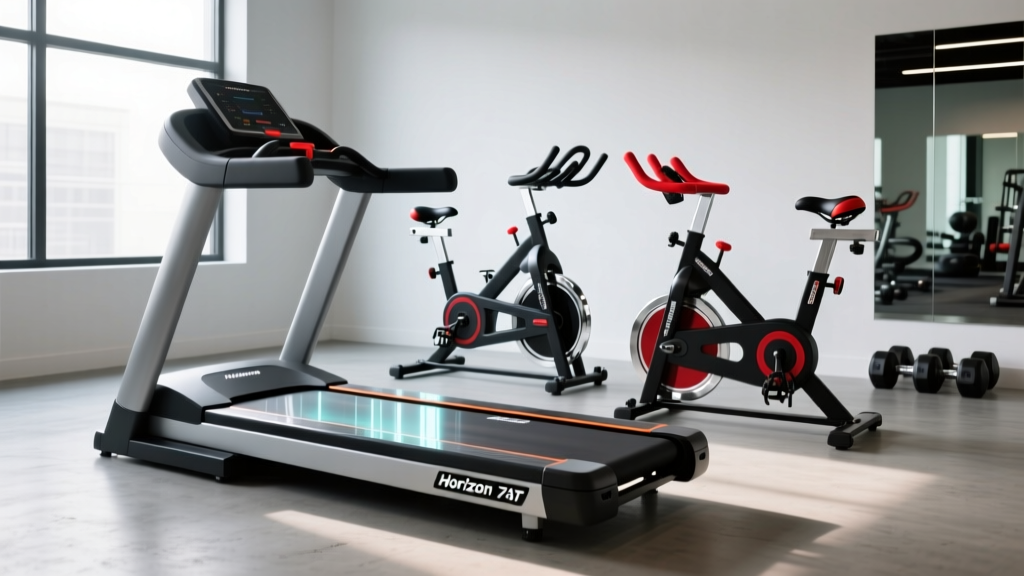
Horizon Fitness 7.8 AT Treadmill vs Stationary Bikes: Upright, Recumbent, or Spin?
Deciding between the Horizon Fitness 7.8 AT treadmill and a stationary bike? We compare upright, recumbent, and spin bikes to find your best cardio match.

The Cardio Crossroads: Premium Treadmills vs. Dedicated Cycling
Building a home gym in 2026 often boils down to a single, high-stakes decision: do you invest in a premium running machine or a dedicated cycling setup? On one side of the debate sits the highly acclaimed Horizon Fitness 7.8 AT treadmill, a staple for runners seeking commercial-grade durability without the commercial-grade footprint. On the other side is the diverse world of stationary bikes. But not all bikes are created equal. To make the right choice, you must understand the biomechanical and practical differences between stationary bike types: upright, recumbent, and spin.
This expert guide breaks down the exact specifications, real-world failure modes, and physiological impacts of the Horizon Fitness 7.8 AT compared to the three primary stationary bike categories, ensuring your cardio investment aligns perfectly with your joint health, space constraints, and fitness goals.
Deep Dive: The Horizon Fitness 7.8 AT Treadmill
The Horizon Fitness 7.8 AT (Advanced Training) is engineered for serious runners who demand rapid incline adjustments and a stable platform. Priced around $1,299, it sits in the mid-to-premium tier of the home cardio market.
Key Specifications and Real-World Performance
- Motor: 3.0 CHP (Continuous Horsepower). Unlike peak horsepower ratings used by budget brands, this continuous duty motor sustains high speeds without overheating during 60+ minute marathon training blocks.
- Running Surface: 22 x 60 inches. This is the gold standard for tall runners (6'2' and above), allowing for a natural stride without heel-strike anxiety.
- Incline System: 0-15% with rapid-dial incline controls on the handrails, a feature usually reserved for $3,000+ machines.
- Deck Cushioning: Horizon utilizes a variable-durometer cushioning system. It is noticeably firmer than the plush 'FlexSelect' decks of competitors like NordicTrack. This is highly beneficial for heavy runners (250+ lbs) to prevent deck bottoming-out, but it can increase shin splint risk for lighter runners if proper footwear is not worn.
A common failure mode we observe with the 7.8 AT occurs when users frequently run at the maximum 15% incline at speeds over 6 mph. The incline motor gear can strip prematurely under this specific high-torque, high-speed load. If you plan on doing extreme hill sprints, alternate your heavy incline days with flat recovery days to extend the actuator lifespan.
Stationary Bike Types Explained: Upright, Recumbent, and Spin
If the footprint or impact profile of the Horizon 7.8 AT doesn't suit your home or your knees, stationary bikes offer a compelling alternative. However, lumping all bikes into one category is a critical buyer mistake. Here is how the three main types break down.
1. Upright Bikes: The Traditional Cardio Workhorse
Upright bikes, such as the Schwinn 170 (approx. $599), mimic the geometry of a standard outdoor bicycle but with a wider Q-factor (the distance between the pedals) and a heavily padded, oversized saddle.
Best For: General cardiovascular health, warm-ups, and users who want a familiar riding position without the aggressive forward lean of a road bike.
Edge Case: The wide saddles on upright bikes often cause chafing during rides exceeding 45 minutes. They are designed for moderate, steady-state cardio, not high-intensity interval training (HIIT).
2. Recumbent Bikes: The Ergonomic and Rehab Champion
Recumbent bikes feature a step-through design, a bucket seat with a mesh backrest, and pedals positioned in front of the hips. The Sole R92 (approx. $1,099) is a top-tier example, featuring a 30 lb flywheel and exceptional lumbar support.
Best For: Seniors, individuals recovering from lower-body injuries, and those with chronic lower back pain or sciatica.
Expert Insight: According to the Cleveland Clinic, recumbent bikes place significantly less stress on the anterior cruciate ligament (ACL) and the lumbar spine compared to upright cycling or treadmill running. The horizontal force vector removes axial loading from the spine entirely.
3. Spin / Indoor Cycling Bikes: The High-Performance Athlete
Spin bikes, like the Schwinn IC4 or Peloton Bike+, are built for performance. They feature heavy magnetic flywheels (40 lbs on the IC4), dual-sided pedals (SPD clip-in and flat cages), and micro-adjustable resistance.
Best For: HIIT, power output training, and users who want to simulate outdoor road cycling or participate in live-streamed studio classes.
Edge Case: The aggressive, forward-leaning geometry and rigid, narrow saddles can cause ischial tuberosity (sit bone) pain for beginners. A professional bike fit—adjusting the saddle height to allow a 25-to-30-degree knee flexion at the bottom of the pedal stroke—is mandatory to prevent patellofemoral pain syndrome.
Head-to-Head Comparison Matrix
| Feature | Horizon 7.8 AT Treadmill | Upright Bike | Recumbent Bike | Spin / Indoor Bike |
|---|---|---|---|---|
| Avg. Price (2026) | $1,299 | $400 - $700 | $800 - $1,500 | $700 - $2,500 |
| Joint Impact (GRF) | High (2.5x Bodyweight) | Low (<0.5x) | Very Low (<0.3x) | Low (<0.5x) |
| Floor Footprint | 73' x 35' (Requires ceiling clearance) | 42' x 24' | 60' x 28' (Longer, but low profile) | 48' x 22' |
| Caloric Burn (1 hr) | 600 - 900 kcal | 400 - 600 kcal | 300 - 500 kcal | 500 - 850 kcal |
| Primary Maintenance | Belt lubrication, deck alignment | Dusting, pedal strap checks | Seat track lubrication | Sweat corrosion prevention |
Biomechanics and Joint Health: What the Experts Say
When choosing between the Horizon Fitness 7.8 AT and a stationary bike, ground reaction forces (GRF) are the most critical physiological metric. The Mayo Clinic emphasizes that weight-bearing exercises like running are essential for bone mineral density, but they come at the cost of repetitive impact on the meniscus and plantar fascia.
'While running on a treadmill provides superior osteogenic benefits for bone health, individuals with existing osteoarthritis in the knees or hips should transition to low-impact, closed-kinetic-chain exercises like recumbent or upright cycling to preserve joint cartilage.' - American College of Sports Medicine (ACSM) Guidelines on Joint Preservation.
If your goal is pure caloric expenditure and cardiovascular conditioning without the delayed onset muscle soreness (DOMS) associated with the eccentric loading of running, a spin bike or upright bike is the superior choice. However, if you are training for a 10K or marathon, no bike can replicate the specific neuromuscular adaptations required for running economy; the Horizon 7.8 AT is mandatory in that scenario.
Maintenance Realities: Treadmills vs. Bikes
A frequently overlooked factor in home gym ownership is long-term maintenance. The Horizon Fitness 7.8 AT requires strict adherence to a maintenance schedule. The running belt must be lubricated with 100% silicone fluid every 150 miles or every 3 months. Failure to do so increases friction, which draws excess amperage through the 3.0 CHP motor, eventually tripping the internal thermal breaker or frying the motor control board.
Conversely, stationary bikes (especially magnetic resistance models like the Sole R92 or Schwinn IC4) are virtually maintenance-free regarding their drive systems. There are no belts to align or chains to oil. The primary failure point for indoor bikes is sweat corrosion. The high salinity of human sweat can quickly rust the handlebars and degrade the magnetic flywheel housing if the bike is not wiped down with a non-abrasive, pH-neutral cleaner after every session.
The Final Verdict: Which Should You Buy?
Decision Framework for 2026
Buy the Horizon Fitness 7.8 AT Treadmill if: You are training for outdoor running events, you prioritize bone-density building, you have a dedicated room with 8+ foot ceilings, and you prefer a firm, responsive deck over a soft, trampoline-like feel.
Buy a Spin Bike if: You thrive on high-intensity, instructor-led classes, you want maximum caloric burn in minimal time, and you have limited floor space.
Buy a Recumbent Bike if: You are managing lower back pain, recovering from joint surgery, or prefer to read, work on a laptop, or watch television while maintaining a steady-state heart rate zone.
Buy an Upright Bike if: You want a budget-friendly, low-impact cardio solution for general health and warm-ups without the aggressive posture of a spin bike.
Frequently Asked Questions
Can I use the Horizon 7.8 AT for walking only?
Yes, but it may be overkill. The 7.8 AT is optimized for running with its 3.0 CHP motor and 60-inch belt. If you exclusively walk, a dedicated walking pad or a lower-tier treadmill like the Horizon T101 will save you $700 while providing adequate belt length and motor power for speeds under 4.5 mph.
Which stationary bike type burns the most calories?
Spin bikes generally yield the highest caloric burn (up to 850 kcal/hour) because they facilitate standing climbs and high-cadence sprints, which engage the core and upper body stabilizers. Recumbent bikes, being fully supported, isolate the lower body and typically result in a 15-20% lower caloric expenditure for the same perceived exertion.
Does the Horizon 7.8 AT connect to Zwift?
Yes. The 7.8 AT features Bluetooth FTMS (Fitness Machine Service) connectivity, allowing it to transmit speed and incline data directly to third-party apps like Zwift and Peloton Digital, enabling automatic incline adjustments based on virtual terrain.
More gear to consider
All reviews
What Does Kcal Mean on a Treadmill? Compact Cardio Space Guide

Gravity Treadmill Setup & Treadmill Motor Size Guide

Under Desk Treadmill Review vs Assault Fitness AirRunner Treadmill

NordicTrack T 5.5 Treadmill Belt Maintenance & Value Breakdown

LSG Focus M3 Treadmill vs Curved Manual: Step-by-Step Guide
